
Skip to content
The Encyclopedia of Horology

Clock · Standing clock

Dutch Standing Clock by Abel de Groot

Partially verified

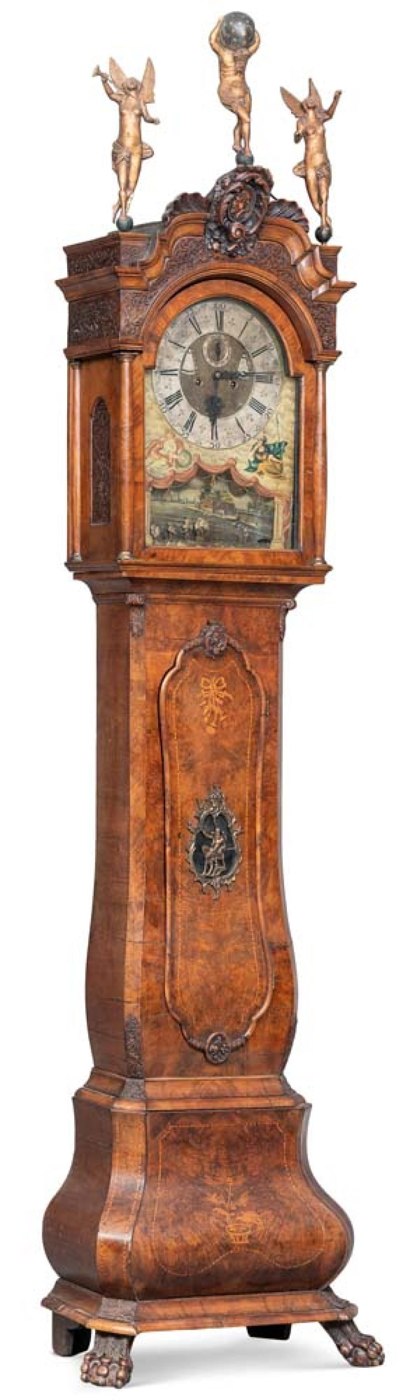
This Dutch standing clock is attributed to the period circa 1740–50 and is signed on the dial by the maker Abel de Groot of Amsterdam. Measuring 290 cm in height, the clock features an elaborate movement with double striking capabilities, a calendar mechanism, and a sun and moon phase indicator. The dial displays Roman numerals and is positioned above a painted metal plate featuring a maritime scene designed to move in synchronization with the pendulum. The clock case is constructed from a pine base with walnut veneer, complemented by intricate maple and mahogany inlay work. Decorative elements include carved wood details, lion-form feet, and a summit arrangement consisting of a central gilded figure of Atlas flanked by two trumpeting angels. One of the trumpeting angels is reported to be missing its trumpet.

Full view of the standing clock, showing the hooded dial, trunk, and base with lion feet.
Full view of the standing clock, showing the hooded dial, trunk, and base with lion feet. — Nagyhazi Gallery and Auction House (via Invaluable). Rights pending — permission not yet requested. Original source

Catalogue identity

Source
www.invaluable.com
Category
Clock · Standing clock
Maker / attribution
Abel de Groot
Reference
Not recorded
Catalogue / lot identifier
822
Source-reported date
circa 1740–50
Source-reported place
Netherlands

Source-reported attribution and specifications are not independent authentication. A listing does not establish present ownership, current display, availability or permission to reproduce.

Object description

Case Construction and Decoration

The clock case stands 290 cm tall, constructed on a base of pine wood. Inlay work using maple and mahogany woods adds decorative complexity to the surface of the trunk and pedestal sections.

The architecture of the case is supported by carved lion feet. The hood is heavily ornamented with carved details, topped by a prominent gilded wooden sculpture of Atlas carrying the world. Flanking this figure are two carved, gilded angels depicted with trumpets, although one of these instruments is no longer present.

Evidence for this section
  • “pine base with walnut covering, maple and mahogany inlay”
  • “carved gilded Atlas figure and two trumpeting angels (one trumpet missing) on top”
  • “lion feet”

Movement and Dial

The dial is characterized by Roman numerals and bears the signature of the maker, Abel de Groot, located in Amsterdam. The movement is complex, incorporating a double striking function, a calendar mechanism, and an indicator for the sun and moon phases, indicating a high level of horological integration for its period.

Situated beneath the primary dial is a painted metal plate that illustrates a seascape. This artistic component is connected to the internal mechanism and is synchronized to move in rhythm with the oscillation of the pendulum, integrating visual display with timekeeping. Two pendulums are provided with the clock.

Evidence for this section
  • “double striking, sun and moon movement, calendar mechanism”
  • “Roman numeral dial marked "Abel de Groot Amsterdam”
  • “painted metal plate under the dial depicting a seascape, which moves in time with the pendulum”

Provenance and Condition

The item is listed as Lot 822 by the Nagyhazi Gallery and Auction House. The information provided confirms the clock's physical dimensions and the set of included accessories, specifically one winding key, one case key, and two pendulums, which are essential for the maintenance and operation of the double-striking and calendar features.

The auction description notes specific physical attributes and condition details, such as the missing trumpet on one of the decorative angels. The clock is described as Dutch in origin, reflecting the regional style attributed to the mid-18th century.

Evidence for this section
  • “Nagyhazi Gallery and Auction House”
  • “(one trumpet missing)”
  • “1 winding key, 1 clock case key, 2 pendulums”

Open research questions

  • What is the specific nature of the 'sun and moon' movement and how is it integrated with the maritime automaton?
  • Are there recorded examples of other clocks by Abel de Groot that share this specific case style and layout?

Source evidence

Recorded claims and source quotations for Dutch Standing Clock by Abel de Groot
FieldSource-reported valueSource quotation
MakerAbel de Groot Amsterdam“Abel de Groot Amsterdam”
Datecirca 1740–50“circa 1740–50”
Dimensions290×74×36 cm“290×74×36 cm”
ConstructionPine base with walnut covering, maple and mahogany inlay“pine base with walnut covering, maple and mahogany inlay”
Summit elementsCarved gilded Atlas figure and two trumpeting angels“carved gilded Atlas figure and two trumpeting angels”
Included accessories1 winding key, 1 clock case key, 2 pendulums“1 winding key, 1 clock case key, 2 pendulums”
Dial featuresRoman numeral dial“Roman numeral dial”

Visible details

  • Case features carved lion feet at the base
  • Summit adorned with a central Atlas figure
  • Includes a painted metal plate showing a seascape
  • Dial indicates Roman numerals

Research qualifications

  • One angel figure is missing its trumpet
  • Functional status of the double striking and sun and moon movement is not specified

Photograph identity and source facts were screened before import; rights clearance remains pending.

Consulted source

Standing clock

Reviewed 2026-10-26 · Record 37fceb82fb

Terms in this record

Glossary explanations for terms named in this object’s record.