
Skip to content
The Encyclopedia of Horology

Clock · Mystery clock

Coral and Jade Koi Fish Mystery Clock

Partially verified

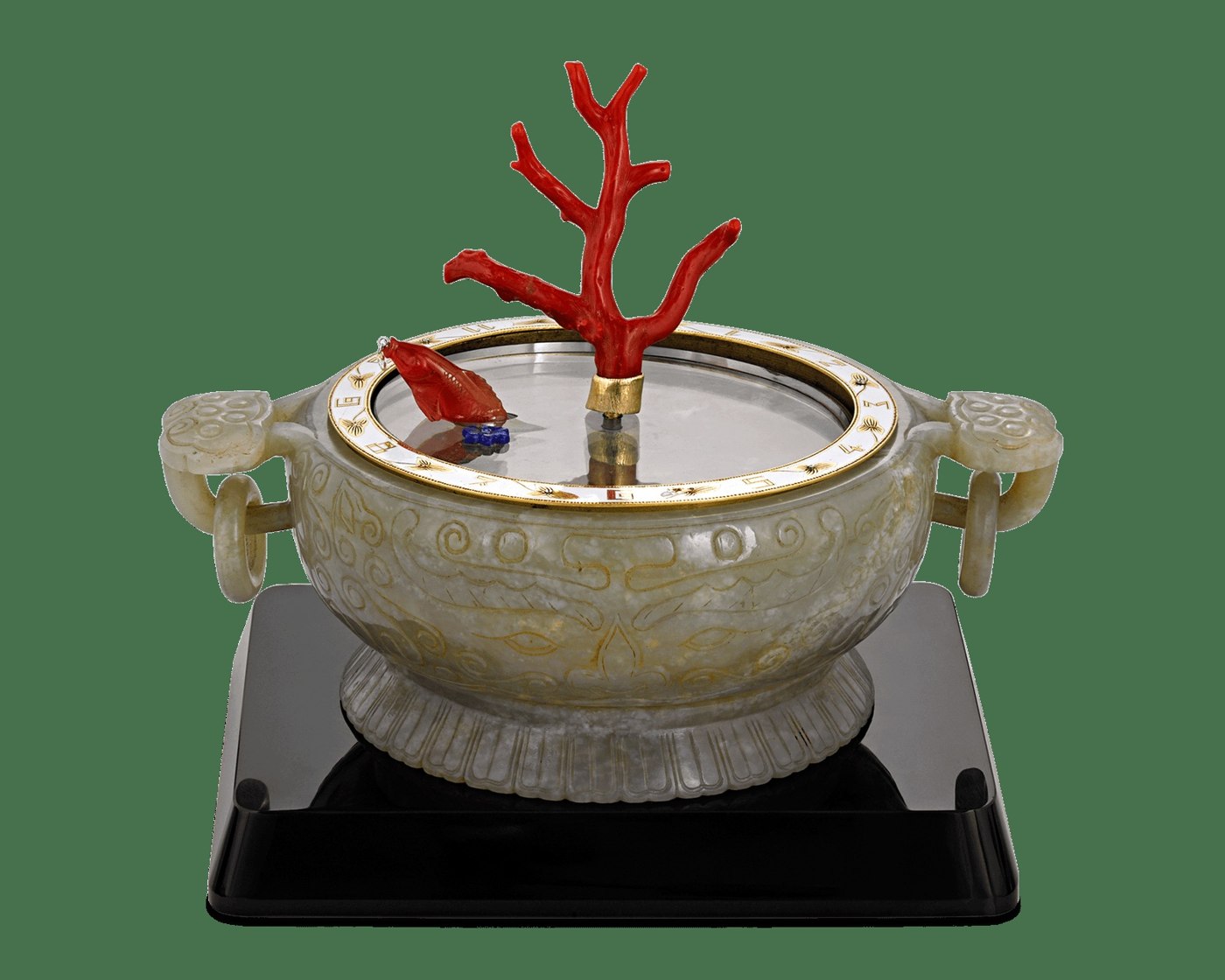
This French mystery clock is dated to approximately 1915. The object features a decorative base carved from jade in a shape described as resembling a traditional Chinese censer, or "koro." The clock incorporates natural materials including a prominent piece of red coral and a carved carnelian koi fish, accompanied by a lotus flower finished with blue lacquer. Timekeeping is managed by a movement mechanism that rotates the "pond" element, causing the koi fish to move along the perimeter of the white enamel dial. The time is read by observing the position of the fish relative to the gold-colored Arabic numerals positioned on the rim of the pond. The internal movement mechanism bears the signature "Lutz, France." The overall design reflects themes associated with the Art Deco era and elements of chinoiserie.

Front view of the Coral and Jade Koi Fish Mystery Clock showing the coral branch, the carnelian koi fish, and the jade base.
Front view of the Coral and Jade Koi Fish Mystery Clock showing the coral branch, the carnelian koi fish, and the jade base. — M.S. Rau. Rights pending — permission not yet requested. Original source

Catalogue identity

Source
zamanito.com
Category
Clock · Mystery clock
Maker / attribution
Lutz
Reference
Not recorded
Catalogue / lot identifier
Source URL identifies the listing
Source-reported date
circa 1915
Source-reported place
France

Source-reported attribution and specifications are not independent authentication. A listing does not establish present ownership, current display, availability or permission to reproduce.

Object description

Design and Materials

The clock is designed with an emphasis on decorative natural materials, featuring a base carved from jade that evokes the form of a Chinese censer. The central decorative element is a branch of red coral extending from the center of the clock face.

A carnelian koi fish serves as the primary indicator for the time, positioned within the clock's pond. The pond includes a lotus flower decoration finished in blue lacquer. The composition utilizes a white enamel dial featuring gold-colored Arabic numerals arranged along the edge of the pond.

The source notes that the design draws inspiration from Eastern cultures and nature, which were popular motifs during the Art Deco period. The aesthetic aligns with the chinoiserie style.

Evidence for this section
  • “پایه یشمی ساعت شکل عودسوز سنتی چینی موسوم به «کورو» را تداعی می‌کند.”
  • “قطعه‌ای مرجان با رنگ درخشان از مرکز صفحه ساعت سر برآورده و ماهی کوی از جنس عقیق کارنلین، همراه با گل نیلوفر با لاک آبی، در «حوض» ساعت جای گرفته است.”
  • “منبع این اثر را نمونه‌ای از طرح‌های شرقی پرجزئیاتی معرفی می‌کند که در عصر آرت‌دکو رواج یافتند.”

Mechanism and Function

The object operates as a mystery clock, where the mechanism is responsible for rotating the central pond structure. As the pond rotates, the carnelian koi fish is moved along the path of the dial.

The current time is determined by the position of the fish relative to the static or rotating Arabic numerals placed around the perimeter of the pond. The movement mechanism is identified by an inscription reading "Lutz, France."

Evidence for this section
  • “سازوکار ساعت حوض را می‌چرخاند و ماهی کوچک را در امتداد لبه صفحه مینای سفید حرکت می‌دهد؛ زمان از موقعیت ماهی نسبت به اعداد عربی طلایی‌رنگِ پیرامون حوض خوانده می‌شود.”
  • “سازوکار این ساعت نشان «Lutz, France» دارد.”

Provenance and Context

The source discusses the object in the context of other mystery clocks created during the Art Deco era. It mentions that a similar mystery clock of Chinese-influenced design, produced by Cartier using coral and jade, is held in the Cartier collection and was exhibited at the Grand Palais in Paris.

The source clarifies that this comparison is intended for descriptive reference and does not imply an attribution of the current clock to Cartier. The record serves as an educational summary of the object's features.

Evidence for this section
  • “همچنین از ساعت رازآلود بسیار مشابهی به سبک چینی‌گرایی، ساخته Cartier با مرجان و یشم، یاد می‌کند که در مجموعه Cartier نگهداری می‌شود و به‌گفته منبع، اخیراً در گراند پاله پاریس به نمایش درآمده است؛ این مقایسه به معنای انتساب ساعت حاضر به Cartier نیست.”

Open research questions

  • What is the specific mechanical design of the 'Lutz, France' movement used in this mystery clock?
  • Are there archival records linking the Lutz company to mystery clock production for the early 20th-century luxury market?

Source evidence

Recorded claims and source quotations for Coral and Jade Koi Fish Mystery Clock
FieldSource-reported valueSource quotation
Maker markLutz, France“سازوکار این ساعت نشان «Lutz, France» دارد.”
MaterialsJade, coral, carnelian, white enamel, blue lacquer“قطعه‌ای مرجان با رنگ درخشان از مرکز صفحه ساعت سر برآورده و ماهی کوی از جنس عقیق کارنلین، همراه با گل نیلوفر با لاک آبی، در «حوض» ساعت جای گرفته است.”
Dimensions6 1/2 x 4 3/4 x 5 1/4 inches“عرض × عمق × ارتفاع: 6 1/2 × 4 3/4 × 5 1/4 اینچ”
Datingcirca 1915“حدود ۱۹۱۵”
Country of originFrance“کشور: فرانسه”
Time indication methodMovement rotation of the pond“سازوکار ساعت حوض را می‌چرخاند و ماهی کوچک را در امتداد لبه صفحه مینای سفید حرکت می‌دهد؛ زمان از موقعیت ماهی نسبت به اعداد عربی طلایی‌رنگِ پیرامون حوض خوانده می‌شود.”

Visible details

  • The jade body features carved scrollwork patterns.
  • The white enamel dial has gold Arabic numerals separated by floral motifs.
  • The clock sits on a separate black rectangular stand.

Research qualifications

  • The source cautions that a comparison to similar Cartier pieces does not equate to an attribution of this specific clock to Cartier.
  • The source states information regarding the object is provided for reference and is not an independent verification of authenticity or functionality.

Photograph identity and source facts were screened before import; rights clearance remains pending.

Consulted source

ساعت میستری ماهی کوی؛ مرجان و یشم

Reviewed 2026-11-02 · Record 0386754bfc

Terms in this record

Glossary explanations for terms named in this object’s record.