
Skip to content
The Encyclopedia of Horology

Clock · Mantel clock

Clock with Barometer

Partially verified

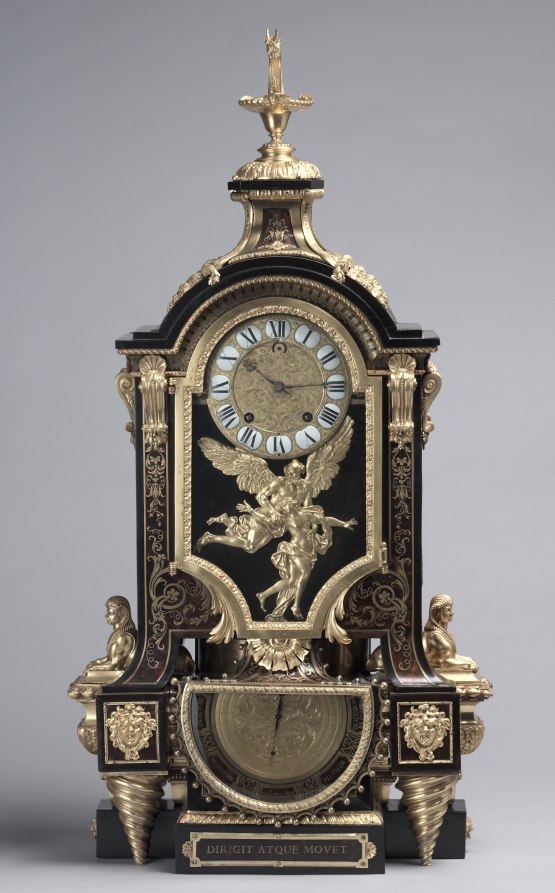
This mantel clock, dating to approximately 1695, is attributed to the cabinetmaker André-Charles Boulle with a movement by Balthazar Martinot II. The object incorporates a pendulum mechanism and an integrated barometer. The case is constructed using tortoiseshell and brass inlay, decorated with gilt bronze elements. The design displays architectural proportions and inlaid motifs. An inscription at the base reads "Dirigit atque movet," which is noted as translatable to "time constantly moves on." The clock reflects the inclusion of scientific instruments within decorative furniture. The overall height of the object measures 113.7 cm. The piece was gifted to the Cleveland Museum of Art by family and friends in honor of Emery May Holden Norweb and Raymond Henry Norweb.

Full view of the clock featuring the barometer at the base and the inscription plaque.
Full view of the clock featuring the barometer at the base and the inscription plaque. — Cleveland Museum of Art. Rights pending — permission not yet requested. Original source

Catalogue identity

Source
clevelandart.org
Category
Clock · Mantel clock
Maker / attribution
André-Charles Boulle
Reference
1967.153
Catalogue / lot identifier
1967.153
Source-reported date
c. 1695
Source-reported place
France

Source-reported attribution and specifications are not independent authentication. A listing does not establish present ownership, current display, availability or permission to reproduce.

Object description

Case Construction and Materials

The clock case is executed in the marquetry technique attributed to André-Charles Boulle, consisting of metal patterns inlaid into tortoiseshell and applied to the furniture surface. The structure exhibits architectural proportions, incorporating various gilt bronze mounts including sphinxes and mask ornaments.

The materials used include tortoiseshell, brass, and gilt bronze. The object features an overall height of 113.7 cm, reflecting the scale of late 17th-century mantel clocks designed for display in aristocratic settings.

Evidence for this section
  • “Known primarily for his use of marquetry, in which metal patterns are inlaid into tortoiseshell then applied within the veneered surface of the furniture”
  • “Often exhibiting stout architectural proportions with elegant groups of inlaid motifs”

Clockwork and Scientific Components

The clock features a timekeeping dial with Roman numerals and is integrated with a pendulum mechanism, which the source describes as a relatively new scientific invention at the time. A semicircular barometer is positioned at the lower section of the case, indicating its dual function as both a timepiece and a scientific instrument.

The movement is attributed to Balthazar Martinot II, a French clockmaker active during the late 17th century. The inclusion of the barometer and the pendulum movement indicates the intersection of timekeeping and scientific innovation favored during this period.

Evidence for this section
  • “clockmaker Balthazar Martinot II”
  • “With its relatively new scientific invention of a pendulum mechanism and the addition of a barometer, the mantel clock represented the wealth, prestige, and intellect of its owner.”

Inscriptions and Provenance

A plaque at the base of the clock displays the Latin inscription "DIRIGIT ATQUE MOVET." The museum source translates this phrase as "time constantly moves on."

The object entered the collection of the Cleveland Museum of Art as a gift from family and friends. It was presented in honor of Emery May Holden Norweb and Raymond Henry Norweb to mark their fiftieth wedding anniversary.

Evidence for this section
  • “The Latin phrase inscribed on this clock, Dirigit atque movet,”
  • “Gift of Family and Friends in honor of Emery May Holden Norweb and Raymond Henry Norweb on their fiftieth wedding anniversary”

Open research questions

  • What specific evidence exists to verify the attribution of the case to the workshop of André-Charles Boulle?
  • What are the internal mechanical features of the barometer component?

Source evidence

Recorded claims and source quotations for Clock with Barometer
FieldSource-reported valueSource quotation
MakerAndré-Charles Boulle“maker André-Charles Boulle”
ClockmakerBalthazar Martinot II“clockmaker Balthazar Martinot II”
Datec. 1695“c. 1695”
Mediumtortoise shell and brass inlay, gilt bronze“Medium tortoise shell and brass inlay, gilt bronze”
Dimensions113.7 cm“Overall: 113.7 cm (44 3/4 in.)”
InscriptionDirigit atque movet“The Latin phrase inscribed on this clock, Dirigit atque movet,”
Accession Number1967.153“1967.153”

Visible details

  • Case decorated with gilt bronze sphinxes and decorative masks
  • Integrated semicircular barometer dial located at the base of the clock
  • Clock dial features Roman numerals
  • Inscribed plaque reading 'DIRIGIT ATQUE MOVET' at the base

Research qualifications

  • Attribution to André-Charles Boulle is historical and based on stylistic context provided by the museum
  • Specific movement components or escapement type are not documented in the source

Photograph identity and source facts were screened before import; rights clearance remains pending.

Consulted source

Clock (Cleveland Museum of Art 1967.153)

Reviewed 2026-11-02 · Record b6c5a7c92c

Terms in this record

Glossary explanations for terms named in this object’s record.