
Skip to content
The Encyclopedia of Horology

Clock · Portable clock

Clock by Joh Georg Wagner

Partially verified

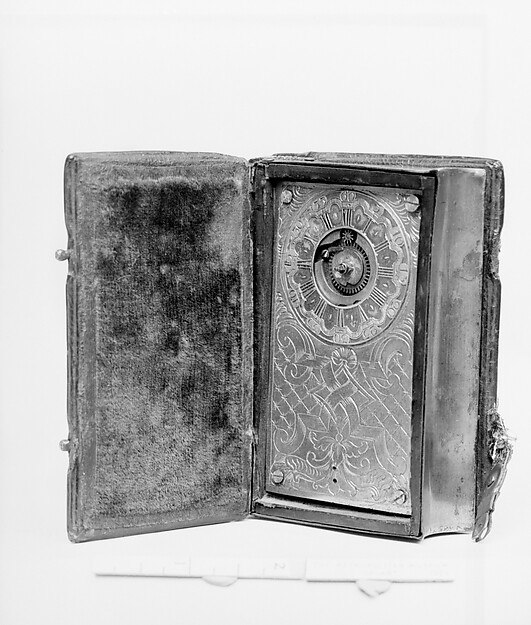
This portable clock, catalogued as accession number 29.52.1 in The Metropolitan Museum of Art, is attributed to the clockmaker Joh Georg Wagner, who was active in Wasserburg. The object dates to the late 17th century and is constructed using a combination of gilt bronze, leather, and wood. Its overall dimensions are 1 1/4 by 4 1/8 by 2 1/2 inches (approximately 3.2 by 10.5 by 6.4 cm). The clock is designed with a protective outer case featuring leather, which opens to reveal an internal mechanism and dial plate. The dial plate exhibits elaborate engraved decoration. The item was gifted to the museum by Mrs. Simon Guggenheim in 1929.

The clock in its open position, showing the engraved gilt-bronze dial plate and the interior of the leather-covered case.
The clock in its open position, showing the engraved gilt-bronze dial plate and the interior of the leather-covered case. — The Metropolitan Museum of Art — Gift of Mrs. Simon Guggenheim, 1929. Rights pending — permission not yet requested. Original source

Catalogue identity

Source
orbiscollectibles.com
Category
Clock · Portable clock
Maker / attribution
Joh Georg Wagner
Reference
Not recorded
Catalogue / lot identifier
29.52.1
Source-reported date
late 17th century
Source-reported place
Germany, Wasserburg

Source-reported attribution and specifications are not independent authentication. A listing does not establish present ownership, current display, availability or permission to reproduce.

Object description

Construction and Design

The clock is configured as a compact, portable device featuring an exterior housing finished in leather, designed to protect the internal components.

The interior reveals a metallic dial plate, constructed from gilt bronze. The plate is heavily decorated with engraved floral and foliate motifs, surrounding a central circular aperture that exposes parts of the motion work. The casing includes a hinged lid that opens to expose the dial, with the inside of the lid being padded or lined.

Evidence for this section
  • “Gilt bronze, leather, wood”
  • “Overall: 1 1/4 × 4 1/8 × 2 1/2 in. (3.2 × 10.5 × 6.4 cm)”

Maker and Origin

The instrument is attributed to the clockmaker Joh Georg Wagner. Historical records identify him as being active in the town of Wasserburg, located in Germany. The origin is generally classified within the German cultural and geographical context of the late 17th century.

The attribution to Wagner remains the formal museum record. While the maker is linked to the location of Wasserburg, independent research is requested to verify the full scope of his production and the specific dating of this object against standard horological reference works.

Evidence for this section
  • “Clockmaker: Joh Georg Wagner (active Wasserburg)”

Collection and Documentation

The object is part of the collection of The Metropolitan Museum of Art, assigned the accession number 29.52.1. It entered the collection in 1929 as a gift from Mrs. Simon Guggenheim. The documentation provided by the museum serves as the primary source of information regarding its identity.

The current records for this object are based on the museum's internal registration. No additional catalogue references or bibliographic entries are currently linked to this specific record, and the degree to which this object serves as a representative example of a larger class of timepieces has not been independently verified.

Evidence for this section
  • “The Metropolitan Museum of Art holds this object as 29.52.1”
  • “Gift of Mrs. Simon Guggenheim, 1929”

Open research questions

  • What specific internal movement components were employed by Joh Georg Wagner in his portable clocks of the late 17th century?
  • Does archival evidence in Wasserburg confirm the career dates and output of Joh Georg Wagner?

Source evidence

Recorded claims and source quotations for Clock by Joh Georg Wagner
FieldSource-reported valueSource quotation
MakerJoh Georg Wagner“Clockmaker: Joh Georg Wagner (active Wasserburg)”
Datelate 17th century“late 17th century”
MaterialsGilt bronze, leather, wood“Gilt bronze, leather, wood”
Dimensions1 1/4 × 4 1/8 × 2 1/2 in. (3.2 × 10.5 × 6.4 cm)“Overall: 1 1/4 × 4 1/8 × 2 1/2 in. (3.2 × 10.5 × 6.4 cm)”
Holding institutionThe Metropolitan Museum of Art“The Metropolitan Museum of Art”
Accession number29.52.1“29.52.1”
ProvenanceGift of Mrs. Simon Guggenheim“Gift of Mrs. Simon Guggenheim, 1929”

Visible details

  • Case features a folding lid with interior lining
  • Dial plate shows extensive foliate engraving
  • Central wheel mechanism visible on the dial face
  • Constructed with a box-like leather-covered housing

Research qualifications

  • The specific date and maker attribution rely on museum records and require further verification against independent specialist sources.
  • The extent to which this individual object represents a wider series of similar clocks remains unverified.

Photograph identity and source facts were screened before import; rights clearance remains pending.

Consulted source

Clock, Joh Georg Wagner, late 17th century

Reviewed 2026-11-02 · Record 3c01a2e9a3

Terms in this record

Glossary explanations for terms named in this object’s record.