
Skip to content
The Encyclopedia of Horology

Tool · Universal diptych sundial

Charles Bloud Folding Universal Travelling Sundial

Partially verified

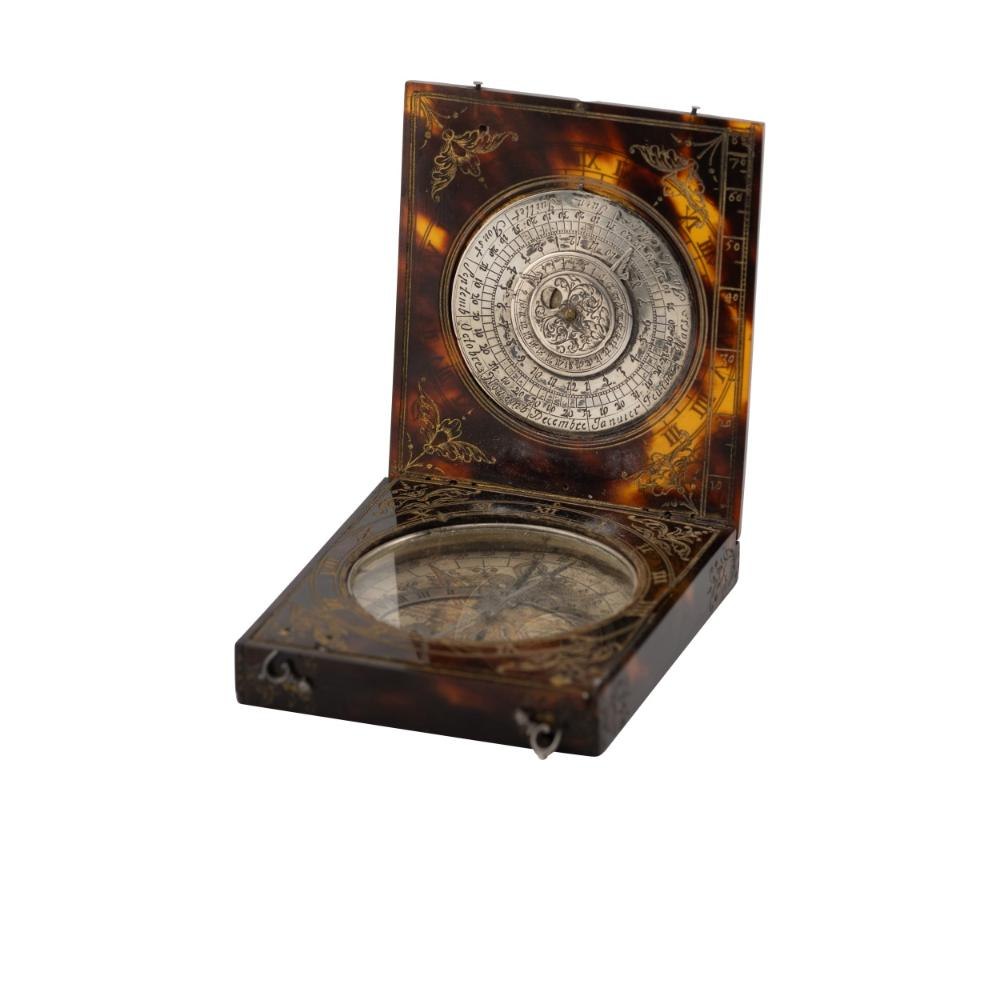
This diptych universal travelling sundial is attributed by the source to French maker Charles Bloud of Dieppe, dating to circa 1670. Fashioned from mottled tortoiseshell and silver, the rectangular folding instrument incorporates multiple scales, an inset compass, and astronomical calculating discs. The inside lid features a poppy-engraved border, an edge latitude scale reading 0° to 80°, and a central silver volvelle displaying calendar calibrations alongside moon phases. The lower plate houses a glass-covered compass with printed geographic latitude data, enclosed by an elliptical silver hour scale. Additional sunflower engravings and silver dials adorn the exterior covers.

Three-quarter perspective view of the opened diptych sundial showing the compass base and upper interior volvelle
Three-quarter perspective view of the opened diptych sundial showing the compass base and upper interior volvelle — Auktionen Dr. Crott. Rights pending — permission not yet requested. Original source

Catalogue identity

Source
www.invaluable.com
Category
Tool · Universal diptych sundial
Maker / attribution
Charles Bloud
Reference
Not recorded
Catalogue / lot identifier
231
Source-reported date
circa 1670
Country
France

Source-reported attribution and specifications are not independent authentication. A listing does not establish present ownership, current display, availability or permission to reproduce.

Object description

Identity and Attribution

This instrument is identified as a folding Norman tortoiseshell universal travelling sundial. It is attributed to the French maker Charles Bloud of Dieppe, with production dated to circa 1670.

Charles Bloud was active as a sundial maker in Dieppe around 1660. The source notes that Bloud was born in Dieppe around 1640 and that other examples of his work are held in the collections of the Mathematisch-Physikalischer Salon in Dresden and the German horological museum in Furtwangen.

Evidence for this section
  • “A rare and luxurious, folding Norman tortoiseshell universal travelling sundial”
  • “Frenchman Charles Bloud was active as a maker of sundials in Dieppe around 1660.”
  • “circa 1670”
  • “More attractive folding sundials by Charles Bloud are part of the collection of the Mathematisch-Physikalischer Salon in Dresden and in the German horological museum in Furtwangen.”

Physical Construction and Ornamentation

The instrument is constructed from tortoiseshell and silver. The top plate is engraved at the corners with sunflower motifs, while the bottom is similarly engraved with sunflower motifs and a central silver disc containing a perpetual calendar.

The inside of the lid features a poppy-flower border around the edges. The base plate is also engraved with poppies and includes an elliptical silver hour scale.

Evidence for this section
  • “Case: Tortoiseshell, silver.”
  • “The top is engraved at the corners with sunflower motifs.”
  • “The inside of the lid with poppy-flower border to the edges”
  • “The base plate, engraved with poppies, features an inlaid compass”
  • “Like the top, the bottom is engraved with sunflower motifs at the corners and a silver disc to the centre with perpetual calender.”

Dial and Mechanism Configuration

The instrument incorporates a central circular equinoctial dial on the top, labeled 1-12 twice, and a central polar dial labeled 8-12-4, set with a central metal rivet. The interior lid features a silver volvelle displaying a calendar and moon phases, accompanied by an engraved latitude scale on the right side reading 0° to 80°.

The base plate houses a compass with a printed paper insert listing countries and their latitudes, flanked by an elliptical silver scale engraved VII-XII-V.

Evidence for this section
  • “The centre is engraved with a circular equinoctial dial labelled 1-12 twice, and central polar dial labelled 8-12-4; with central metal rivet.”
  • “engraved latitude scale to the right hand side labelled 0° to 80°.”
  • “A silver volvelle to the centre, depicting a calendar and phases of the moon.”
  • “features an inlaid compass with printed paper listing countries and their latitudes; silver elliptical scale engraved VII-XII-V.”

Open research questions

  • Are the specific geographic locations listed on the printed paper insert standard for Bloud's travelling sundials of this period?
  • Does the current condition description ('slightly rubbed, slightly chipped') reflect the cumulative effect of its age?

Source evidence

Recorded claims and source quotations for Charles Bloud Folding Universal Travelling Sundial
FieldSource-reported valueSource quotation
Dimensions68 x 80 x 16 mm“Dimensions 68 x 80 x 16 mm”
Weight135 g“Weight 135 g”
Case MaterialsTortoiseshell, silver“Case: Tortoiseshell, silver.”
Latitude Scale Range0° to 80°“engraved latitude scale to the right hand side labelled 0° to 80°.”
Volvelle DisplayCalendar and moon phases“A silver volvelle to the centre, depicting a calendar and phases of the moon.”
ConditionVery good, slightly rubbed, slightly chipped“Case: very good, slightly rubbed, slightly chipped.”

Visible details

  • Rectangular folding case constructed with semi-translucent, figured tortoiseshell plates.
  • Central circular multi-ring silver volvelle engraved with calendar months and astrological divisions on the inner lid.
  • Recessed round compass with glass crystal and needle in the base leaf, flanked by silver hour numerals.
  • Gilt or engraved foliate corner motifs bordering the inner plates.

Research qualifications

  • Exterior top and bottom plates described in the text are not fully visible in the open perspective photo.
  • Import of tortoiseshell is subject to strict customs and CITES prohibitions outside the EU.

Photograph identity and source facts were screened before import; rights clearance remains pending.

Consulted source

At Auction: Charles Bloud à Dieppe - Sundial

Reviewed 2026-10-25 · Record 77830d7b9a

Terms in this record

Glossary explanations for terms named in this object’s record.