
Skip to content
The Encyclopedia of Horology

Clock · Mantel clock

Ch. Paris Napoleon III Mantel Clock

Partially verified

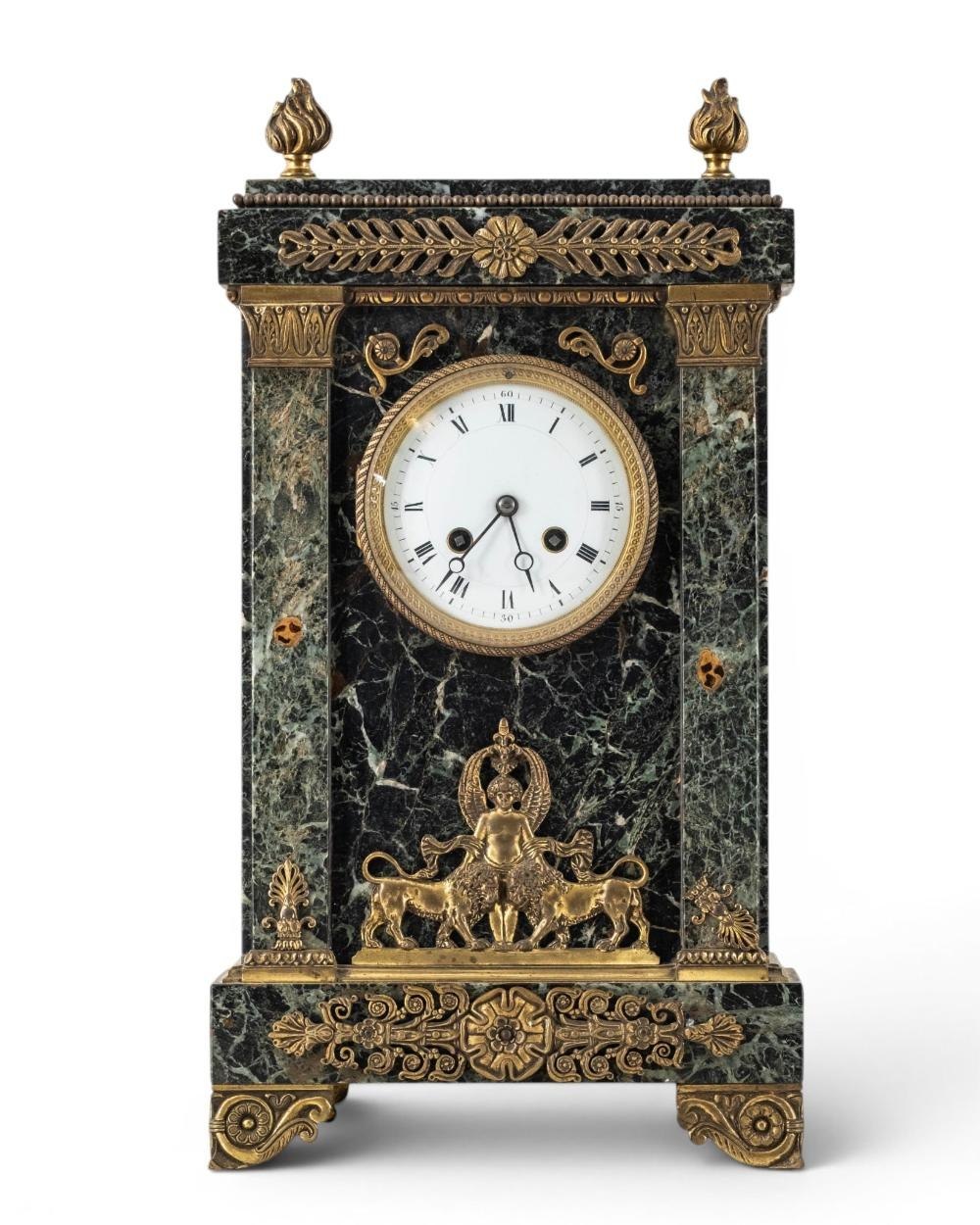
This 19th-century French mantel clock originates from the Napoleon III period. The object features an architectural case fabricated from dark green serpentine marble, which is contrasted by numerous gilt bronze ornamental mounts. The design incorporates classical architectural elements, such as columns, alongside a figural relief positioned beneath the dial, depicting a cherub situated between two reclining lions. Decorative details include foliate borders, garlands, scrollwork, and flame-form finials crowning the upper section. The timepiece is supported by gilt bronze feet. A white enamel dial displays Roman numerals for the hour indications and Arabic numerals for the minutes, paired with pierced hands. The movement of the clock is signed by Ch. Paris.

Frontal view of the Ch. Paris mantel clock featuring green serpentine marble and gilt bronze mounts.
Frontal view of the Ch. Paris mantel clock featuring green serpentine marble and gilt bronze mounts. — Collective Hudson, LLC, via Invaluable. Rights pending — permission not yet requested. Original source

Catalogue identity

Source
orbiscollectibles.com
Category
Clock · Mantel clock
Maker / attribution
Ch. Paris
Reference
Not recorded
Catalogue / lot identifier
Source URL identifies the listing
Source-reported date
19th century
Source-reported place
France

Source-reported attribution and specifications are not independent authentication. A listing does not establish present ownership, current display, availability or permission to reproduce.

Object description

Case and Aesthetic Composition

The clock is built upon an architectural framework defined by the use of dark green serpentine marble. The choice of stone, noted for its rich veining, provides a base for the extensive gilt bronze embellishments. These bronze elements include classicized columns and structured borders that frame the dial area, contributing to a symmetrical, vertical layout.

Decorative accents are distributed across the marble structure, featuring intricate foliate patterns, garlands, and scrollwork that emphasize the ornamental nature of the piece. The base is supported by gilt bronze feet, while the upper register is topped with matching flame-form finials, ensuring a balanced silhouette consistent with the architectural style of its era.

Evidence for this section
  • “architectural case constructed from richly veined dark green serpentine marble”
  • “heavily embellished with elaborate gilt bronze mounts, including classical columns, foliate borders, decorative garlands, and intricate scrollwork”
  • “finished with flame-form finials at the summit.”

Dial and Figural Ornamentation

The central focus of the clock is the circular white enamel dial, which sits flush within the upper half of the serpentine marble case. The dial features black Roman numerals for the hours and smaller Arabic numerals for the minute track, paired with pierced hands.

Beneath the dial, a distinct gilt bronze relief serves as a focal point. This relief captures a cherub figure positioned between two reclining lions, adding a mythological dimension to the otherwise formal architectural geometry of the clock body.

Evidence for this section
  • “white enamel dial is marked with black Roman numerals for the hours and Arabic numerals for the minutes, complemented by pierced hands”
  • “A prominent central figural relief depicts a cherub standing between two reclining lions, adding a classical motif to the composition.”

Signature and Identification

The timepiece is attributed to the maker Ch. Paris, based on the signature present on the clock's movement.

The presence of the mark allows for the classification of the piece within the wider context of 19th-century French mantel clocks.

Evidence for this section
  • “The clock's movement is signed by the maker, Ch. Paris.”
  • “overall construction displays the ornamental, ornate style characteristic of Second Empire French horology”

Open research questions

  • What is the specific horological background or history of the maker Ch. Paris?
  • Are there recorded variants of this specific model in other marble colorways?

Source evidence

Recorded claims and source quotations for Ch. Paris Napoleon III Mantel Clock
FieldSource-reported valueSource quotation
MakerCh. Paris“The clock's movement is signed by the maker, Ch. Paris.”
PeriodNapoleon III“This 19th-century French mantel clock dates to the Napoleon III period”
MaterialsSerpentine marble and gilt bronze“constructed from richly veined dark green serpentine marble. The design is heavily embellished with elaborate gilt bronze mounts”
DialWhite enamel“The white enamel dial is marked with black Roman numerals for the hours and Arabic numerals for the minutes”
Figural elementsCherub and lions“A prominent central figural relief depicts a cherub standing between two reclining lions”
FinialsFlame-form“finished with flame-form finials at the summit.”

Visible details

  • Dark green serpentine marble housing
  • Gilt bronze central relief of a cherub and lions
  • Flame-form finial ornamentation
  • White enamel dial with dual numeral sets

Research qualifications

  • Movement internal condition is unverified
  • Exact manufacture date within the 19th century is not specified

Photograph identity and source facts were screened before import; rights clearance remains pending.

Consulted source

Ch. Paris Napoleon III marble and gilt bronze mantel clock

Reviewed 2026-11-02 · Record 0fb60e5b2e

Terms in this record

Glossary explanations for terms named in this object’s record.