
Skip to content
The Encyclopedia of Horology

Clock · Magnetic water clock

Cartier Circa 1929 La Pendule Magnétique 'Water Clock'

Partially verified

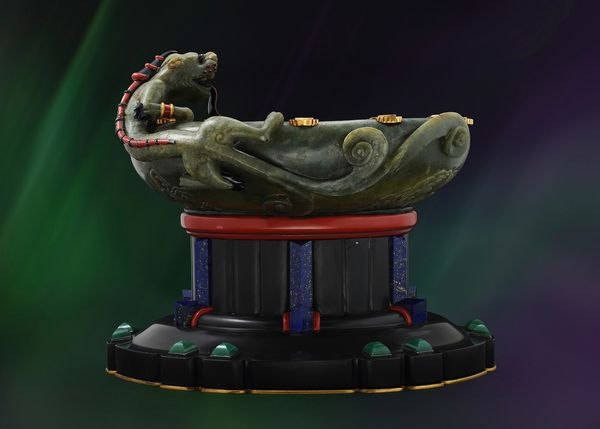
Lot 933 from the Phillips Hong Kong Watch Auction: XVIII represents a rare Cartier magnetic water clock, known as 'La Pendule Magnétique', dating to circa 1929. Built under the supervision of Maurice Couet, the clock incorporates an 18th-century Chinese carved nephrite basin encircled by a mythical chimera. Time is indicated by a floating carp fish traversing a shallow water-filled bowl around gold, lacquer, coral, mother-of-pearl, and enamel markers, propelled by hidden magnets within the case. The basin rests upon a fluted marble base ornamented with lapis lazuli pillars and aventurine cabochons.

Side elevation of the Cartier La Pendule Magnétique water clock showing the carved nephrite chimera basin and columned plinth
Side elevation of the Cartier La Pendule Magnétique water clock showing the carved nephrite chimera basin and columned plinth — Phillips. Rights pending — permission not yet requested. Original source

Catalogue identity

Source
www.phillips.com
Category
Clock · Magnetic water clock
Maker / attribution
Cartier
Reference
Not recorded
Catalogue / lot identifier
933
Source-reported date
circa 1929
Country
France

Source-reported attribution and specifications are not independent authentication. A listing does not establish present ownership, current display, availability or permission to reproduce.

Object description

Object Identity and Provenance

The timepiece, identified as 'La Pendule Magnétique' or 'water clock', is dated to circa 1929. The object was produced under the guidance of Maurice Couet, who founded Cartier’s horological workshop in Paris in 1919.

The source notes the object's inclusion in 'The Cartier Collection: Timepieces' by Franco Cologni and François Chaille. The archival record states that this clock, one of three similar examples, was missing for a period before reappearing at a 1990 auction in New York.

Evidence for this section
  • “Built under the guidance of Maurice Couet, who founded Cartier's initial horological workshop at 30 rue Lafayette, in Paris, in 1919”
  • “The most precious of the three clocks, dated 1929, which had long been missing and only known through a photograph from the archives, reappeared in 1990 at auction in New York”

Construction and Materiality

The central basin is identified as an 18th-century Chinese piece made of nephrite. A carved chimera figure is integrated into the basin, positioned along the rim.

The base structure is constructed of marble and incorporates lapis lazuli and aventurine accents. Other materials cited in the object's composition include silver, coral, mother-of-pearl, and enamel.

Evidence for this section
  • “The basin itself is a Chinese creation from the 18th century. Crafted out of nephrite, a Chimera creature coils around the basin”
  • “It's crafted of marble, silver, lapis lazuli, nephrite, coral, mother-of-pearl, enamel, and jade.”

Mechanism and Time Indication

The clock utilizes a magnetic field mechanism to move an indicator around a shallow, water-filled bowl. The internal drive components and magnets are concealed within the case.

Time is indicated by a floating carp fish, which traverses the bowl past markers made of gold, coral, mother-of-pearl, and enamel.

Evidence for this section
  • “The mechanism itself operates via a simple magnetic field that is placed between sets of concealed magnets inside the case as well as in the carp fish”
  • “moving past the gold, coral, mother-of-pearl and enamel markers in order to indicate the passing time.”
  • “in this instance, the fish has been painstakingly created to indicate the hours and minutes.”

Open research questions

  • What are the specific technical or aesthetic distinctions between the three clocks referenced in the Cartier archive?
  • Does the Cartier archive distinguish the 'tortoiseshell turtle' and the 'carp' as interchangeable indicators or distinct iterations of the magnetic clock model?

Source evidence

Recorded claims and source quotations for Cartier Circa 1929 La Pendule Magnétique 'Water Clock'
FieldSource-reported valueSource quotation
Lot IdentificationLot 933: A Circa 1929 La Pendule Magnétique 'Water Clock'“Lot 933: A Circa 1929 La Pendule Magnétique 'Water Clock'”
MaterialsMarble, silver, lapis lazuli, nephrite, coral, mother-of-pearl, enamel, and jade“It's crafted of marble, silver, lapis lazuli, nephrite, coral, mother-of-pearl, enamel, and jade.”
MechanismConcealed magnetic field propelling floating carp indicator“The mechanism itself operates via a simple magnetic field that is placed between sets of concealed magnets inside the case as well as in the carp fish, moving them around the shallow, water-filled bowl”
Workshop DirectionMaurice Couet“Built under the guidance of Maurice Couet, who founded Cartier's initial horological workshop at 30 rue Lafayette, in Paris, in 1919”
Decorative MotifChimera (Qilin)“The Chimera, also known as the Qilin, is an auspicious creature of Far Eastern Mythology”

Visible details

  • Carved green nephrite basin with an elongated mythical chimera perched along the rim
  • Fluted cylindrical pedestal flanked by upright lapis lazuli pilasters and red accents
  • Tiered dark base adorned with pyramidal green aventurine cabochons and gilt metal trim
  • Gilt or decorative markers visible along the inner rim of the basin

Research qualifications

  • The interior basin floor, water level, and the floating magnetic carp indicator are not visible in this profile photograph
  • Internal drive components and magnet assemblies are entirely concealed within the base plinth

Photograph identity and source facts were screened before import; rights clearance remains pending.

Consulted source

Discover Cartier's Extraordinary Clockmaking History This Auction Season At Phillips

Reviewed 2026-10-22 · Record 44cb2cfd75

Terms in this record

Glossary explanations for terms named in this object’s record.