
Skip to content
The Encyclopedia of Horology

Wristwatch · Manual-wind rectangular watch

Cartier Basculante Mécanique

Partially verified

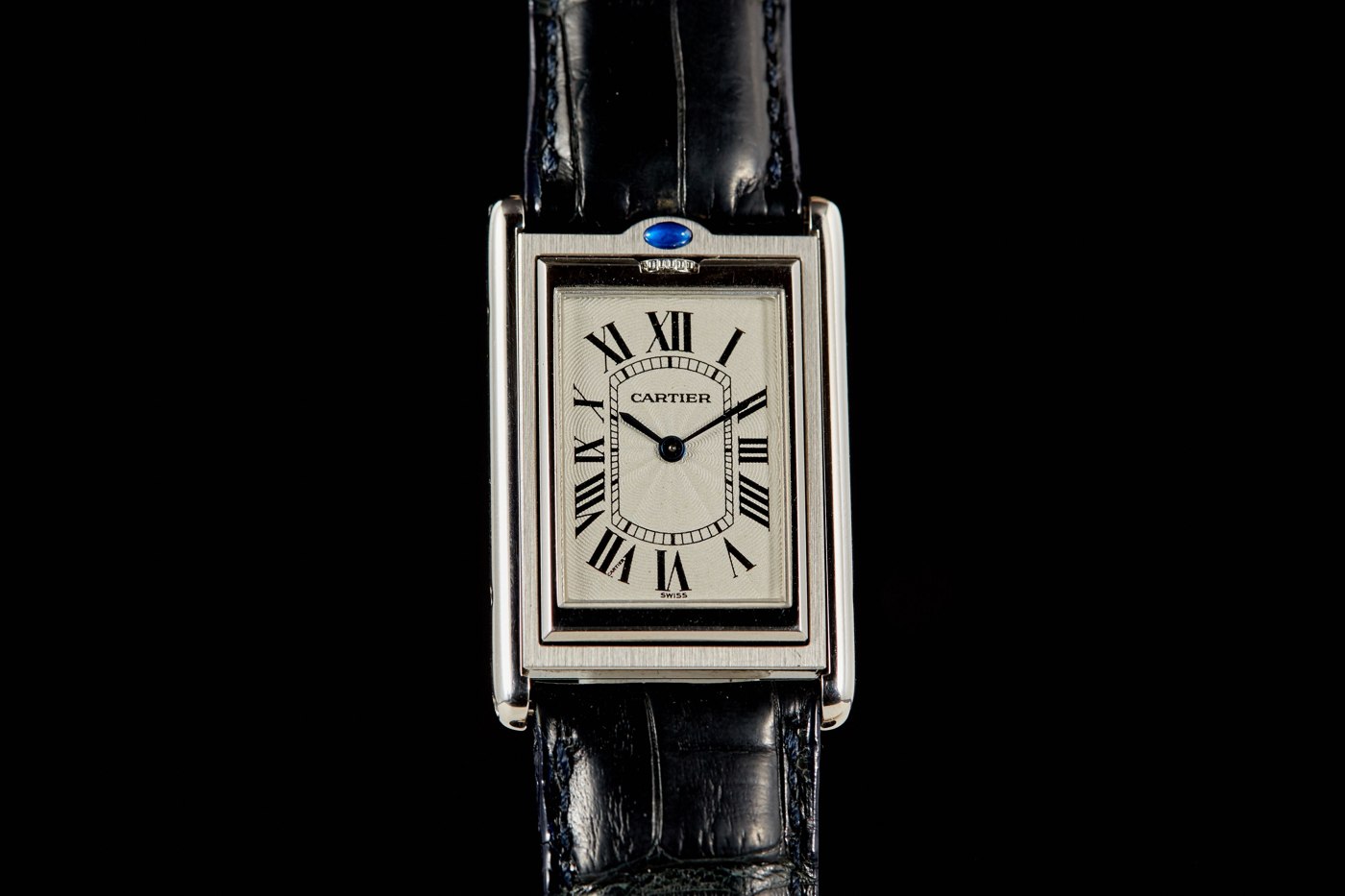
This Cartier Tank Basculante Mécanique is a manual-wind wristwatch featuring an articulating hinged rectangular case. Unlike fixed-case models, the inner dial housing of this watch pivots within a swinging frame, a design feature described as a seesaw mechanism, derived from the French word bascule. The watch features a white dial decorated with a central guilloché pattern and is marked with black Roman numerals. The dial includes a central minute track and is signed with the Cartier name and the word Swiss at the bottom. A blue stone is set into the winding crown. The watch is presented on a black alligator leather strap. The movement used in this model is the Calibre 610, which was sourced from Fréderique Piguet. According to the auction description, this particular example originates from the last decade of the model's production and displays light signs of wear.

Front view of the Cartier Tank Basculante Mécanique on a leather strap, showing the rectangular case and dial.
Front view of the Cartier Tank Basculante Mécanique on a leather strap, showing the rectangular case and dial. — Analog Shift. Rights pending — permission not yet requested. Original source

Catalogue identity

Source
shop.analogshift.com
Category
Wristwatch · Manual-wind rectangular watch
Maker / attribution
Cartier
Reference
Not recorded
Catalogue / lot identifier
Source URL identifies the listing
Source-reported date
Last decade of production
Source-reported place
Not established

Source-reported attribution and specifications are not independent authentication. A listing does not establish present ownership, current display, availability or permission to reproduce.

Object description

Case and Mechanism

The Cartier Tank Basculante Mécanique is defined by its articulating case design. The inner housing, which protects the dial, is mounted within an outer frame that facilitates a swivelling motion. This mechanism is functionally distinct from other pivoting watch designs as it employs a swinging frame, allowing the inner case to rotate on a central axis.

This construction is designed to protect the crystal when not in use. The movement is protected within this pivoting frame, and the case exterior is completed with a crown set with a blue stone, which is positioned on the top edge of the watch frame in the upright orientation.

Evidence for this section
  • “the case in which the dial is housed pivots inside an outer case”
  • “the Basculante employs a swinging frame. When deployed, the inner case looks as though it's on a seesaw.”

Dial and Aesthetic

The watch displays a rectangular dial finished with a central guilloché texture. The hours are indicated by black-printed Roman numerals arranged around a central railroad-style minute track. The dial is signed with the Cartier wordmark in the upper half and features the word Swiss printed at the lower edge.

The watch is secured to the wrist with a black alligator leather strap. The combination of the brushed-finish outer frame and the textured inner dial provides a contrast between the geometric outer structure and the detailed finish of the internal dial housing.

Evidence for this section
  • “With its elegant guilloché dial and crisp Roman numerals”

Movement and History

The timepiece is powered by the Calibre 610, a movement sourced from Fréderique Piguet. The calibre is characterized by its thin profile, measuring 2.1mm in thickness. It was first conceived for use in 1926.

The Basculante Mécanique was first introduced to the Cartier collection in 1932, one year following the debut of the Jaeger-LeCoultre Reverso. This specific watch is reported by the vendor to date from the final decade of the model's production cycle.

Evidence for this section
  • “The movement of the Basculante was sourced from Fréderique Piguet. First conceived in 1926, at 2.1mm the Calibre 610”
  • “The Tank Basculante Mécanique was released in 1932”
  • “Ours dates from the last decade of production”

Open research questions

  • What is the specific date of manufacture for this unit?
  • What are the precise serial numbers found on the case back and movement for this specific object?

Source evidence

Recorded claims and source quotations for Cartier Basculante Mécanique
FieldSource-reported valueSource quotation
MakerCartier“Vendor: Cartier”
MechanismSwinging frame“unlike the Reverso, which only uses a single track, the Basculante employs a swinging frame. When deployed, the inner case looks as though it's on a seesaw.”
Dial detailGuilloché“With its elegant guilloché dial”
Production dateLast decade of production“Ours dates from the last decade of production”
Release date1932“The Tank Basculante Mécanique was released in 1932”

Visible details

  • Rectangular case with hinged frame mechanism
  • Blue cabochon winding crown
  • Guilloché patterned dial center
  • Black Roman numeral hour markers

Research qualifications

  • Movement caliber is sourced from Fréderique Piguet but not verified by serial
  • Specific production year within the last decade is not provided

Photograph identity and source facts were screened before import; rights clearance remains pending.

Consulted source

ساعت مچی دستی Cartier Tank Basculante Mécanique

Reviewed 2026-11-02 · Record 819142cccf

Terms in this record

Glossary explanations for terms named in this object’s record.