
Skip to content
The Encyclopedia of Horology

Clock · Cartel clock

Cartel clock by Jan Hendrik Kühn

Partially verified

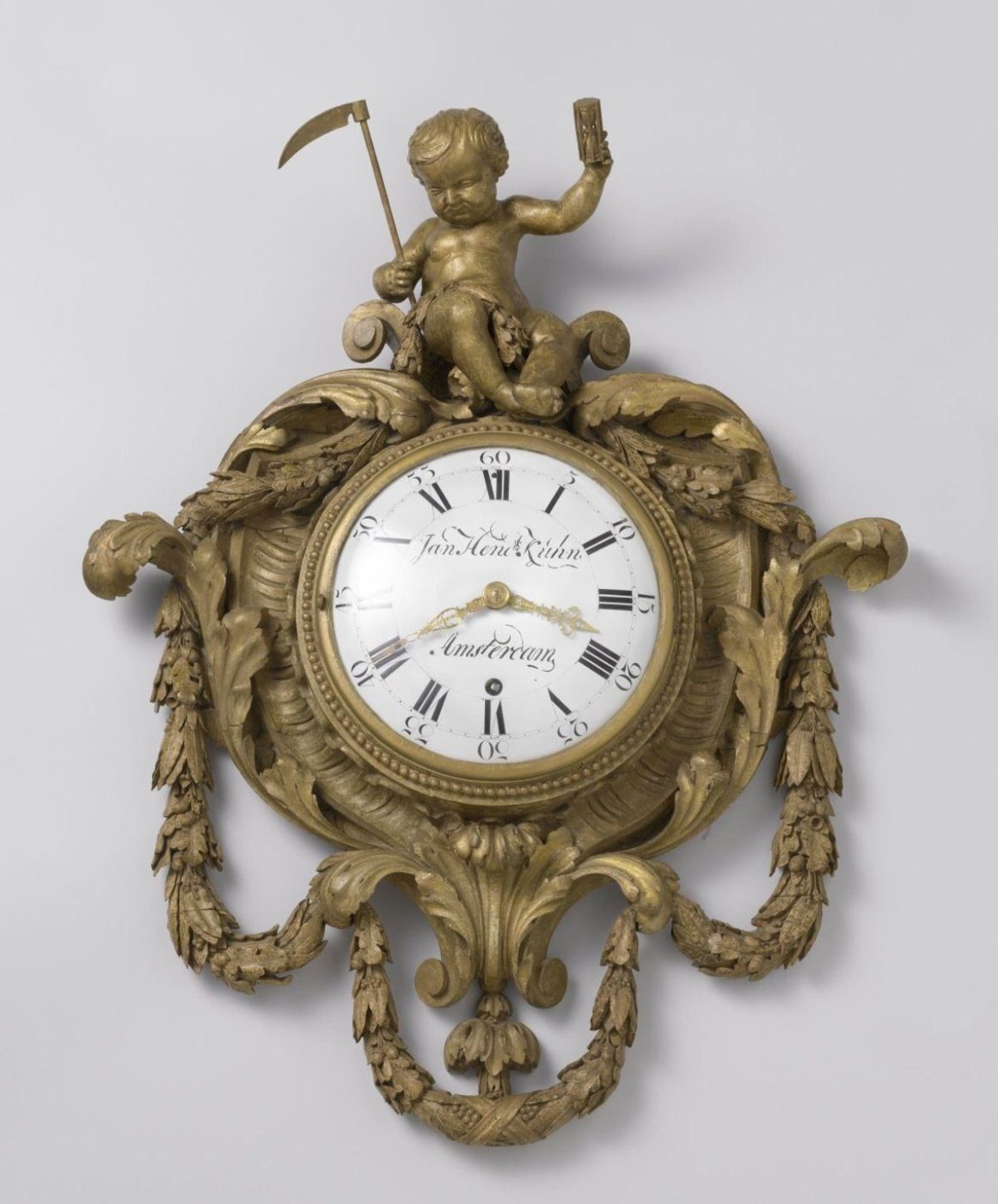
This cartel clock, accessioned as BK-NM-8869, was produced circa 1792 for the Grote Entréekamer within the Felix Meritis building in Amsterdam. The clock features a lyre-shaped wooden case carved from linden wood, which is finished with gilding and areas of brown paint. The design, attributed to the architect Jacob Otten Husly, incorporates an allegorical child figure positioned at the crown of the clock, holding a scythe and an hourglass to represent time. Ornamentation includes acanthus leaves, scrollwork, and garlands composed of oak and laurel foliage. The round dial is encircled by a pearl-patterned border. The movement is attributed to the Amsterdam horologist Jan Hendrik Kühn, whose signature appears on the dial. The sculpture is attributed to the Amsterdam-based artist Jan Swart. The object was acquired by the Rijksmuseum as a donation from the Maatschappij Felix Meritis in 1889.

A front-facing view of the cartel clock showing the lyre-shaped case, the child figure at the top, and the signed dial.
A front-facing view of the cartel clock showing the lyre-shaped case, the child figure at the top, and the signed dial. — Rijksmuseum. Rights pending — permission not yet requested. Original source

Catalogue identity

Source
www.rijksmuseum.nl
Category
Clock · Cartel clock
Maker / attribution
Jan Hendrik Kühn
Reference
Not recorded
Catalogue / lot identifier
BK-NM-8869
Source-reported date
circa 1792
Source-reported place
Netherlands

Source-reported attribution and specifications are not independent authentication. A listing does not establish present ownership, current display, availability or permission to reproduce.

Object description

Case Design and Sculpture

The cartel clock is constructed from linden wood, featuring a decorative scheme of gilding and brown paint. Its structural form is defined as a lyre shape, which terminates in volutes at both the top and the bottom, embellished with wave or foam-like ornamental detailing. The entire assembly is framed by acanthus leaves, from which garlands of oak and laurel foliage are suspended.

The apex of the clock is crowned by a figurative sculpture of a seated child. This figure acts as an allegorical representation of time, illustrated by the inclusion of a scythe and an hourglass held within the figure's hands. The broader design of the case is credited to the architect Jacob Otten Husly, who conceived the work as a variation on a French model for the Grote Entréekamer of the Felix Meritis building.

Evidence for this section
  • “Hangklok van lindehout, verguld en bruin geschilderd.”
  • “Husly ontwierp een variatie op een Frans type. Het jongetje met de zeis symboliseert de tijd.”
  • “De kast wordt bekroond door een zittende kinderfiguur die een zeis en zandloper in de handen houdt.”

Dial and Signature

The round clock dial is set within the central lyre-shaped frame. It is bordered by a pearl-patterned ring. The dial surface contains the primary identification for the piece, displaying the name and location of the clockmaker.

The text inscribed on the dial reads 'Jan Hendk Kuhn Amsterdam' in a clear script format. This mark confirms the association with the Amsterdam horologist Jan Hendrik Kühn, who is identified in the records as the maker of the clock movement. No further markings are specified on the exterior of the clock face.

Evidence for this section
  • “De ronde wijzerplaat wordt omgeven door een parelrand”
  • “Wijzerplaat is gesigneerd: "Jan Hendk Kuhn Amsterdam".”

History and Acquisition

The clock was created around 1792, specifically for the main entrance chamber of the Felix Meritis building located on the Keizersgracht in Amsterdam. The building itself was designed by Jacob Otten Husly in a neoclassical style and opened in 1788. This horological object remained within the Felix Meritis collection for nearly a century following its creation.

In 1889, the clock was transferred to the Rijksmuseum. It was officially recorded as a donation from the Maatschappij Felix Meritis, the same organization for which it was originally commissioned. It remains part of the museum's permanent collection under the object number BK-NM-8869.

Evidence for this section
  • “Deze hangklok werd enkele jaren later gemaakt voor de Grote Entréekamer op de hoofdverdieping.”
  • “Schenking van de Maatschappij Felix Meritis”
  • “schenking 1889”

Open research questions

  • What is the specific type of movement (e.g., eight-day, striking) contained within the linden wood case?
  • Are there any hidden maker's marks or signatures on the wooden case hidden from view?

Source evidence

Recorded claims and source quotations for Cartel clock by Jan Hendrik Kühn
FieldSource-reported valueSource quotation
MakerJan Hendrik Kühn“uurwerkmaker: Jan Hendrik Kühn, Amsterdam”
SculptorJan Swart“beeldhouwer: Jan Swart, Amsterdam”
DesignerJacob Otten Husly“ontwerper: naar Jacob Otten Huslij, Amsterdam”
MaterialLinden wood and gilding“lindehout, verguld en bruin geschilderd.”
Dimensions102.5 cm height“hoogte 102,5 cm x breedte 75,5 cm x diepte 25 cm”
Datecirca 1792“ca. 1792”
ProvenanceGift of the Maatschappij Felix Meritis“Schenking van de Maatschappij Felix Meritis”
Dial signatureJan Hendk Kuhn Amsterdam“Wijzerplaat is gesigneerd: "Jan Hendk Kuhn Amsterdam".”

Visible details

  • The dial features Roman numerals for the hours and Arabic numerals for the minutes.
  • A child figure with a scythe and hourglass sits atop the case.
  • The case is decorated with hanging garlands of oak and laurel leaves.
  • The dial is signed 'Jan Hendk Kuhn Amsterdam'.

Research qualifications

  • The exact technical specifications of the internal clockwork mechanism are not detailed in the source.
  • The involvement of Jan Swart and Jacob Otten Husly represents institutional attribution rather than verified workshop documents.

Photograph identity and source facts were screened before import; rights clearance remains pending.

Consulted source

Cartel clock, c. 1792

Reviewed 2026-11-02 · Record eaedaa1314

Terms in this record

Glossary explanations for terms named in this object’s record.