
Skip to content
The Encyclopedia of Horology

Clock · Capucine carriage clock

Capucine carriage clock by Cary

Partially verified

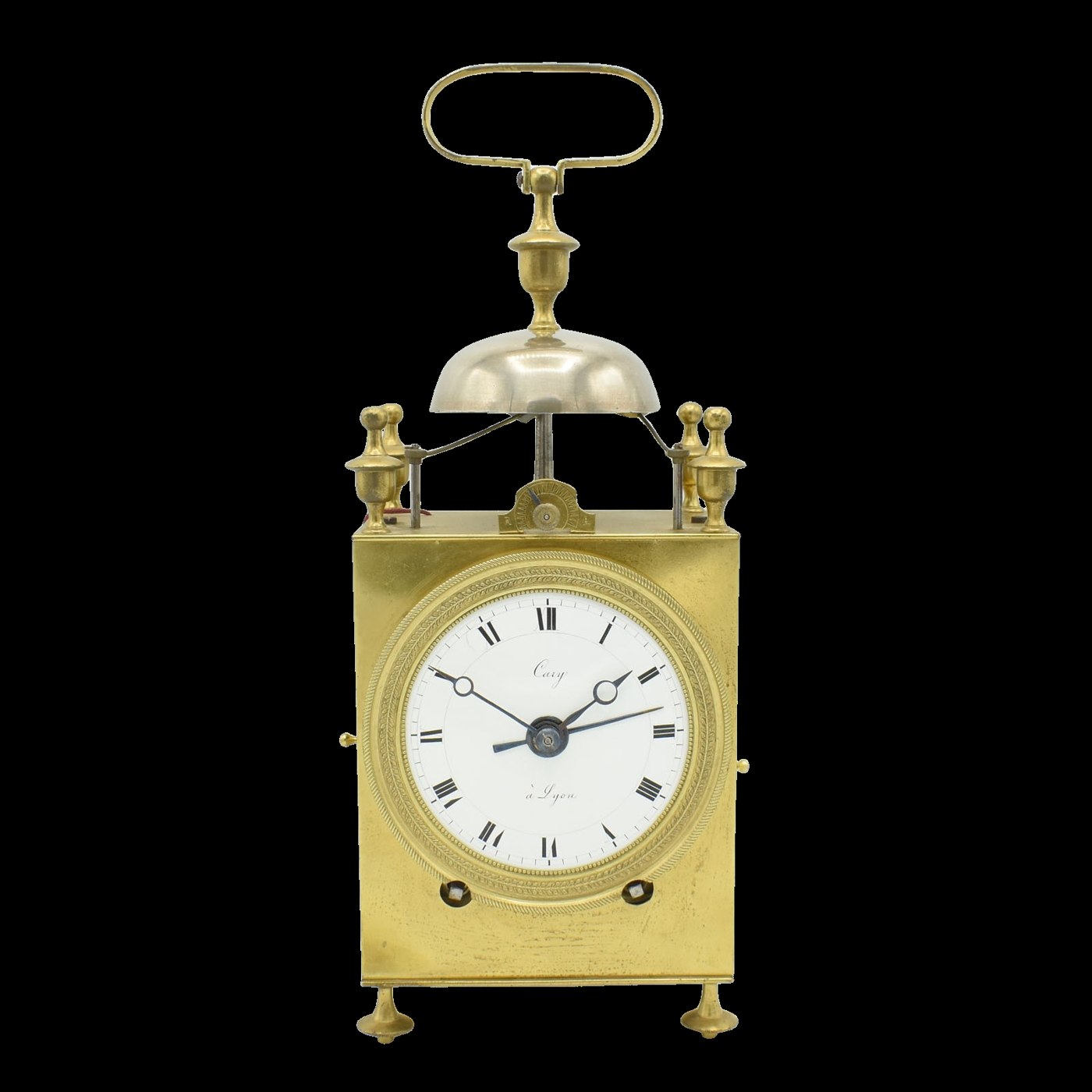
This Capucine carriage clock, attributed to the maker Cary of Lyon, dates to circa 1850. The timepiece is housed in a brass case featuring four turned finials, a flattened loop handle, and hinged access doors on the sides with a rear latch. It functions with a 7-day movement and includes an alarm mechanism. The white dial displays Roman numerals and is fitted with blued steel Breguet-style hands, complemented by an alarm indicator hand. The clock utilizes a bell-striking mechanism that strikes on the hour, two minutes after the hour, and once for the half-hour, a method described as vineyard striking. Measuring 110 by 110 by 300 mm, the clock retains its original condition with a developed patina, according to the source. It is identified by the signature "Cary" and the location "à Lyon" on the dial.

Front view of the brass Capucine carriage clock showing the bell, finials, and white dial with blued steel hands.
Front view of the brass Capucine carriage clock showing the bell, finials, and white dial with blued steel hands. — It's About Time (The Clock & Watch Shop). Rights pending — permission not yet requested. Original source

Catalogue identity

Source
theclockandwatchshop.co.uk
Category
Clock · Capucine carriage clock
Maker / attribution
Cary
Reference
CL-CA-1742
Catalogue / lot identifier
Source URL identifies the listing
Source-reported date
1850s
Source-reported place
France

Source-reported attribution and specifications are not independent authentication. A listing does not establish present ownership, current display, availability or permission to reproduce.

Object description

Case and Dial

The clock is constructed with a brass case featuring a white dial marked with Roman numerals. The design incorporates four turned finials mounted atop the case and a flattened loop handle. Access to the internal components is provided by hinged doors located on all sides, with a simple latch securing the rear panel.

The dial is signed with the maker's name "Cary" and the location "à Lyon," consistent with the clock's attribution to the French region. The timekeeping is indicated by blued steel Breguet-style hands, which are accompanied by an additional hand for the alarm function. The exterior brass surfaces exhibit a developed patina.

Evidence for this section
  • “The dial is signed Cary , a clockmaker of Lyon (France)”
  • “Four turned finials and typical flattened loop handle. Hinged doors to all sides with a simple latch to the rear.”
  • “The dial showing Roman numerals with the blued steel Breguet hands with alarm hand.”

Movement and Striking

This clock operates on a 7-day movement. It features an integrated alarm mechanism and a specialized bell-striking system. The strike sequence occurs on the hour, followed by a strike two minutes later. This specific pattern is referenced in the documentation as "vineyard striking."

A singular blow on the bell is utilized to signal the half-hour. The bell is mounted at the top of the clock, situated beneath the handle assembly, facilitating the audible strike intervals described.

Evidence for this section
  • “Bell striking on the hour and two minutes after the hour, sometimes called vineyard striking, with one blow on the bell for the half hour.”

Condition and Attribution

The auction description reports that the clock is in original condition and has acquired a patina over time. It is listed as having been fully restored. The attribution to Cary of Lyon and the date of circa 1850 are stated as part of the item's historical identification.

The piece is catalogued with the reference number CL-CA-1742. No further provenance or specific history beyond the maker and estimated date is provided in the current documentation.

Evidence for this section
  • “This fine and rare clock is in very original condition and has developed a beautiful patina.”
  • “who made the clock circa 1850.”
  • “Fully restored and sold with a full 12 month guarantee .”

Open research questions

  • What specific mechanisms define 'vineyard striking' in 19th-century French Capucine clocks?
  • Are there extant movement records for the maker Cary of Lyon to verify the circa 1850 date?

Source evidence

Recorded claims and source quotations for Capucine carriage clock by Cary
FieldSource-reported valueSource quotation
MakerCary“The dial is signed Cary , a clockmaker of Lyon (France)”
Datecirca 1850“who made the clock circa 1850”
Striking mechanismBell striking on the hour and two minutes after the hour“Bell striking on the hour and two minutes after the hour, sometimes called vineyard striking”
Dimensions110 × 110 × 300 mm“110 × 110 × 300 mm”
DialWhite dial with Roman numerals“The dial showing Roman numerals”
HandsBlued steel Breguet hands“the blued steel Breguet hands with alarm hand”

Visible details

  • Bell-striking mechanism with top-mounted bell
  • Blued steel hands including an alarm hand
  • Four turned brass finials
  • Hinged side doors for access to movement

Research qualifications

  • The exact date of manufacture is given as "circa 1850"
  • The term "vineyard striking" is mentioned as a colloquialism

Photograph identity and source facts were screened before import; rights clearance remains pending.

Consulted source

Capucine Clock by Cary a Lyon

Reviewed 2026-11-02 · Record 519580b831

Terms in this record

Glossary explanations for terms named in this object’s record.