
Skip to content
The Encyclopedia of Horology

Tool · German ring dial

Brass Ring Dial

Partially verified

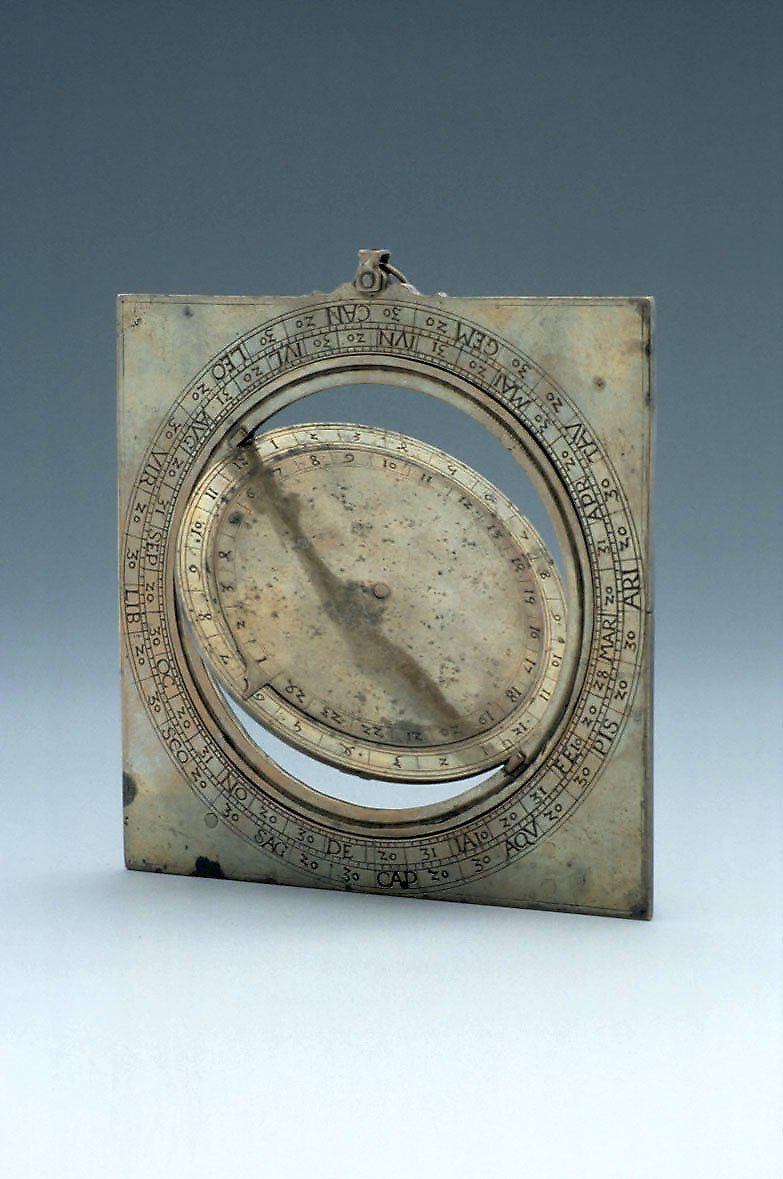
This unsigned brass ring dial, inventory number 34394 in the collection of the Museum of the History of Science, Oxford, measures 96 by 96 by 2 mm. It is a precursor to the equinoctial ring dial, functioning as an astronomical ring dial without an equatorial ring. The construction features a square brass plate with a central hole that houses a sliding disc. The dial includes an equal scale of latitudes, a ruler with an unequal scale, and a calendar scale displaying months and solar declination via zodiac signs. One side of the round plate incorporates a shadow square, while the reverse features a lunar volvelle with hour scales. Operation requires setting the sliding ring to the user's latitude and the alidade to the solar declination, then directing the sights toward the sun to measure time using the central ruler.

Front view of the brass ring dial, showing the central rotating disc and engraved zodiac scale on the square plate.
Front view of the brass ring dial, showing the central rotating disc and engraved zodiac scale on the square plate. — Museum of the History of Science, Oxford. Rights pending — permission not yet requested. Original source

Catalogue identity

Source
www.mhs.ox.ac.uk
Category
Tool · German ring dial
Maker / attribution
Not established
Reference
Not recorded
Catalogue / lot identifier
34394
Source-reported date
circa 1480 ?
Source-reported place
Germany

Source-reported attribution and specifications are not independent authentication. A listing does not establish present ownership, current display, availability or permission to reproduce.

Object description

Structural Design and Components

The object comprises a 96 by 96 mm square brass plate, which serves as the primary support for the internal moving components. At the center of this plate is a hole that carries a sliding disc, central to the instrument's operation. Surrounding the sliding disc on the square plate is an equal scale of latitudes ranging from 0 to 90 degrees, marked in 2-degree increments and numbered every 10 degrees.

A ruler, marked with an unequal scale from 1 to 12 in increments of 1, is secured to the plate by two slots. The reverse side of the plate contains a calendar scale featuring months and the declination of the sun, identified by the corresponding zodiac signs. This combination of fixed and movable elements facilitates the calculation of time through observed solar positioning.

Evidence for this section
  • “The instrument consists of a brass plate with a hole in the centre carrying a sliding disc.”
  • “Around the sliding disc is an equal scale of latitudes from [0?] to 90? by 2?, numbered by 10?.”
  • “A ruler marked with an unequal scale from 1 to 12 by 1 is retained by means of two slots.”

Operational Mechanisms and Scales

The dial is designed to determine time through a specific alignment procedure. To use the instrument, the sliding ring is adjusted to the latitude of the observer, while the alidade is set to match the declination of the sun. The entire assembly is suspended, and the disc is rotated until the sights align with the sun. Time is read by measuring the distance between a notch on the sliding ring and a notch in the center of the zodiac scale using the small ruler.

Further functional depth is provided by the round plate, which features a shadow square and a counterchanged alidade on one side. The opposite side includes a lunar volvelle, which provides an hour scale marked from 1 to 12 twice, and 1 to 24, expanding the instrument's capacity for celestial observation.

Evidence for this section
  • “To use the dial , the sliding ring is set to the latitude and the alidade is set to the declination .”
  • “The distance between the notch on the sliding ring and the notch in the centre of the zodiac scale is measured by a small ruler, where the time may be read directly.”
  • “The other side of the round plate has a lunar volvelle with an hour scale marked 1 to 12 twice and 1 to 24.”

Inscriptions and Provenance

The plate bears a partially deleted inscription on one side that reads 'MARTIN FREY'. A historical museum accession card indicates that the text previously extended to read 'REGENSPURE 1590'.

Due to the state of the metal, this extended portion of the inscription is no longer legible to observers. The instrument is held by the Museum of the History of Science in Oxford, and it is catalogued under the inventory number 34394,

Evidence for this section
  • “On one side of the square plate is a partly deleted inscription (probably modern), reading 'MARTIN FREY'.”
  • “A museum accession card reports that the inscription continues 'REGENSPURE 1590' but this is no longer legible.”
  • “Inventory number: 34394”

Open research questions

  • What is the historical evidence or technical basis for the 'circa 1480' dating?
  • Can the 'REGENSPURE 1590' portion of the inscription be verified via archival records of similar instruments?

Source evidence

Recorded claims and source quotations for Brass Ring Dial
FieldSource-reported valueSource quotation
MakerUnsigned“Unsigned”
Datecirca 1480 ?“circa 1480 ?”
Dimensions96 x 96 x 2 mm“96 x 96 x 2 mm”
Inventory Number34394“Inventory number: 34394”
OriginGerman“German”
Primary functionAstronomical ring dial“is in fact a form of astronomical ring dial without an equatorial ring”

Visible details

  • Square brass plate measuring 96 x 96 mm
  • Sliding disc integrated into central circular aperture
  • Zodiac signs engraved around the square frame
  • Counterchanged alidade visible on the central disc

Research qualifications

  • The inscription 'MARTIN FREY' is reported to be likely modern
  • The full inscription 'REGENSPURE 1590' is no longer legible
  • The dating 'circa 1480' is marked with a question mark in the source

Photograph identity and source facts were screened before import; rights clearance remains pending.

Consulted source

Ring Dial

Reviewed 2026-10-26 · Record 5ea8935f7b

Terms in this record

Glossary explanations for terms named in this object’s record.