
Skip to content
The Encyclopedia of Horology

Clock · Flute clock

Black Forest Flute Clock

Partially verified

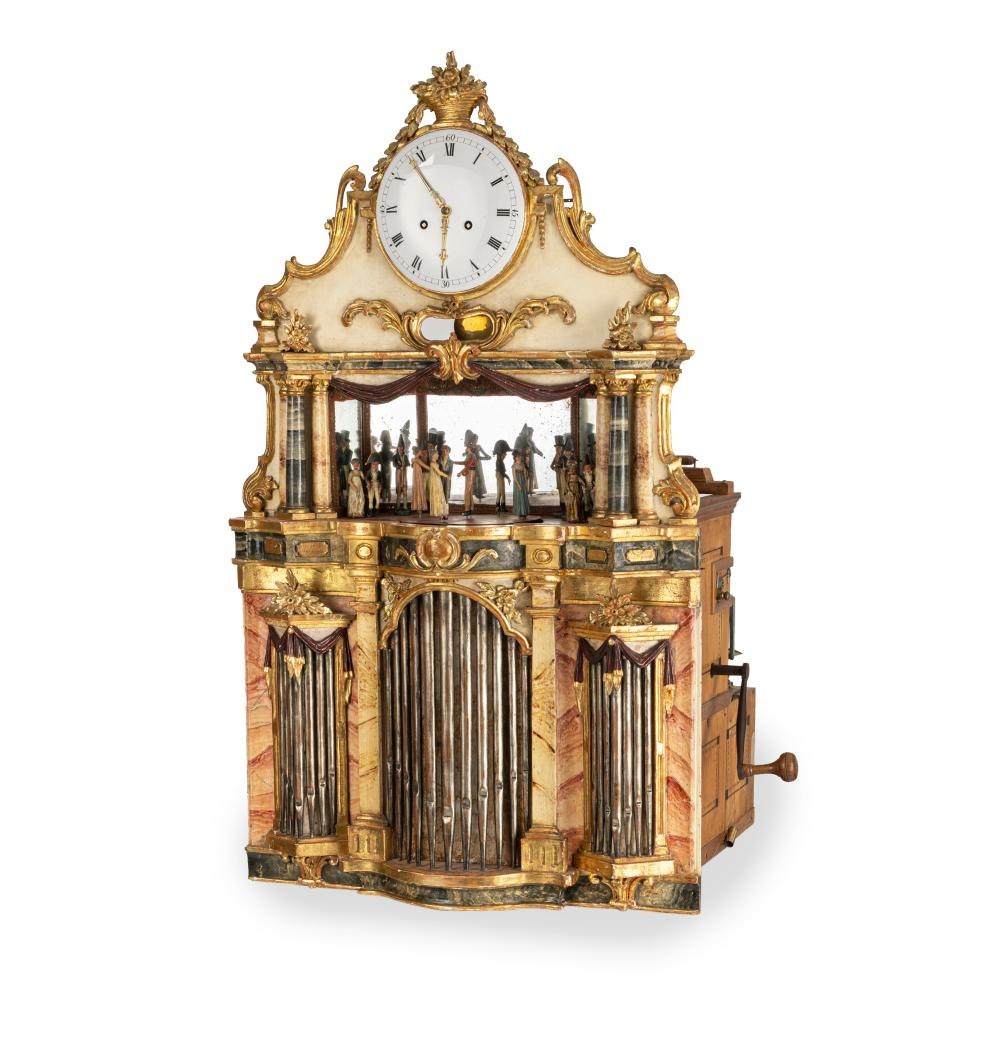
This late 18th-century Black Forest flute clock features a poliment-gilt wooden case designed with the visual motif of a church organ. Timekeeping is displayed on a white enamel dial featuring Roman numerals and an Arabic minute track, complemented by decorated hands. The movement, which is reported as a replacement, includes an 8-day duration and a half-hour strike on a bell, with the pendulum hung via thread suspension. The mechanical musical assembly comprises 64 wooden pipes and two large pin barrels, each capable of playing eight distinct melodies. The clock is accompanied by a wooden base constructed in the shape of a chest of drawers. Provenance is linked to the Sapper Collection in Stuttgart, with records indicating an acquisition from Antiquitäten Rust in Cologne in 1991.

Frontal view of the large Black Forest flute clock showing the theatre backdrop and organ pipe decoration.
Frontal view of the large Black Forest flute clock showing the theatre backdrop and organ pipe decoration. — Nagel Auction (via Invaluable). Rights pending — permission not yet requested. Original source

Catalogue identity

Source
www.invaluable.com
Category
Clock · Flute clock
Maker / attribution
Not established
Reference
Not recorded
Catalogue / lot identifier
853
Source-reported date
late 18th century
Source-reported place
Germany

Source-reported attribution and specifications are not independent authentication. A listing does not establish present ownership, current display, availability or permission to reproduce.

Object description

Case and Musical Assembly

The clock is housed in a poliment-gilt wooden case that features a theatre-style backdrop at the front. The design incorporates a depiction of a church organ, providing a decorative facade for the internal mechanical elements.

The musical function is driven by a flute movement containing 64 wooden pipes. It operates using two large pin barrels, with each barrel capable of producing eight different melodies. The system is described as having three registers and 21 claverns.

Evidence for this section
  • “Frontal view as a theatre backdrop and a diverse staffage of figures. Poliment-gilt wooden case on the front, with a depiction of a church organ.”
  • “Flute movement with 64 wooden pipes, two large pin barrels with 8 melodies each.”
  • “werk mit drei Registern, 21 Clavern (Tonstufen) und neun folkloristischen Tanzstücken”

Timekeeping Mechanism

The timekeeping display consists of a white enamel dial with Roman hour numerals and an Arabic minute track. The dial is fitted with decorated hands for reading the time.

The internal pendulum movement is an 8-day mechanism that strikes on a bell at the half-hour. The pendulum itself uses a thread suspension system. The auction description notes that both the movement and the dial are replaced components.

Evidence for this section
  • “White enamel dial with Roman numerals, Arabic minute track and decorated hands.”
  • “Large pendulum movement with 8-day running time, half-hour strike on bell and thread suspension of the pendulum.”
  • “Werk und Zifferblatt ergänzt.”

Attribution and Provenance

The clock has been part of the Sapper Collection in Stuttgart. Documentation provided with the lot includes a letter from Antiquitäten Rust, which details an acquisition in 1991.

The same documentation contains an assertion regarding the origin of the shield and figures, attributing them to Matthias Faller for the French court. This remains an attribution stated in the supporting letter rather than a confirmed provenance record.

Evidence for this section
  • “The Sapper Collection, Stuttgart Acquired from Antiquitäten Rust, Cologne, 1991”
  • “Shield and figures made by Matthias Faller for the French court.”

Open research questions

  • What is the specific nature of the replaced movement and how does it integrate with the original flute work?
  • Does the letter from Antiquitäten Rust provide evidence or further context for the attribution to Matthias Faller?

Source evidence

Recorded claims and source quotations for Black Forest Flute Clock
FieldSource-reported valueSource quotation
Dimensions100 x 60 cm“100 x 60 cm”
Datinglate 18th century“late 18th century”
Movement components64 wooden pipes, two large pin barrels with 8 melodies each“Flute movement with 64 wooden pipes, two large pin barrels with 8 melodies each”
Striking mechanismHalf-hour strike on bell“half-hour strike on bell”
ProvenanceThe Sapper Collection, Stuttgart; acquired from Antiquitäten Rust, Cologne, 1991“The Sapper Collection, Stuttgart Acquired from Antiquitäten Rust, Cologne, 1991”
Condition statusReplaced movement and dial; restoration and additions noted“Werk und Zifferblatt ergänzt. Rest., erg., Altersschäden.”

Visible details

  • Frontal case decoration resembles a miniature theatre stage with figures
  • Poliment-gilt wooden finish on the exterior
  • Dial includes Roman hour markers and Arabic minute numerals
  • Integrated winding crank visible on the side of the clock

Research qualifications

  • The auction description reports the movement and dial are replaced
  • Attribution to Matthias Faller is based on an enclosed letter from a third party rather than internal marks
  • Extent of age-related damage and restoration is not fully detailed

Photograph identity and source facts were screened before import; rights clearance remains pending.

Consulted source

A LARGE BLACK FOREST FLUTE CLOCK

Reviewed 2026-10-26 · Record f2f978c681

Terms in this record

Glossary explanations for terms named in this object’s record.