
Skip to content
The Encyclopedia of Horology

Tool · Equatorial sundial

Augsburg equatorial sundial by Johann Georg Vogler

Partially verified

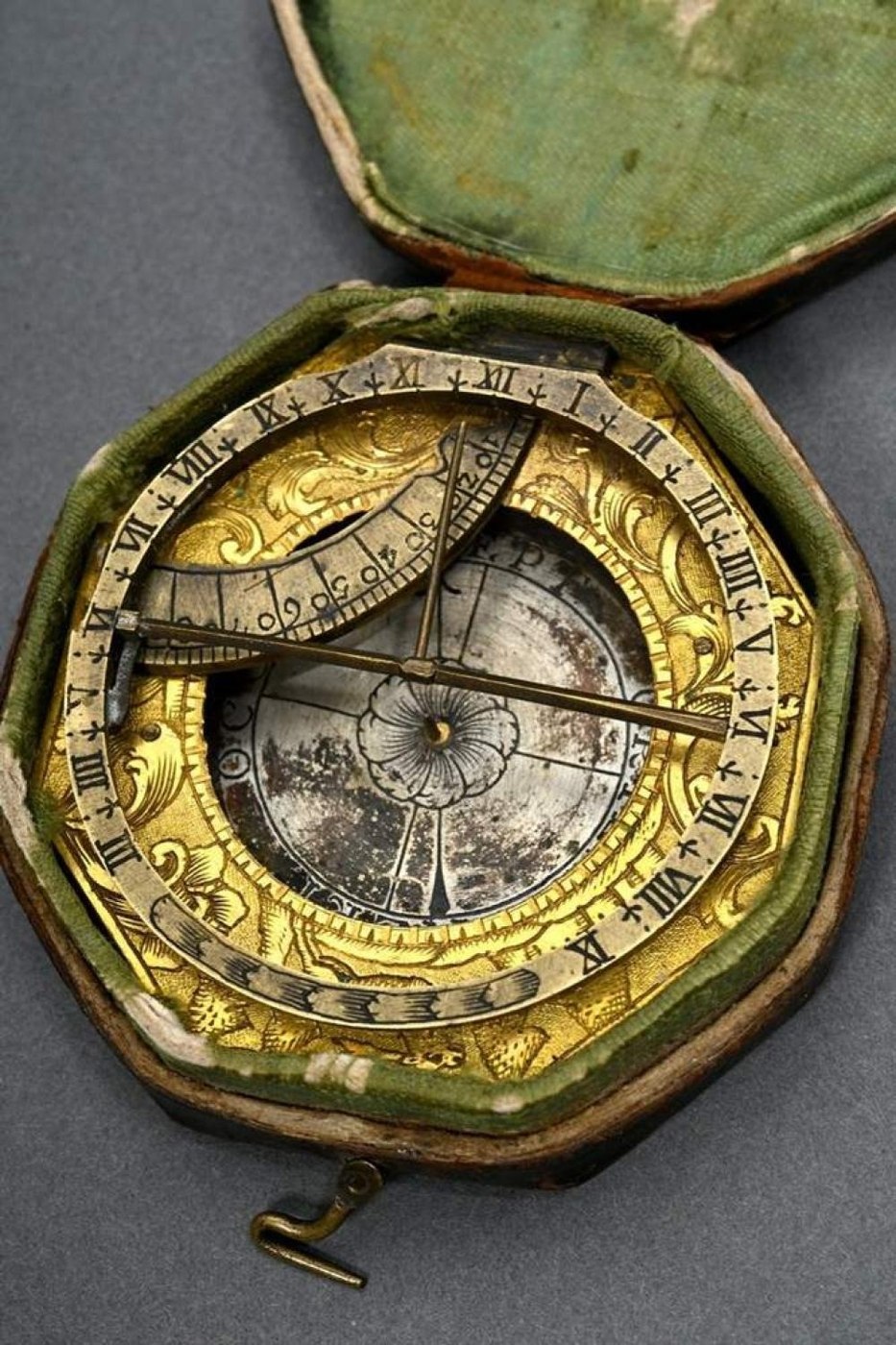
This equatorial sundial, produced in Augsburg between circa 1720 and 1765, is attributed to the maker Johann Georg Vogler. The instrument features a fire-gilded octagonal base plate which is decorated with fine engravings depicting a leaping stag, houses, and foliage. Centrally located on the base is a round compass box, with the cardinal points identified as SEPT, ORIE, MERI, and OCCI. The sundial assembly includes a hinged dial ring, a pole stick, and a protractor for adjustment. The underside of the base plate contains engraved pole lengths for various European cities, including Paris, Berlin, Madrid, and Lisbon. The complete set is housed in its original octagonal case, which is constructed from cardboard and lined with green silk, featuring an exterior finished in brown leather.

View of the Augsburg equatorial sundial showing the gilded octagonal base plate, the central compass, the hinged dial ring, and the protective cardboard and leather case.
View of the Augsburg equatorial sundial showing the gilded octagonal base plate, the central compass, the hinged dial ring, and the protective cardboard and leather case. — Kendzia / Invaluable. Rights pending — permission not yet requested. Original source

Catalogue identity

Source
orbiscollectibles.com
Category
Tool · Equatorial sundial
Maker / attribution
Johann Georg Vogler
Reference
Not recorded
Catalogue / lot identifier
202822841
Source-reported date
c. 1720-1765
Source-reported place
Germany

Source-reported attribution and specifications are not independent authentication. A listing does not establish present ownership, current display, availability or permission to reproduce.

Object description

Base Plate and Compass

The primary structure of the instrument is an octagonal fire-gilded base plate. The surface is ornamented with detailed engravings, which represent a leaping stag, various houses, and vines. This decorative program covers the areas surrounding the central compass box.

Integrated into the center of the base is a round compass. The cardinal points are engraved around the perimeter of the compass box, designated as 'SEPT,' 'ORIE,' 'MERI,' and 'OCCI,' which indicate North, East, South, and West respectively. This serves as the foundational orientation point for the sundial's function.

Evidence for this section
  • “fire-gilded finely engraved octagonal base plate “Leaping stag, houses and vines” above round compass box”
  • “cardinal points engraved with names: “SEPT,” “ORIE,” “MERI,” and “OCCI,””

Dialling Components and Engravings

The sundial features a hinged dial ring that allows for vertical adjustment, accompanied by a pole stick and a protractor mechanism. These components are essential for the equatorial function of the device, allowing the user to set the instrument according to the local latitude.

The underside of the base plate provides a list of European cities paired with their specific pole lengths. These entries include 'Eleva Poli Corfu 39, Lyon 45, Berlin 53, Cadix 36, Lisabo 39, Savion 43, Madrit 40, Paris 48, Cölln 51, Reval 61.' This list identifies the geographical versatility of the instrument for the 18th-century traveler.

Evidence for this section
  • “hinged dial ring, pole stick and protractor”
  • “underside engraved with pole lengths and names of European cities "Eleva Poli Corfu 39, Lyon 45, Berlin 53, Cadix 36, Lisabo 39, Savion 43, Madrit 40, Paris 48, Cölln 51, Reval 61,”

Signature and Presentation

The instrument is signed by the maker as 'I.G. Vogler,' identified in the record as Johann Georg Vogler, who was active between approximately 1720 and 1765.

The sundial is preserved in its original octagonal case. The case is constructed from cardboard with an exterior covering of brown leather, while the interior is finished with a green silk lining, providing protection for the gilded surfaces and the delicate folding components.

Evidence for this section
  • “signed “I.G. Vogler” (Johann Georg Vogler, c. 1720-1765)”
  • “octagonal cardboard case with green silk lining and brown leather cover”

Open research questions

  • What is the specific provenance of this instrument prior to its entry into the current auction record?
  • Are there comparable instruments by Johann Georg Vogler in museum collections that contain identical lists of city latitudes?

Source evidence

Recorded claims and source quotations for Augsburg equatorial sundial by Johann Georg Vogler
FieldSource-reported valueSource quotation
MakerJohann Georg Vogler“signed “I.G. Vogler” (Johann Georg Vogler, c. 1720-1765)”
MaterialFire-gilded metal“fire-gilded”
Dimensions5.7 cm diameter“Ø 5.7 cm”
Compass markingsSEPT, ORIE, MERI, OCCI“cardinal points engraved with names: “SEPT,” “ORIE,” “MERI,” and “OCCI,””
CaseOctagonal cardboard, green silk lining, brown leather cover“octagonal cardboard case with green silk lining and brown leather cover”
DecorationLeaping stag, houses, vines““Leaping stag, houses and vines””

Visible details

  • Octagonal base plate with decorative engraving of a leaping stag
  • Compass box at center with indicated cardinal points
  • Hinged dial ring marked with Roman numerals
  • Original octagonal cardboard case with green silk lining

Research qualifications

  • Independent authentication of the specific type remains research required
  • Source provided dating is an estimated range rather than a fixed production date

Photograph identity and source facts were screened before import; rights clearance remains pending.

Consulted source

Augsburg equatorial sundial

Reviewed 2026-11-02 · Record 3816dface7

Terms in this record

Glossary explanations for terms named in this object’s record.