
Skip to content
The Encyclopedia of Horology

Tool · Equatorial sundial

Equatorial Sundial by Lorenz Grassl

Partially verified

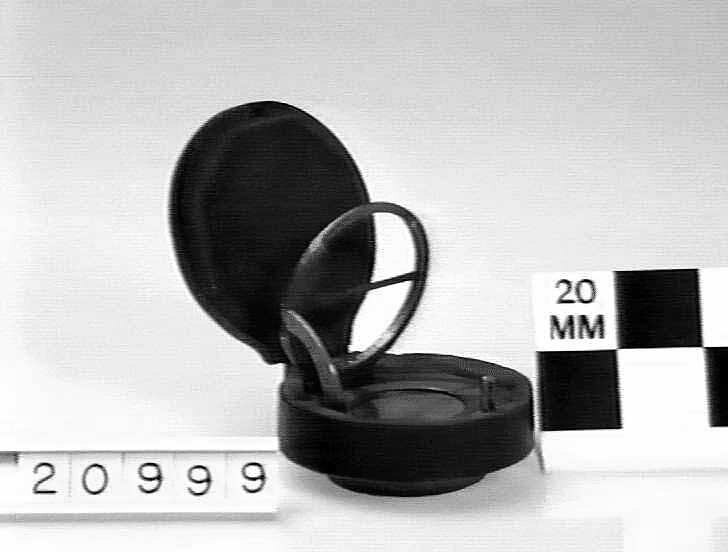
This equatorial sundial, or equinoctial sundial, was produced in Augsburg, Germany, by maker Lorenz Grassl between circa 1750 and 1800. The device features a brass dial assembly housed within a round wooden case, which includes a hinged lid and a brass clasp mechanism. The dial itself consists of an octagonal brass base incised with floral motifs and geometric patterning, and incorporates an integral compass. The central timekeeping mechanism includes a hinged brass circle calibrated in degrees and a needle gnomon, which is intended to be positioned parallel to the Earth's axis. The instrument is further marked with geographical latitude elevations for specific European locations, including Naples, Rome, Ingolstadt, and Strasburg, identifying it as an object designed for use across multiple regional jurisdictions. It was acquired by the museum via a transfer from the National Gallery of Victoria in 1939.

Equatorial sundial in its wooden case with the dial assembly partially raised.
Equatorial sundial in its wooden case with the dial assembly partially raised. — Museums Victoria. Rights pending — permission not yet requested. Original source

Catalogue identity

Source
collections.museumsvictoria.com.au
Category
Tool · Equatorial sundial
Maker / attribution
Lorenz Grassl
Reference
Not recorded
Catalogue / lot identifier
ST 20999
Source-reported date
circa 1750-1800
Source-reported place
Germany

Source-reported attribution and specifications are not independent authentication. A listing does not establish present ownership, current display, availability or permission to reproduce.

Object description

Construction and Design

The sundial is constructed with an octagonal brass base that functions as the foundation for the timekeeping components. This base is embellished with four floral designs and a series of incised lines and dots. A compass is affixed directly below the base, allowing for proper orientation during use. The entire assembly fits within a round wooden case, equipped with a brass clasp and hinge to protect the dial when not in use.

The gnomon consists of a needle set perpendicular to the diameter of the brass circle. The circle is hinged to the base and passes through a curved scale calibrated in degrees from 10 to 80, marked in Arabic numerals, which facilitates the adjustment of the dial to the user's specific latitude. Roman numerals are used to indicate the hours for the Northern Hemisphere.

Evidence for this section
  • “Brass octagonal base incised with 4 flower designs and mesh of lines and dots.”
  • “Compass affixed below base.”
  • “Gnomon is needle perpendicular to diameter of brass circle.”
  • “Inscribed with hours in roman numerals for northern hemisphere, circle hinged to base and passes curved scale calibrated in degrees 10 20 to 80 from vertical to horizontal in arabic numerals.”

Inscriptions and Functionality

The device is intended to function as an equatorial or equinoctial sundial. Its primary design allows the gnomon to be set parallel to the Earth's axis, while the ring is positioned parallel to the plane of the equator.

The rear of the instrument is inscribed with specific geographical details to assist the user. The text indicates that the dial was intended for use in several locations, listing 'Neapolis' (Naples), 'Rom' (Rome), 'Strasburg', and 'Ingolstadt' along with a numerical indicator of 48. The maker's name, 'L. Grassl', is also engraved on the reverse.

Evidence for this section
  • “The gnomon is set parallel to the axis of the earth and the ring parallel to the plane of the equator.”
  • “Back inscribed 'Eleva Pol, Neapolis Rom Strasburg 48 Ingolstadt 48 L.Grassl'”

Provenance and Documentation

The object was previously held by the National Gallery of Victoria. It was transferred to the current collection in February 1939. It is catalogued under the registration number ST 20999.

The documentation provided by the collection notes the measurement of the object in its closed box configuration as 6.3 cm in length, 5.8 cm in width, and 3 cm in height. The overall diameter of the object is recorded as 6 cm.

Evidence for this section
  • “Transfer from National Gallery of Victoria (NGV), Feb 1939”
  • “Registration number: ST 20999”
  • “dimensions: 6.3 cm (Length), 5.8 cm (Width), 3 cm (Height), comments: Measurement From Conservation.”

Open research questions

  • What is the significance of the specific value '48' listed next to Ingolstadt and Strasburg?
  • Are there similar extant dials by Lorenz Grassl that show consistent design variations in the floral engraving?

Source evidence

Recorded claims and source quotations for Equatorial Sundial by Lorenz Grassl
FieldSource-reported valueSource quotation
MakerLorenz Grassl“Lorenz Grassl”
Place of manufactureAugsburg, Germany“Augsburg, Germany”
Registration NumberST 20999“ST 20999”
MaterialBrass and wood“Brass dial in wooden case”
Latitude referencesNaples, Rome, Ingolstadt, Strasburg“elevations for Naples, Rome, Ingolstadt, Strasburg”
AcquisitionTransfer from National Gallery of Victoria in 1939“Transfer from National Gallery of Victoria (NGV), Feb 1939”
Case dimensions6 cm diameter“6 cm (Outside Diameter)”

Visible details

  • The wooden case appears circular with a side-mounted metal clasp.
  • The dial assembly is hinged to fold flat within the case.
  • The base plate of the dial features distinct engraved floral decorations.
  • A small compass is visible embedded in the central portion of the dial base.

Research qualifications

  • The exact year of manufacture is not specified beyond the broad range of 1750-1800.
  • The full list of latitude settings on the base plate is not entirely visible in the available imagery.

Photograph identity and source facts were screened before import; rights clearance remains pending.

Consulted source

Sundial - Equatorial, Lorenz Grassl, Augsburg, Germany, circa 1750-1800

Reviewed 2026-10-26 · Record 00aacc040b

Terms in this record

Glossary explanations for terms named in this object’s record.

Other equatorial sundial records