
Skip to content
The Encyclopedia of Horology

Clock · Cabinet clock

Augsburg Cabinet Clock

Partially verified

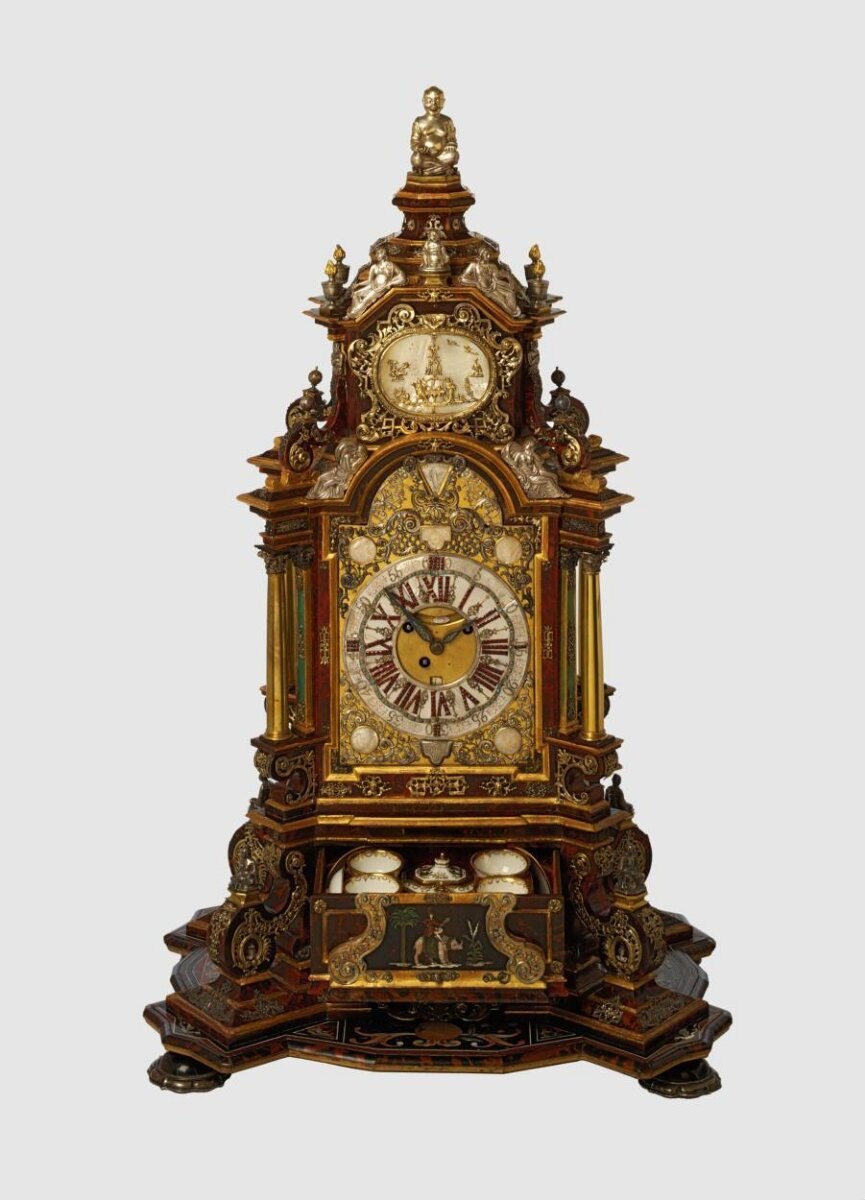
The Augsburg cabinet clock is an architectural timepiece constructed of wood, tortoiseshell, silver-gilt, and mother-of-pearl. Its structure is composed of a three-section body comprising a base, a central section, and an upper storey topped by a lantern. The exterior features silver-gilt Corinthian columns at the corners and chinoiserie-inlaid panels. The dial is formed of mother-of-pearl, embellished with cut garnets and turquoise, with micromosaic hands. The clock mechanism is a quarter-striking movement with calendar capabilities. The base contains velvet-lined drawers housing a Meissen tea service and a silver-gilt inkwell and pounce pot. Silver statuettes of Buddha are positioned on the volutes at the base, the upper storey, and the lantern pediment. Classical mythological figures decorate the side panels of the cabinet. Gemstones, additional mounts, and veneers were integrated during the 19th century.

Front view of the Augsburg cabinet clock, showing the dial, drawers, and decorative statuary.
Front view of the Augsburg cabinet clock, showing the dial, drawers, and decorative statuary. — Victoria and Albert Museum, London. Rights pending — permission not yet requested. Original source

Catalogue identity

Source
collections.vam.ac.uk
Category
Clock · Cabinet clock
Maker / attribution
Not established
Reference
Not recorded
Catalogue / lot identifier
LOAN:GILBERT.3:1-2008
Source-reported date
1700-1725
Source-reported place
Augsburg

Source-reported attribution and specifications are not independent authentication. A listing does not establish present ownership, current display, availability or permission to reproduce.

Object description

Construction and Design

The cabinet clock follows an architectural design divided into three primary sections: a base, a central body, and a crowning upper storey lantern. The construction employs a variety of materials, including wood, tortoiseshell, and silver-gilt. The cabinet's corners are articulated with Corinthian columns and silver-gilt accents.

The exterior ornamentation features chinoiserie motifs implemented through inlay work using mother-of-pearl, ivory, enamel, and brass. Additional decorative elements include silver statuettes of Buddha and figures derived from classical mythology appearing on the cabinet sides.

Evidence for this section
  • “A cabinet clock of architectural form in three sections: a base with shaped borders and volutes at the corners; a central body; and a top storey with a lantern.”
  • “The cabinet is faced in tortoiseshell, with borders and Corinthian columns at each corner of silver-gilt.”

Mechanism and Appointments

The clock features a mother-of-pearl dial, which incorporates cut garnets and turquoise. The timekeeping is indicated by micromosaic hands. The internal clockwork includes both a calendar movement and a quarter-striking mechanism.

Integrated into the base are drawers lined with red velvet. One drawer contains a nine-piece Meissen tea service, while another contains a removable silver-gilt inkwell and pounce pot, alongside two rectangular compartments intended for pens and keys.

Evidence for this section
  • “The mother of pearl dial applied with cut garnets and turquoise, the arms are made of micromosaic.”
  • “The clock mechanism has a calendar movement and is quarter striking.”

Provenance and History

The clock was historically associated with the collection of the Fifth Earl of Rosebery and was housed at Mentmore Towers until its sale in 1977. It subsequently entered the collection of Ronald A. Lee before joining the Gilbert Collection.

Research regarding the original ownership has linked the piece to the countly family Schönborn, citing the occurrence of rhinoceros motifs in combination with the family's coat-of-arms on comparable decorative objects from the same period.

Evidence for this section
  • “Provenance: Fifth Earl of Rosebery, Mentmore Towers Sale, Sotheby's, lot 1053, 20/05/1977”
  • “Anna Maria Massinelli sees a link with the politically influential countly family Schönborn”

Open research questions

  • What specific calendar functions does the movement provide?
  • What is the date and origin of the 19th-century additions noted in the documentation?

Source evidence

Recorded claims and source quotations for Augsburg Cabinet Clock
FieldSource-reported valueSource quotation
Object TypeCabinet clock“Cabinet clock”
Date1700-1725 and later“Augsburg; 1700-1725 and later”
Accession NumberLOAN:GILBERT.3:1-2008“LOAN:GILBERT.3:1-2008”
Tea ServiceMeissen“a Meissen tea service consisting of nine pieces”

Visible details

  • Silver statuette of Buddha on top of lantern pediment
  • Mother-of-pearl dial with cut garnets and turquoise
  • Chinoiserie panel on the front base drawer depicting a figure on a rhinoceros
  • Red velvet-lined drawer containing a porcelain tea service

Research qualifications

  • The exact attribution of the gilding to a member of the Seuter family remains a suggestion
  • The association with the countly family Schönborn is a theory based on rhinoceros motifs

Photograph identity and source facts were screened before import; rights clearance remains pending.

Consulted source

Cabinet clock — Augsburg Clock, Augsburg, 1700-1725

Reviewed 2026-11-02 · Record 16fb5e7210

Terms in this record

Glossary explanations for terms named in this object’s record.