
Skip to content
The Encyclopedia of Horology

Tool · French astronomical compendium

Astronomical Compendium by Sebastian Thibault Dreux

Partially verified

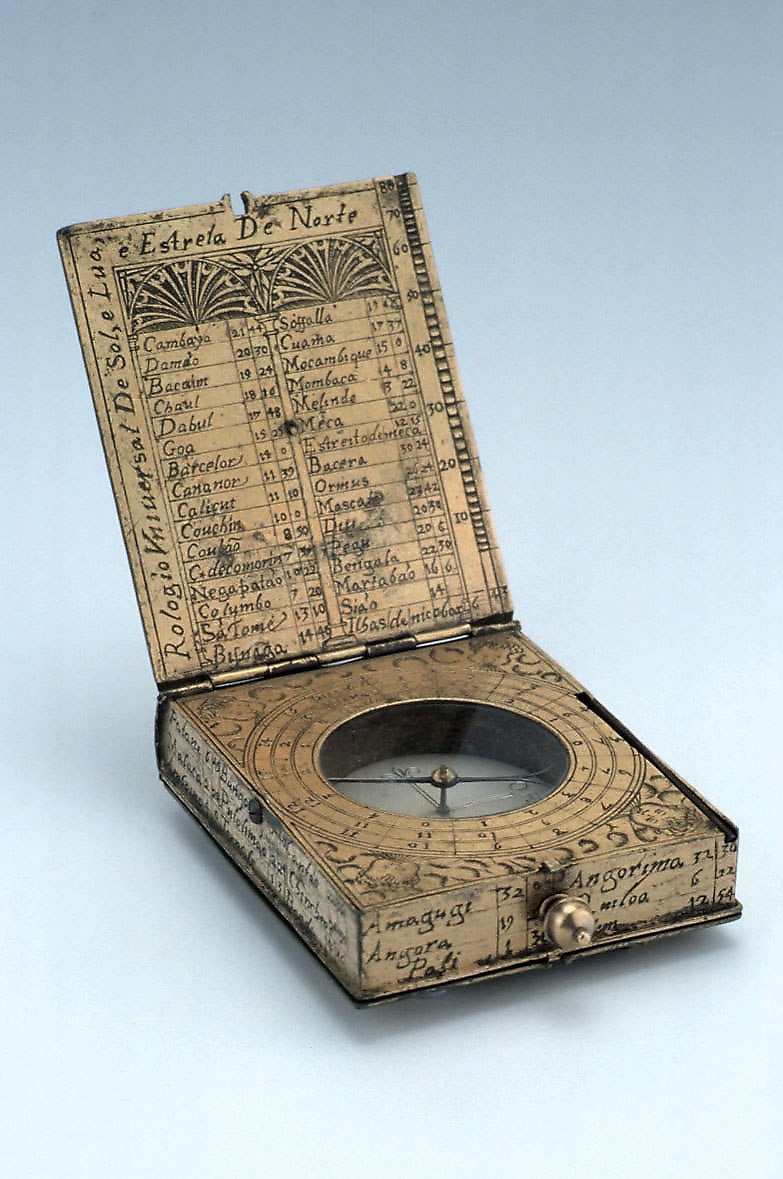
This brass astronomical compendium, dated 1588, is constructed in a book-form measuring 73 x 59 x 11 mm when closed. Signed by the French maker Sebastian Thibault Dreux, it incorporates a universal equinoctial sundial, a compass, a quadrant, and a nocturnal. The exterior features a swivelling suspension ring attached to the spine. While the maker's signature is in Latin, the instrument's text is predominantly in Portuguese. The compendium functions as a comprehensive navigation and time-measuring tool, including latitude tables primarily focused on Portuguese territories in Africa and Asia. The object is held by the Museum of the History of Science, Oxford.

The open compendium displaying the latitude tables on the inside lid and the compass bowl on the base.
The open compendium displaying the latitude tables on the inside lid and the compass bowl on the base. — Museum of the History of Science, Oxford. Rights pending — permission not yet requested. Original source

Catalogue identity

Source
www.mhs.ox.ac.uk
Category
Tool · French astronomical compendium
Maker / attribution
Sebastian Thibault Dreux
Reference
Not recorded
Catalogue / lot identifier
51027
Source-reported date
1588
Source-reported place
France

Source-reported attribution and specifications are not independent authentication. A listing does not establish present ownership, current display, availability or permission to reproduce.

Object description

Instrument Components

The compendium is structured as a folding book containing multiple time-keeping and navigational elements. The upper portion houses a universal solar and lunar equinoctial dial equipped with an alidade and lunar volvelle. A folding support, stored within the compass section, facilitates the setting of the dial.

The base section contains a compass bowl with a silvered plate marking the cardinal points. The interior covers provide additional utility, including a quadrant with a shadow square and a nocturnal with a folding index for star observation. The exterior covers are decorated with fruit and foliage engraving and include latitude data for various locations.

Evidence for this section
  • “incorporates a universal equinoctial sundial , compass , quadrant and nocturnal”
  • “The plate of the compass bowl is silvered”
  • “The inside back cover carries a quadrant with an arc of degrees 0 to 90”

Inscriptions and Tables

The instrument displays extensive geographical and temporal information primarily in Portuguese. Latitude tables for 32 locations are inscribed on the reverse, with an additional 25 locations listed along the edges. These represent regions outside of Europe, specifically Portuguese territories in Africa and Asia.

The quadrant plate includes a circular table of dominical letters and golden numbers, both marked to begin in 1588. The lunar table, titled 'Taboa da Lua', features columns corresponding to the 19-year lunar cycle and the months of the year. The signature 'Ego Sebastianus Thibault Dreux Fesit [sic]' is located within the quadrant plate.

Evidence for this section
  • “Aside from the signature all of the text is in Portuguese”
  • “The reverse carries a table of the latitudes of 32 places”
  • “In the unused corner of the quadrant plate is the signature 'Ego Sebastianus Thibault Dreux Fesit [sic]'”

Provenance and Condition

The object is held in the collection of the Museum of the History of Science, Oxford. The provenance is linked to the historical Portuguese maritime trade, as indicated by the specific focus of the latitude tables.

The auction/museum description notes that the sights on the alidade are modern replacements, indicating some historical intervention. The general state of the brass casing and engraving is consistent with its 16th-century origin, featuring decorative elements such as wind-blowing cherub heads and botanical motifs.

Evidence for this section
  • “Holding museum: Museum of the History of Science, Oxford”
  • “The sights on the alidade are modern replacements.”

Open research questions

  • What specific star in Scorpio does the nocturnal setting pointer index?
  • Does the '1588' date of the golden number table correspond strictly to the year of manufacture or the start of a cycle for the instrument's intended use?

Source evidence

Recorded claims and source quotations for Astronomical Compendium by Sebastian Thibault Dreux
FieldSource-reported valueSource quotation
MakerSebastian Thibault Dreux“Signed by Sebastian Thibault Dreux”
Date1588“Dated to 1588”
OriginFrance“French”
Dimensions73 x 59 x 11 mm“73 x 59 x 11 mm closed”
Inventory Number51027“Inventory number 51027”

Visible details

  • Engraved latitude tables in Portuguese covering diverse global locations.
  • Integrated silvered compass bowl marked with cardinal directions.
  • Book-form housing with a swivelling suspension ring on the spine.
  • Decorative engraving featuring wind-blowing cherub heads at compass corners.

Research qualifications

  • Sights on the alidade are identified as modern replacements.
  • The 19-year lunar cycle table is presumed rather than confirmed by explicit marking.
  • The nocturnal is constructed for a specific star in Scorpio, but the exact utility remains historically inferred.

Photograph identity and source facts were screened before import; rights clearance remains pending.

Consulted source

Astronomical Compendium

Reviewed 2026-10-26 · Record 3ef97506f9

Terms in this record

Glossary explanations for terms named in this object’s record.