
Skip to content
The Encyclopedia of Horology

Tool · French astronomical compendium

Astronomical Compendium

Partially verified

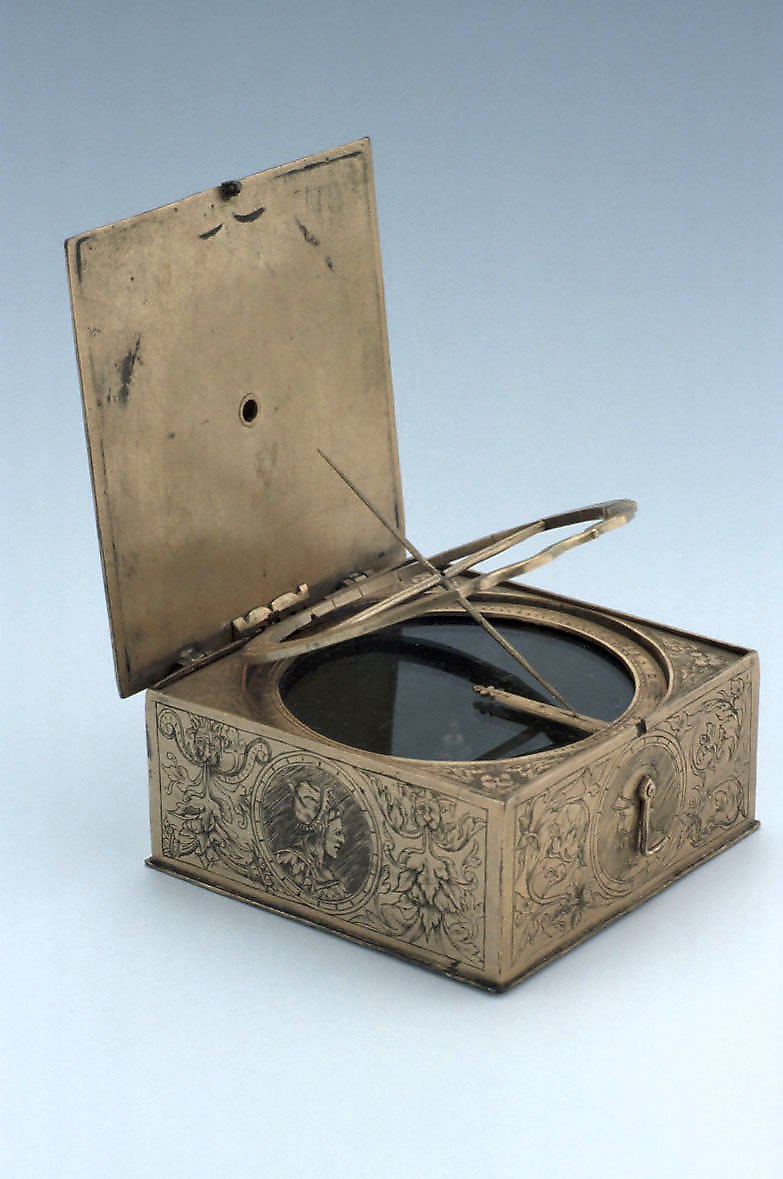
This astronomical compendium, held in the collection of the Museum of the History of Science, Oxford, is an unsigned brass instrument dating from circa 1600 and attributed to French manufacture. The object measures 87 x 87 x 39 mm and features a square box structure with a hinged cover lid. Its functional components comprise a nocturnal, an equinoctial sundial, and a compass. The instrument is distinguished by its deep compass bowl and elaborate exterior decoration, which includes foliate patterns and engraved roundels featuring portrait heads of two women and two helmeted men. The nocturnal is situated on the cover, while the equinoctial dial occupies a recess above the compass. The instrument is secured with a horse's head-shaped clasp. The brass construction and specific mechanical arrangements for the sundial gnomon and volvelle are consistent with the technical requirements for portable timekeeping and astronomical observation during the early seventeenth century.

The compendium open to show the internal compass, equinoctial dial, and the engraved exterior.
The compendium open to show the internal compass, equinoctial dial, and the engraved exterior. — Museum of the History of Science, Oxford. Rights pending — permission not yet requested. Original source

Catalogue identity

Source
www.mhs.ox.ac.uk
Category
Tool · French astronomical compendium
Maker / attribution
Not established
Reference
Not recorded
Catalogue / lot identifier
50593
Source-reported date
circa 1600
Source-reported place
France

Source-reported attribution and specifications are not independent authentication. A listing does not establish present ownership, current display, availability or permission to reproduce.

Object description

Structural Design and Exterior

The compendium is constructed as a square brass box measuring 87 mm by 87 mm with a height of 39 mm. It features a hinged lid, which is secured closed by a clasp shaped in the form of a horse's head and neck. A hinged piece with a trefoil aperture is mounted on the cover, designed to function as a handle or suspension point. The exterior vertical surfaces are decorated with engraved foliate patterns, arranged around four roundels.

Within these roundels are engravings of portrait heads, comprising two women and two helmeted men. These decorative elements occupy the sides of the box, with the cover itself remaining blank on the underside. The overall build includes a deep compass bowl, contributing to the instrument's significant dimensions relative to the specific set of functions provided.

Evidence for this section
  • “The compendium consists of a box for the compass and a hinged cover lid.”
  • “Each side is engraved with foliate decoration on either side of a roundel containing a portrait head; two women and two helmeted men are depicted.”
  • “A clasp in the form of a horse's head and neck is fixed close to the handle”

Astronomical Functions

The instrument functions as a nocturnal and an equinoctial sundial. The nocturnal is situated on the outward face of the cover, utilizing a decorated, hinged index and a toothed volvelle. The volvelle features radiating lines for hours IIII to XII to VIII, subdivided to half-hour increments. A calendar scale is provided, where months are identified by their initial letters and subdivided to five days. The nocturnal is calibrated for a star with a right ascension corresponding to the sun's position on approximately 13 October.

The equinoctial dial is located in a recess above the compass. The gnomon is a cross-piece design, which can be placed into one of three unnumbered indentations on a brass bar, allowing for three distinct latitudes. This mounting prevents the gnomon from being strictly perpendicular to the hour ring. The hour ring itself is circular with a scroll-shaped, ungraduated night-time portion.

Evidence for this section
  • “The hinged cover is retained by a clasp and carries a nocturnal on its outward face.”
  • “The nocturnal is constructed for a star whose right ascension matches that of the sun on about 13 October.”
  • “The dial is intended for 3 latitudes and is set by placing the end of the cross- piece gnomon in one of three unnumbered indentations on a brass bar fixed over the compass glass.”

Compass and Decoration

The large compass is integrated into the base of the instrument. Instead of a conventional degree scale, it features a circular scale divided to 5 and 1, numbered by 5 in a 30-0-30-0-30 pattern. The needle is blued and south-pointing. The four cardinal points are marked with crossed lines, and a star symbol denotes North. An indicator on the base plate marks a magnetic variation of about 18 degrees West.

Beyond the primary astronomical markings, the instrument displays deliberate ornamental choices. The base of the instrument carries a simple circular geometric design. The maker also integrated the portrait heads into the side panels, which are interpreted as generalized depictions rather than specific historical figures.

Evidence for this section
  • “Rather than a degree scale, the large compass is surrounded by a circular scale 30 to 0 to 30 to 0 to 30, divided to 5 and 1, and numbered by 5.”
  • “The blued needle is south pointing and the four cardinal points of the compass are represented by crossed lines with a star at north.”
  • “The base of the instrument carries a simple circular geometric design as decoration.”

Open research questions

  • What specific star was intended for the nocturnal's right ascension calibration beyond the 13 October sun reference?
  • Does the magnetic variation of 18 degrees West reflect a later addition or a measurement taken during the instrument's active use?

Source evidence

Recorded claims and source quotations for Astronomical Compendium
FieldSource-reported valueSource quotation
Dimensions87 x 87 x 39 mm“87 x 87 x 39 mm (box)”
Datecirca 1600“circa 1600”
Attributed OriginFrench“French”
Inventory Number50593“Inventory number 50593”
Compass Variation18 degrees West“An inked or painted indicator on the base plate shows a magnetic variation of about 18? W.”

Visible details

  • Case sides feature foliate motifs surrounding circular portraits of human figures
  • Magnetic compass includes a blued south-pointing needle
  • Equinoctial dial gnomon is adjustable across three latitude positions
  • Nocturnal features a toothed volvelle for star-time calculation

Research qualifications

  • Portrait heads are described as likely generalized rather than specific depictions
  • Magnetic variation measurement of 18 degrees West is of uncertain historical origin

Photograph identity and source facts were screened before import; rights clearance remains pending.

Consulted source

Astronomical Compendium

Reviewed 2026-10-26 · Record 6a6bd4a32d

Terms in this record

Glossary explanations for terms named in this object’s record.