
Skip to content
The Encyclopedia of Horology

Tool · Italian astronomical compendium

Astronomical Compendium

Partially verified

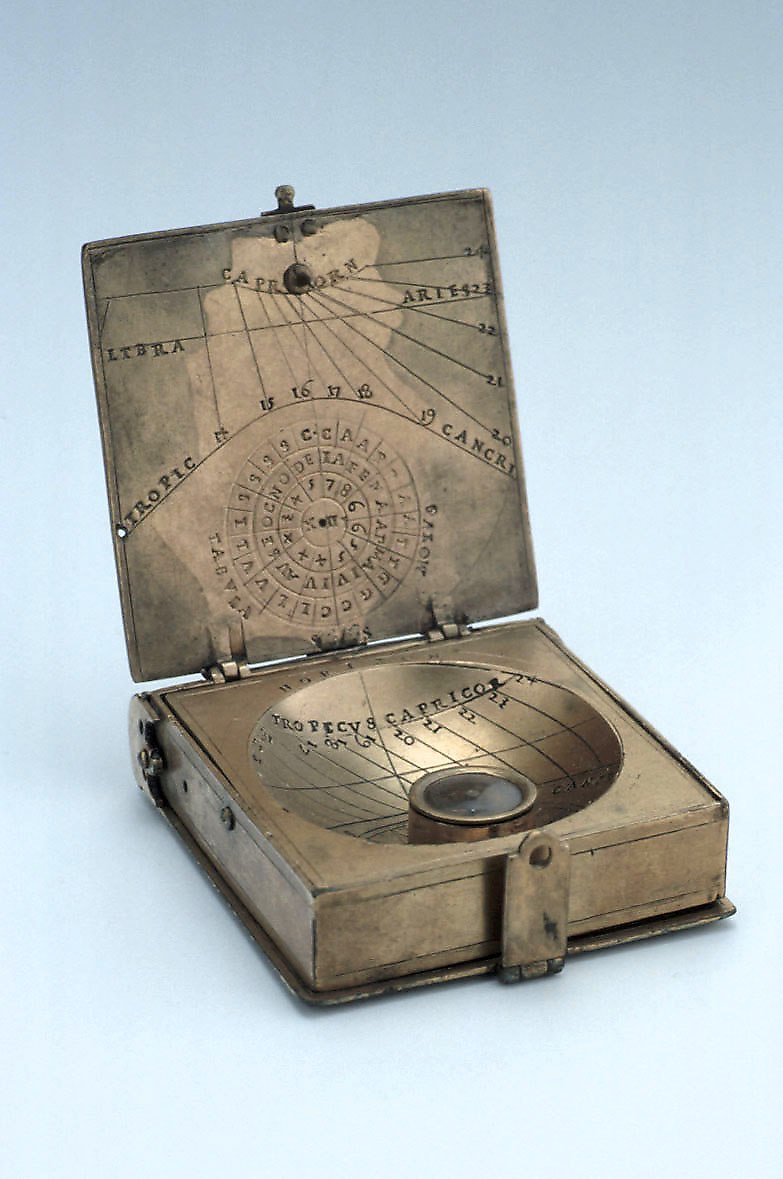
This unsigned astronomical compendium, held by the Museum of the History of Science in Oxford, is an instrument constructed of gilt brass measuring 53 x 50 x 18 mm. Formed to resemble a small book with a curved spine and clasp, its exterior covers feature simple circular engraved decorations. The internal components integrate a vertical pin-gnomon sundial for Italian hours, a circular table tracking solar motion by zodiac signs, a central scaphe sundial for Italian hours between 10 and 24, and an inset compass with a blued needle surrounded by a 16-point wind rose. The interior of the back cover contains a midnight-time table for the entire year.

The astronomical compendium opened to display the internal pin-gnomon sundial and the central scaphe dial.
The astronomical compendium opened to display the internal pin-gnomon sundial and the central scaphe dial. — Museum of the History of Science, Oxford. Rights pending — permission not yet requested. Original source

Catalogue identity

Source
www.mhs.ox.ac.uk
Category
Tool · Italian astronomical compendium
Maker / attribution
Not established
Reference
Not recorded
Catalogue / lot identifier
54522
Source-reported date
circa 1600
Source-reported place
Italy

Source-reported attribution and specifications are not independent authentication. A listing does not establish present ownership, current display, availability or permission to reproduce.

Object description

Construction and Exterior

The astronomical compendium is constructed from gilt brass, measuring 53 mm by 50 mm by 18 mm. Its physical configuration follows a book-like format, complete with a curved spine and an integrated clasp to keep the instrument closed when not in use. The outer covers are finished with simple circular engraved decorative patterns.

The interior contains a series of functional components necessary for determining time and solar information. The central box houses a scaphe-style sundial designed for Italian hours ranging from 10 to 24. This section also incorporates an inset magnetic compass featuring a blued needle, surrounded by a compass rose showing 16 winds marked with the initials of their Italian names.

Evidence for this section
  • “The instrument is in the form of a book, with a curved spine and a clasp.”
  • “Gilt brass; 53 x 50 x 18 mm”
  • “The compendium is in book form, with its covers carrying a simple circular engraved decoration.”

Sundials and Tables

The internal face of the front cover functions as a vertical pin-gnomon sundial calibrated for Italian hours from 14 to 24. This dial also marks the tropics of Cancer and Capricorn, as well as the equator at Libra and Aries. Positioned beneath this dial is a circular table, the 'TABVLA S[OLI]S MOTVS', which records the sun's movement through the zodiac signs across the months of the year.

The inside of the back cover is engraved with a circular table titled 'MEDIA NOX PER TOTVMV ANNVM'. This table provides the time of midnight in Italian hours and minutes for two points throughout each month. This specific data allows for the inference of the instrument's intended geographical use at a latitude of approximately 41 degrees.

Evidence for this section
  • “The reverse of the front cover carries a vertical pin-gnomon sundial for Italian hours, 14 to 24”
  • “The inside of the back cover carries a circular table for 'MEDIA NOX PER TOTVMV [sic] ANNVM'.”

Attribution and Origin

Although the compendium bears no maker's signature, its construction features indicate an Italian origin. The use of the Italian hour system and the employment of Italian names for the compass winds support this attribution.

Furthermore, the internal tables contain data points consistent with a latitude of approximately 41 degrees. This specific latitude aligns with the geographical location of Naples, reinforcing the connection between the instrument and Italy.

Evidence for this section
  • “Although carrying no sign of maker or origin, the compendium 's use of Italian hours and the Italian names of the winds suggest the attribution to Italy.”
  • “From the information in this table it is possible to infer that the instrument was constructed for a latitude of approximately 41?.”

Open research questions

  • What specific workshop traditions in circa 1600 Italy produced book-form compendia?
  • Could the 'TABVLA S[OLI]S MOTVS' center-stamp 'XIII' relate to a specific calculation or maker's code?

Source evidence

Recorded claims and source quotations for Astronomical Compendium
FieldSource-reported valueSource quotation
Inventory number54522“Inventory number: 54522”
MaterialsGilt brass“Gilt brass”
Dimensions53 x 50 x 18 mm“53 x 50 x 18 mm”
Attributed datecirca 1600“circa 1600”
Attributed originItaly“suggest the attribution to Italy”
Compass details16 winds with Italian initial letters“pointing out 16 winds and identifying the eight principal directions with the initial letters of their Italian names”
LatitudeApproximately 41 degrees“latitude of approximately 41?”

Visible details

  • Compendium fashioned as a book with a clasp.
  • Internal blued steel compass needle.
  • Engraved gilt brass surfaces throughout.
  • Scaphe dial located within the central box.

Research qualifications

  • Maker and exact place of origin remain unidentified.
  • Latitude attribution based on inferred table calculations rather than maker's markings.

Photograph identity and source facts were screened before import; rights clearance remains pending.

Consulted source

Astronomical Compendium

Reviewed 2026-10-26 · Record 87cab48e0a

Terms in this record

Glossary explanations for terms named in this object’s record.

Other italian astronomical compendium records