
Skip to content
The Encyclopedia of Horology

Tool · Italian astronomical compendium

Astronomical Compendium

Partially verified

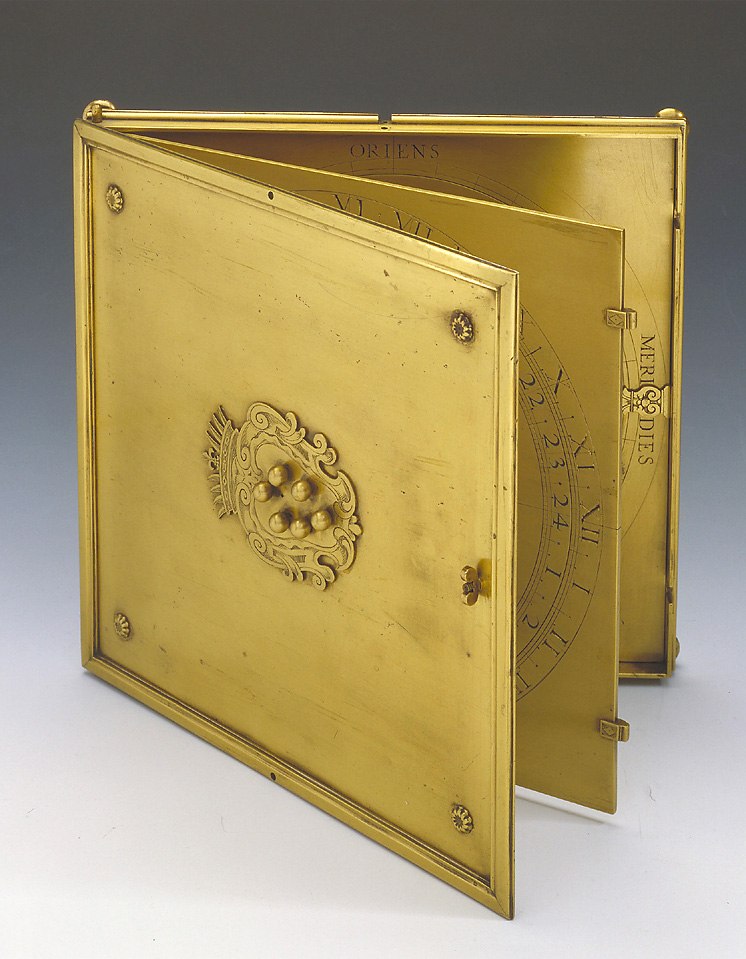
This brass astronomical compendium, measuring 233 mm along the side, is attributed to 16th-century Florentine makers. The device comprises three hinged brass leaves featuring integrated sundials. The lid displays the relief-engraved Medicean coat of arms and houses a central aperture for sunlight passage. Internal engravings on the lid provide tables for semi-diurnal arcs corresponding to the latitudes of Florence and Pisa. The central plate supports a dual 24-hour scale system, allowing for the conversion between standard and Italian hours. The base contains an unfinished wind-rose, though the central compass and components of the wind-rose are missing. The back of the base is equipped with four feet and a threaded cylinder for mounting onto a tripod. While unsigned, the instrument is identified as Florentine based on the Medicean coat of arms and the specific engraving style. Some internal components, including certain wing nuts, are noted as missing or replaced.

The astronomical compendium with the lid open, revealing the central plate and engraving details.
The astronomical compendium with the lid open, revealing the central plate and engraving details. — Istituto e Museo di Storia della Scienza, Firenze. Rights pending — permission not yet requested. Original source

Catalogue identity

Source
www.mhs.ox.ac.uk
Category
Tool · Italian astronomical compendium
Maker / attribution
Not established
Reference
Not recorded
Catalogue / lot identifier
2497
Source-reported date
16th century
Source-reported place
Italy

Source-reported attribution and specifications are not independent authentication. A listing does not establish present ownership, current display, availability or permission to reproduce.

Object description

Construction and Design

The astronomical compendium is constructed from brass and measures 233 mm along its side. It is designed with three hinged leaves. The exterior lid features a double-stepped frame, four decorative corner bosses, and an applied plaque bearing the Medici arms, which includes six spheres in relief. The inner face of this lid is engraved with tables documenting the length of a half-day throughout the year for Pisa and Florence, including zodiacal indicators.

The central plate features a circular twenty-four hour scale, with an additional nested 24-hour scale that rotates to facilitate the conversion of standard equal hours to Italian hours. A string gnomon is attached between cursors on the lid and the base plate, passing through the central plate to function as a vertical string-gnomon dial.

Evidence for this section
  • “Hinged to one edge of a rectangular box with double bun feet is a plain lid with a double stepped frame surrounding four decorative bosses in the corners and at the centre the Medici arms engraved on an applied plaque with their six spheres in relief.”
  • “The inner face of the lid is engraved with two tables giving the length of a half day throughout the year for the latitudes of Pisa (43? 25') and Florence (43? 45').”
  • “Attached by the same hinge as the lid, the centre plate of the instrument is engraved with a circular twenty four hour scale (0 to XII ? 2) reading to 5'.”

Base and Mounting

The base of the device contains an unfinished wind-rose; while 32 points are indicated, only the Latin names for the four cardinal points are engraved. A central recessed space previously housing a compass is now filled with a plain metal disc incised with the letters 'F L' and 'd'.

The base is supported by four bun-style feet at the corners. For fieldwork or observation, the reverse side of the plate features a heavy nut and screw; the interior of this cylinder is threaded to allow the instrument to be mounted securely onto a tripod or staff head.

Evidence for this section
  • “The base of the box is engraved with an unfinished wind-rose, only the Latin names of the four cardinal points having been engraved, although 32 points are indicated.”
  • “The centre of the wind-rose and the compass are both missing, the recessed space and central hole for them being now filled by a disc of metal, plain except for three radial lined and the letters 'F L' and 'd' lightly incised on it.”
  • “The plate is fixed in position by a heavy nut and screw, the interior of the screw cylinder also being threaded for attachment to a staff head.”

Provenance and Attribution

The instrument is held at the Istituto e Museo di Storia della Scienza in Florence under inventory number 2497. It is unsigned, though it is attributed to 16th-century Florentine makers. This attribution is based on the presence of the Medicean coat of arms and the specific style of the engraving and pointing found on the brass leaves.

The object shows evidence of past modification and loss of components. A wing nut associated with the cursor strip is missing and has been replaced with a modern component. Additionally, the compass and central portions of the wind-rose are missing, with only a makeshift metal disc remaining in the center.

Evidence for this section
  • “Although it is unsigned, the Medicean coat of arms and the type of pointing are reminiscent of 16th-century Florentine instrument makers.”
  • “The wing nut for the cursor strip mounted at the lower centre of the plate is missing and has been replaced by a recent nut.”
  • “The centre of the wind-rose and the compass are both missing, the recessed space and central hole for them being now filled by a disc of metal”

Open research questions

  • What is the significance of the incised letters 'F L' and 'd' found on the replacement disc in the center of the base?
  • Can the specific identity of the instrument maker be linked to known workshops in 16th-century Florence through comparative analysis of the relief-engraved Medici arms?

Source evidence

Recorded claims and source quotations for Astronomical Compendium
FieldSource-reported valueSource quotation
Inventory number2497“Inventory number: 2497”
MaterialBrass“Brass; 233 mm along side”
Date16th century“16th century; Florence”
Place of originFlorence, Italy“16th century; Florence”
Dimensions233 mm side“233 mm along side”
Latitudes providedFlorence (43° 45') and Pisa (43° 28')“latitudes of Florence (43? 45') and Pisa (43? 28')”
Design featuresMedicean coat of arms“On the lid of the device is the Medicean coat of arms, in relief”

Visible details

  • Medicean coat of arms on the exterior lid
  • Dual 24-hour scale system for time conversion
  • Unfinished 32-point wind-rose on the base plate
  • Threaded screw cylinder on the base for tripod mounting

Research qualifications

  • Unsigned, though attributed to 16th-century Florence
  • Exact identity of the maker remains unverified

Photograph identity and source facts were screened before import; rights clearance remains pending.

Consulted source

Astronomical Compendium

Reviewed 2026-10-26 · Record 736cf9dd1b

Terms in this record

Glossary explanations for terms named in this object’s record.

Other italian astronomical compendium records