
Skip to content
The Encyclopedia of Horology

Clock · Pedestal astronomical clock

Astronomical Clock by Samuel Watson

Partially verified

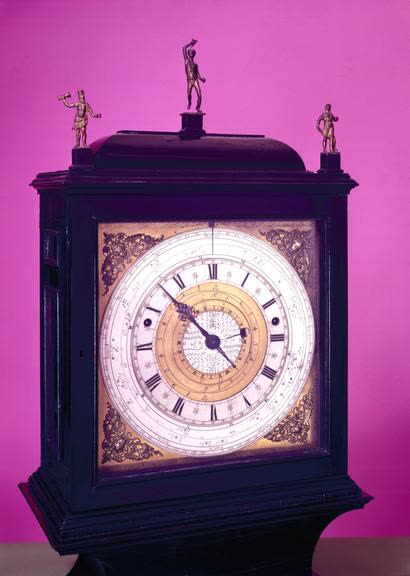
According to the Science Museum Group, this spring-driven pendulum astronomical clock was signed and made by Samuel Watson in London around 1695, within a broader dating of 1690–1710. Housed in an ebonised case surmounted by classical metal figurines, it is reported by the museum as the earliest English astronomical clock in which the Sun is positioned according to the Copernican principle. Its dial provides the time of day, calendar date, position of the Sun in the Zodiac, lunar phase and latitude for eclipse calculations, times of sunrise, moonrise, and moonset, and high tide at London Bridge.

Astronomical pedestal clock by Samuel Watson in an ebonised case
Astronomical pedestal clock by Samuel Watson in an ebonised case — Science Museum Group Collection. Rights pending — permission not yet requested. Original source

Catalogue identity

Source
collection.sciencemuseumgroup.org.uk
Category
Clock · Pedestal astronomical clock
Maker / attribution
Samuel Watson
Reference
Not recorded
Catalogue / lot identifier
Source URL identifies the listing
Source-reported date
1690-1710
Country
United Kingdom

Source-reported attribution and specifications are not independent authentication. A listing does not establish present ownership, current display, availability or permission to reproduce.

Object description

Maker and Historical Attribution

According to the Science Museum Group, this astronomical clock is signed by Samuel Watson, London, and was made about 1695, within a broader catalogued dating of 1690–1710. Museum records note that Watson was born in Coventry about 1635 and worked there until moving to London around 1690, before dying about 1710.

The museum records state that this is the earliest English astronomical clock in which the sun is fixed on the Copernican principle. A separate gallery label noted in the source documentation adds that Watson constructed a much more elaborate astronomical clock between 1683 and 1690 to the order of King Charles II, which is now in the Royal Library at Windsor Castle.

Evidence for this section
  • “This astronomical clock, signed by Samuel Watson, London, and made about 1695, is the earliest English astronomical clock in which the sun is fixed on the Copernican principle.”
  • “Samuel Watson was born in Coventry about 1635 and worked there until about 1690, when he moved to London. He died about 1710.”
  • “A much more elaborate astronomical clock was made by Watson over the period 1683 to 1690, to the order of King Charles II; this clock is now in the Royal Library at Windsor Castle.”

Case Construction and Exterior Presentation

The clock is housed in an ebonised case resting on a pedestal base, featuring a glazed door and crowned by three standing figurative finials. Recorded materials for the main assembly (part 1970-25 Pt1) comprise unidentified wood, brass, bronze, glass, and steel.

Overall measurements in the main summary are recorded as 970 mm by 540 mm by 340 mm with a weight of 31 kg, whereas the entry for part 1970-25 Pt1 lists dimensions as 1000 mm by 570 mm by 340 mm at 31 kg. The object is accompanied by one cranked winding key and two door keys.

Evidence for this section
  • “Pedestal astronomical clock by Samuel Watson, London, England, in ebonised case, with one cranked winding key and two door keys, 1690-1710.”
  • “Black ebonised case with glazed door, resting on a pedestal base and crowned by three standing figurative finials.”
  • “Materials: brass (copper, zinc alloy) , bronze (copper, tin alloy) , wood (unidentified) , glass and steel (metal)”
  • “Measurements: Overall: 970 mm x 540 mm x 340 mm, 31 kg”
  • “Measurements: Overall: 1000 mm x 570 mm x 340 mm, 31 kg”

Dial Indications and Observations

Visual examination reveals a square brass dial plate fitted with openwork corner spandrels depicting cherubic and scrollwork motifs, alongside concentric calibrated rings displaying Roman numerals, zodiacal indications, and calendar graduations. Central blued steel hands include an ornate hour hand and an arm with a viewing circular aperture positioned over an inner disk.

Institutional text reports that the dial indicates the time of day, calendar date, position of the Sun in the Zodiac, lunar phase and latitude (noted as important for eclipse predictions), sunrise, moonrise, and moonset, and allows high tide at London Bridge to be read off.

Evidence for this section
  • “Square brass dial plate with elaborate openwork corner spandrels displaying cherubic and scrollwork motifs.”
  • “Multiple concentric calibrated rings showing Roman numerals, zodiacal indications, and calendar graduations.”
  • “Central blued steel hands including an ornate hour hand and an arm with a viewing circular aperture over the inner disk.”
  • “In addition to the time of day, its dial indicates the date, the position of the Sun in the Zodiac, the phase of the Moon and its latitude (important for eclipse predicitons), and the times of sunrise and of moonrise and moonset; and the time of high tide at London Bridge.”

Open research questions

  • What specific horological functions did the detached components in part 1970-25 Pt2 serve in the astronomical train?
  • What explains the variation in case height and width between the overall record (970 x 540 mm) and part 1970-25 Pt1 (1000 x 570 mm)?
  • What particular species of wood underlies the ebonised finish on the pedestal case?

Source evidence

Recorded claims and source quotations for Astronomical Clock by Samuel Watson
FieldSource-reported valueSource quotation
MakerSamuel Watson“Astronomical clock, made by Samuel Watson, London, about 1695.”
Date Range1690-1710“Made: 1690-1710 in London”
Object Number1970-25“Object Number: 1970-25”
Clock TypeSpring driven pendulum clock“type: spring driven pendulum clock”
Measurements970 mm x 540 mm x 340 mm, 31 kg“Measurements: Overall: 970 mm x 540 mm x 340 mm, 31 kg”
Case FinishEbonised case“in ebonised case with one cranked winding key and two door keys.”
Museum Credit LineSotheby and Compan“credit: Sotheby and Compan”
Display LocationScience Museum: Mathematics: The Winton Gallery“On display Science Museum: Mathematics: The Winton Gallery”
Cardboard Box Dimensions and Weight80 mm x 160 mm x 90 mm, 0.48 kg“Measurements: Cardboard box of parts: 80 mm x 160 mm x 90 mm, 0.48 kg”

Visible details

  • Square brass dial plate with elaborate openwork corner spandrels displaying cherubic and scrollwork motifs.
  • Multiple concentric calibrated rings showing Roman numerals, zodiacal indications, and calendar graduations.
  • Central blued steel hands including an ornate hour hand and an arm with a viewing circular aperture over the inner disk.
  • Black ebonised case with glazed door, resting on a pedestal base and crowned by three standing figurative finials.

Research qualifications

  • Internal pendulum movement and mechanical gears are enclosed and not visible in the primary exterior photograph.
  • Seven or eight detached movement pieces and keys catalogued as parts 1970-25 Pt2 and Pt3 are not displayed in this image.

Photograph identity and source facts were screened before import; rights clearance remains pending.

Consulted source

Astronomical clock by Samuel Watson | Science Museum Group Collection

Reviewed 2026-10-21 · Record 3af7373ee8

Terms in this record

Glossary explanations for terms named in this object’s record.