
Skip to content
The Encyclopedia of Horology

Clock · Astronomical clock

Astronomical clock

Partially verified

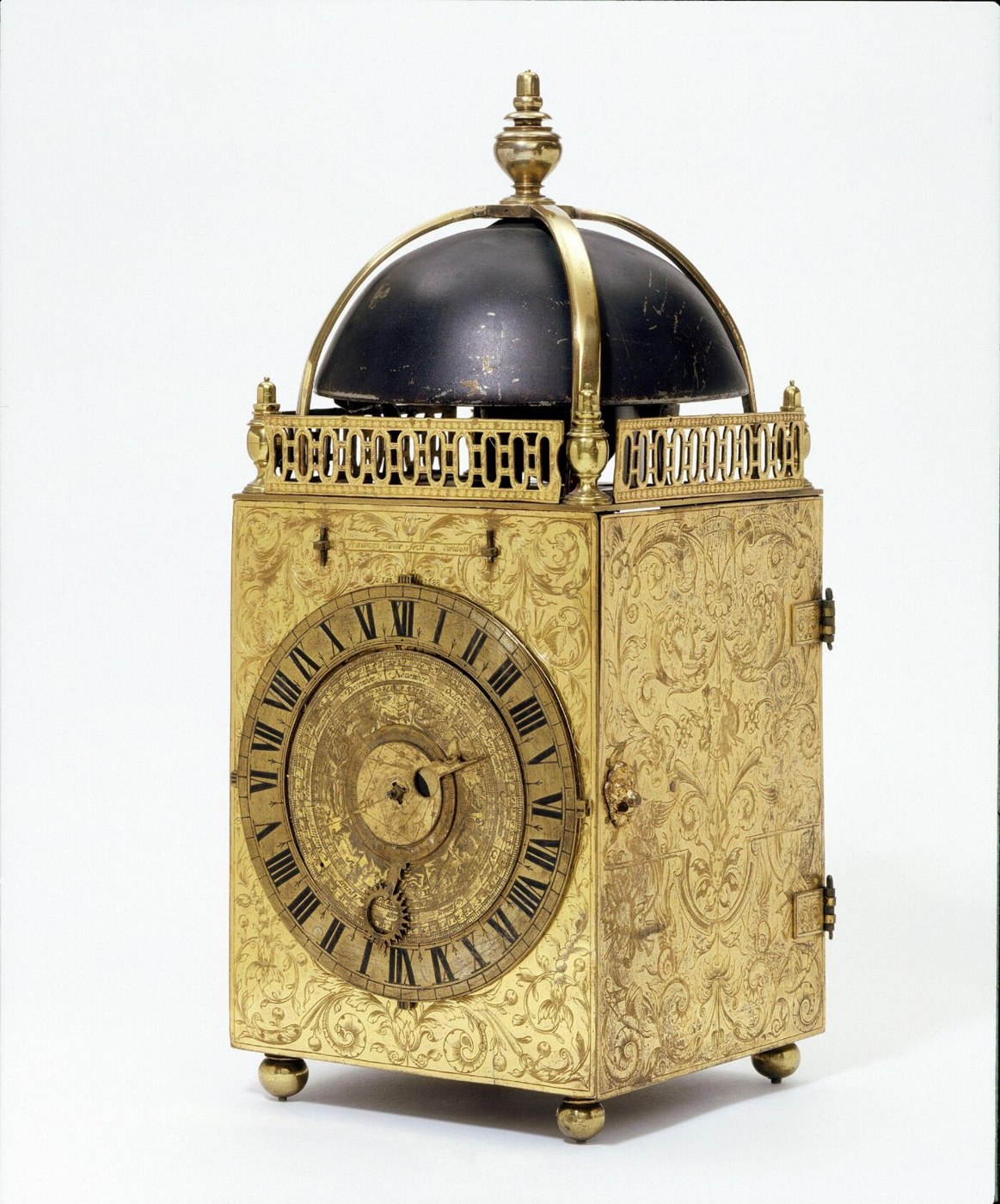
This astronomical clock features a gilt brass case originally made in London in 1588 by Francis Nowe. While the case and frame components are from the 16th century, the present movement is an upgrade dating from the late 17th century. The clock was heavily modified in the 17th century with a replacement movement featuring an anchor escapement, a long pendulum, and astronomical gearing under the dial. The dial assembly, which includes a calendar disc and moon phase indicators, is a later replacement pinned over the original chapter-ring area.

Astronomical clock by Francis Nowe, 1588, with late 17th-century movement and later astronomical dial.
Astronomical clock by Francis Nowe, 1588, with late 17th-century movement and later astronomical dial. — Victoria and Albert Museum, London. Rights pending — permission not yet requested. Original source

Catalogue identity

Source
collections.vam.ac.uk
Category
Clock · Astronomical clock
Maker / attribution
Francis Nowe
Reference
Not recorded
Catalogue / lot identifier
M.39:1 to 6-1959
Source-reported date
1588; late 17th century
Source-reported place
London

Source-reported attribution and specifications are not independent authentication. A listing does not establish present ownership, current display, availability or permission to reproduce.

Object description

Case and Aesthetic Design

The clock is housed in a gilt brass case that retains original elements from 1588. The structure consists of four simple Doric columns, which support the top and bottom plates. The exterior surfaces of the front and side plates are engraved with elaborate decorative motifs, including strapwork, foliage, birds, grotesques, snails, butterflies, and cherub heads. The design of this engraving is associated with the work of Etienne Delaune and Abraham de Bruyn.

The case includes functional ornamental details such as turned urn finials at the corners and a pierced cresting featuring egg and tongue decoration. Access to the interior is managed through hinged side plates secured by spring-loaded latches, which are finished with gilt lion mask release buttons.

Evidence for this section
  • “The brass frame formed of four simple Doric columns joined at top and bottom by square brass plates and mounted on four ball feet. This is original 16th century work.”
  • “Front and side plates gilt and engraved with strapwork and foliage, trophies of arms, birds and grotesques, snails, butterflies and cherub heads.”

Movement and Chronometry

The current movement dates to the late 17th century and represents a comprehensive modernization of the original 1588 mechanism. The going train features an anchor escapement with a 30-tooth escape wheel, designed to operate with a long pendulum suspended by a brass attachment.

In addition to timekeeping, the movement includes a striking train and a rear-mounted quarter-chiming train, which operates on three bells. The assembly is weight-driven, utilizing cylindrical brass-covered weights and iron pulleys. The inclusion of these components indicates a complete transition to late 17th-century technical standards while retaining the original 16th-century case silhouette.

Evidence for this section
  • “The whole present clock movement is of late 17th century date, with frame and wheels all of brass.”
  • “Going train in front, with anchor escapement, 30T escape wheel and pallets embracing 8 teeth. Crutch for long pendulum.”

Astronomical Dial Assembly

The astronomical features are provided by a secondary dial assembly pinned over the original chapter-ring area. This assembly consists of a brass chapter-ring and a central calendar disc displaying months, days, and pictorial zodiac signs. A rotating sun pointer and moon pointer are superposed on the calendar disc, designed to indicate the sun's position, the moon's age, and high-water times at London Bridge.

These astronomical components are later replacements rather than part of the original 1588 clock. The gearing is calibrated for distinct rotational periods, including a lunar pointer that rotates once per lunar day and an additional wheel designed to rotate in approximately 24 hours. The complexity of these displays illustrates the 17th-century intent to update the instrument's functional capabilities.

Evidence for this section
  • “A later set of astronomical dials has been pinned over the original chapter-ring area but is now shown separately.”
  • “The chapter ring and astronomical dial are later replacements.”
  • “The astromonical gearing provides for a minute-hand rotating once per hour, the sun-pointer rotating once in 24 hour, and a lunar pointer rotating once in a lunar day 24 x 59/57 hours.”

Open research questions

  • What specific evidence exists to link the late 17th-century movement to a particular maker or workshop?
  • Are there contemporary records describing the original 1588 movement before its replacement?

Source evidence

Recorded claims and source quotations for Astronomical clock
FieldSource-reported valueSource quotation
MakerFrancis Nowe“Maker: Nowe, Francis (maker)”
Date1588; late 17th century“Date: 1588; late 17th century”
Place of originLondon“Place of origin: London (made)”
DimensionsHeight: 38.2 cm; Width: 15.7 cm; Depth: 15.9 cm“Height: 38.2 cm; Width: 15.7 cm; Depth: 15.9 cm”
InscriptionsFrauncoy Nowe fecit a London Ao Dino 1588“Inscribed 'Frauncoy Nowe fecit a London Ao Dino 1588'”
ProvenanceChristie's auction 1959, lot 80“was sold at auction by Christie's London 12 March 1959 lot 80.”
17th century movementAnchor escapement“Going train in front, with anchor escapement, 30T escape wheel and pallets embracing 8 teeth.”

Visible details

  • Engraved gilt brass case featuring strapwork, grotesques, and trophies of arms
  • Lion mask buttons on the side door latches
  • Later astronomical dial assembly showing zodiac signs and lunar phase indicators
  • Case mounted on four ball feet with original turned urn finials

Research qualifications

  • The exact extent of the 17th-century modification to the astronomical gearing is complex to verify
  • The bells are later replacements and may not match the original acoustic configuration

Photograph identity and source facts were screened before import; rights clearance remains pending.

Consulted source

Astronomical clock

Reviewed 2026-10-26 · Record 8d57242f29

Terms in this record

Glossary explanations for terms named in this object’s record.