
Skip to content
The Encyclopedia of Horology

Tool · Compass sundial

Astrolabium

Partially verified

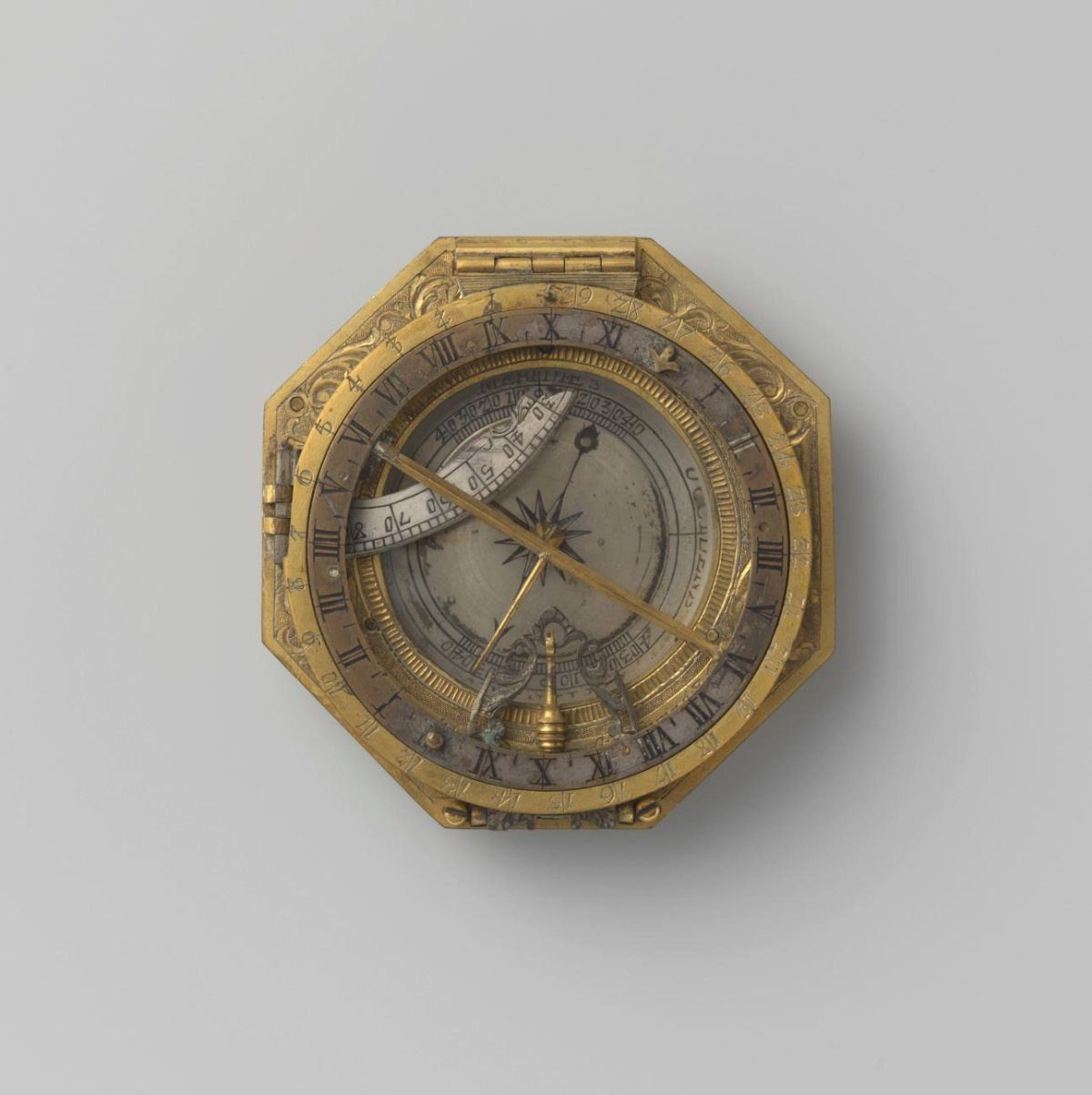
This eight-sided compass sundial is a portable horological instrument from the early eighteenth century, dated between 1700 and 1750. Held by the Rijksmuseum in Amsterdam under accession number BK-1969-179, the device is constructed from brass and iron. The top surface incorporates a circular glass cover positioned centrally, protecting the internal components, which include a magnetic compass and sundial elements. Measuring 7.5 cm in height and 7.2 cm in diameter, the object represents a specific class of portable time-measuring tools common during its period of origin.

The eight-sided compass sundial (BK-1969-179) showing the top dial face and central compass needle.
The eight-sided compass sundial (BK-1969-179) showing the top dial face and central compass needle. — Rijksmuseum, Amsterdam. Rights pending — permission not yet requested. Original source

Catalogue identity

Source
orbiscollectibles.com
Category
Tool · Compass sundial
Maker / attribution
Not established
Reference
Not recorded
Catalogue / lot identifier
BK-1969-179
Source-reported date
1700–1750
Source-reported place
Not established

Source-reported attribution and specifications are not independent authentication. A listing does not establish present ownership, current display, availability or permission to reproduce.

Object description

Construction and Design

The sundial is constructed with an eight-sided brass frame, providing a distinct geometric form compared to traditional circular or rectangular horological instruments. The device stands upon three small feet, allowing for a level orientation on a surface.

The central portion of the dial is protected by a circular glass cover, which serves to shield the delicate internal compass needle and sundial components from environmental damage. This assembly is designed to remain compact for portability while housing the necessary mechanisms for solar timekeeping and direction finding.

Evidence for this section
  • “Eight-sided compass sundial”
  • “Compass sundial of brass and iron, eight-sided on 3 feet”
  • “circular glass cover in the center”

Museum Documentation and Classification

The object is catalogued by the Rijksmuseum in Amsterdam under the accession number BK-1969-179. The museum classifies the item as both an astrolabe and a sundial, reflecting its multifunctional nature as a scientific tool. The dimensions are documented by the institution as having a height of 7.5 cm and a diameter of 7.2 cm.

The documentation provided by the Rijksmuseum serves as the primary technical record for the object. While the record identifies the object as an 'astrolabium', it is concurrently described as a compass sundial, suggesting its primary role in measuring solar time through shadow casting rather than complex astronomical calculation. There is no specific maker recorded in the museum's entry.

Evidence for this section
  • “The Rijksmuseum, Amsterdam, holds this object as BK-1969-179”
  • “astrolabe · sundial”
  • “height 7.5 cm x diameter 7.2 cm”

Provenance and Condition

The object remains in the collection of the Rijksmuseum. The provided descriptive information is derived from a translation of the museum's Dutch catalogue text. The source notes that the details provided are specific to this museum piece and that further research is required to verify the attribution of the maker or the representativeness of this specific specimen within its wider type.

Because the object is a museum piece, it is maintained as an archival record. The condition is not explicitly detailed beyond the provided dimensions and the observation of the materials. No external catalogue references have been verified for this item, and the record remains a partial documentation of the object as held in the Amsterdam collection.

Evidence for this section
  • “The Rijksmuseum, Amsterdam, holds this object as BK-1969-179”
  • “Description translated from the museum's Dutch catalogue text”
  • “this record describes a single museum object”

Open research questions

  • What is the specific manufacturer or workshop responsible for this piece?
  • How does the internal dial configuration function to determine time compared to standard vertical or horizontal sundials?

Source evidence

Recorded claims and source quotations for Astrolabium
FieldSource-reported valueSource quotation
Object typeEight-sided compass sundial“Eight-sided compass sundial, 1700–1750”
Museum accession numberBK-1969-179“The Rijksmuseum, Amsterdam, holds this object as BK-1969-179”
MaterialsBrass (alloy) and iron“Compass sundial of brass and iron”
Height7.5 cm“height 7.5 cm”
Diameter7.2 cm“diameter 7.2 cm”
Date1700–1750“1700 - 1750”
Holding institutionRijksmuseum, Amsterdam“The Rijksmuseum, Amsterdam, holds this object as BK-1969-179”

Visible details

  • Octagonal brass housing
  • Three small feet for stability
  • Circular protective glass cover
  • Integrated central compass dial

Research qualifications

  • Maker is currently unidentified
  • Geographic origin is not specified beyond the holding museum

Photograph identity and source facts were screened before import; rights clearance remains pending.

Consulted source

Eight-sided compass sundial, 1700–1750

Reviewed 2026-11-02 · Record 8b251667be

Terms in this record

Glossary explanations for terms named in this object’s record.