
Skip to content
The Encyclopedia of Horology

Clock · Acorn clock

Acorn Clock

Partially verified

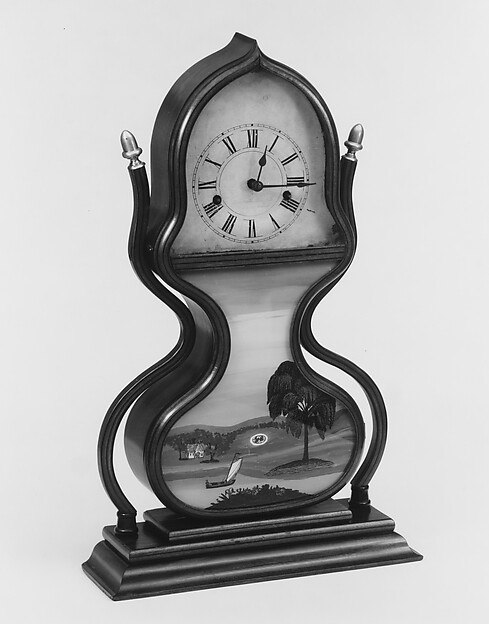
The Acorn Clock, accession number 1970.289.6, is an American timepiece held within the collection of The Metropolitan Museum of Art. Produced between 1847 and 1850 in Bristol, Connecticut, the clock is attributed to the Forestville Manufacturing Company, which operated between 1835 and 1853. It measures approximately 24 3/8 inches in height, 14 5/8 inches in width, and 5 1/8 inches in depth (61.9 x 37.1 x 13 cm). The case supports a dial and a lower panel featuring decorative imagery, mounted on a base, with the overall design defined by its organic, curved silhouette.

Front view of the Acorn Clock in laminated mahogany, accession number 1970.289.6.
Front view of the Acorn Clock in laminated mahogany, accession number 1970.289.6. — The Metropolitan Museum of Art, New York. Rights pending — permission not yet requested. Original source

Catalogue identity

Source
orbiscollectibles.com
Category
Clock · Acorn clock
Maker / attribution
Forestville Manufacturing Company
Reference
Not recorded
Catalogue / lot identifier
1970.289.6
Source-reported date
1847–50
Source-reported place
United States

Source-reported attribution and specifications are not independent authentication. A listing does not establish present ownership, current display, availability or permission to reproduce.

Object description

Case and Aesthetic Design

The clock is identified by its specific case architecture, which is constructed from laminated mahogany. This design choice results in the characteristic curved profile associated with the acorn-style mantle clock, providing a sculptural quality to the exterior frame. The main body supports the timekeeping elements within an upper housing, while the lower section features a glass panel decorated with a pictorial landscape scene.

The structural integrity of the clock is supported by a rectangular base, upon which the curved frame sits. The upper section of the case, housing the dial, terminates in a form that suggests the top of an acorn, accented by small ornamental finials on either side. The visual composition integrates the functional clock movement area with a lower decorative panel, creating a unified silhouette.

The materials and dimensions reflect the mid-century manufacturing practices of the Forestville Manufacturing Company.

Evidence for this section
  • “Mahogany, laminated”
  • “24 3/8 x 14 5/8 x 5 1/8 in. (61.9 x 37.1 x 13 cm)”

Maker and Production Context

The timepiece is attributed to the Forestville Manufacturing Company, an enterprise that was active in Bristol, Connecticut, between 1835 and 1853. The dating of the object to 1847–1850 places its creation within the latter period of the company's existence. This firm is recognized within the context of American horological production during the mid-19th century, specifically for its output of shelf clocks.

The classification of this object as part of The Metropolitan Museum of Art’s collection provides a verified provenance for this specific unit. The museum records it under accession number 1970.289.6, within the institution's American Wing. The attribution remains specific to the information maintained by the holding institution, with the record noting that the piece represents this particular specimen in their collection.

Evidence for this section
  • “Forestville Manufacturing Company (1835–1853)”
  • “Made in Bristol, Connecticut, United States”
  • “1847–50”

Documentation and Museum Attribution

This record is based on data provided by The Metropolitan Museum of Art, which maintains the object within its institutional records. The museum documents the object’s physical specifications and historical attribution, serving as the primary source for the identification of this piece. The record serves as a reference point for this specific clock.

Research documentation acknowledges that while the specific clock is well-documented within the museum's catalogue, further academic inquiry is necessary to synthesize this object's details with wider horological literature regarding the manufacturer’s full range of production. The museum records are the basis for all stated facts regarding its physical dimensions, material composition, and origin.

Evidence for this section
  • “The Metropolitan Museum of Art holds this object as 1970.289.6”
  • “details are those of this museum object”

Open research questions

  • What are the specific technical characteristics and escapement details of the internal movement used by the Forestville Manufacturing Company in this clock?
  • How does the specific painted landscape on the lower panel compare to other known decorative motifs used by this manufacturer during the late 1840s?

Source evidence

Recorded claims and source quotations for Acorn Clock
FieldSource-reported valueSource quotation
MakerForestville Manufacturing Company“Forestville Manufacturing Company (1835–1853)”
Date1847–50“1847–50”
MaterialMahogany, laminated“Mahogany, laminated”
Dimensions24 3/8 x 14 5/8 x 5 1/8 in. (61.9 x 37.1 x 13 cm)“24 3/8 x 14 5/8 x 5 1/8 in. (61.9 x 37.1 x 13 cm)”
Museum Number1970.289.6“1970.289.6”
Place of ManufactureBristol, Connecticut, United States“Made in Bristol, Connecticut, United States”

Visible details

  • Case features curved, laminated mahogany elements resembling an acorn shape
  • Dial displays Roman numerals and two central hands
  • Lower glass panel decorated with a painted landscape including a boat and tree
  • Decorative finials are positioned at the top of the side structures

Research qualifications

  • The record is based on a single museum specimen; broader typology remains to be verified
  • Attribution to Forestville Manufacturing Company is documented by the museum record

Photograph identity and source facts were screened before import; rights clearance remains pending.

Consulted source

Acorn Clock

Reviewed 2026-11-02 · Record 4d7646447c

Terms in this record

Glossary explanations for terms named in this object’s record.