
Skip to content
The Encyclopedia of Horology

Clock · Wall clock

Aaron Willard Wall Clock

Partially verified

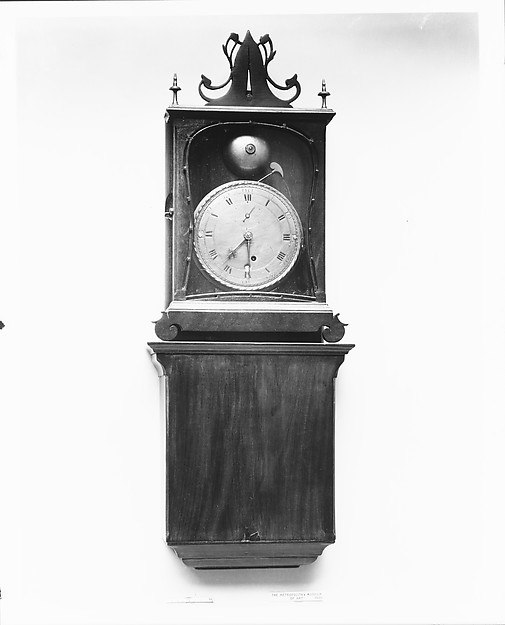
This wall clock, catalogued as object 30.120.52 by The Metropolitan Museum of Art, is attributed to the American clockmaker Aaron Willard (1757–1844). Dating from 1772–82, the clock is constructed of mahogany and measures approximately 23 1/2 by 8 7/8 by 3 inches. It represents a formative design in early New England wall timepieces, a group comprising nearly two dozen known examples signed by either Aaron or his older brother, Simon Willard. The clock features a dial that includes a unique date aperture, a detail not observed in the other known examples of this group. The design of this wall clock served as a precursor to the development of Massachusetts shelf clocks. The object remains in the collection of the American Wing at The Metropolitan Museum of Art, having been received as a gift from George Coe Graves in 1930.

Front view of the Aaron Willard wall clock, displaying the unique date aperture on the dial and the mahogany case.
Front view of the Aaron Willard wall clock, displaying the unique date aperture on the dial and the mahogany case. — The Metropolitan Museum of Art — The Sylmaris Collection, Gift of George Coe Graves, 1930. Rights pending — permission not yet requested. Original source

Catalogue identity

Source
orbiscollectibles.com
Category
Clock · Wall clock
Maker / attribution
Aaron Willard
Reference
Not recorded
Catalogue / lot identifier
30.120.52
Source-reported date
1772–82
Source-reported place
United States

Source-reported attribution and specifications are not independent authentication. A listing does not establish present ownership, current display, availability or permission to reproduce.

Object description

Design and Construction

The object is identified as a wall clock produced in the late 18th century, specifically between 1772 and 1782. Its construction incorporates a mahogany case that measures roughly 23.5 inches in height. The clock's aesthetic is characterized by a distinctive, scrolled decorative crest at the apex of the case and an exposed bell mechanism situated above the circular dial.

This specific clock is identified as part of a small group of early New England wall timepieces, numbering fewer than twenty-four examples in total. The design is credited with establishing a structural framework that directly influenced the production of subsequent Massachusetts shelf clocks. The dial itself is reported to be unique within this specific category of timepieces due to the presence of a date aperture, a feature not documented on other related examples.

Evidence for this section
  • “This timepiece represents the earliest form of the New England wall clock”
  • “The dial belonging to this specific clock is unique amongst the known group, being the only one that incorporates a date aperture.”
  • “The overall design of these New England wall clocks provided the foundational basis for later Massachusetts shelf clocks.”

Maker and Attribution

The clock is signed by Aaron Willard, who was active as an American clockmaker between 1757 and 1844.

The attribution of the piece to Aaron Willard is documented by The Metropolitan Museum of Art. Within the broader classification of the New England wall clock group, the pieces are recorded as being signed by either Aaron or his older brother, Simon Willard.

Evidence for this section
  • “Aaron Willard (1757–1844) was an American clockmaker who developed his early career alongside his brothers”
  • “Within this recorded group, five clocks are signed by Aaron Willard, whilst the rest are signed by his older brother, Simon.”

Provenance and Documentation

The clock is held within the collection of The American Wing at The Metropolitan Museum of Art, designated under the museum object number 30.120.52. The acquisition of the object was made possible through the Sylmaris Collection, via a gift from George Coe Graves in 1930.

The museum record serves as the primary documentation for this object. While the piece is part of a larger, recognized historical group of wall clocks, the institution notes that further independent research is often required to verify the nuances of maker and date for such pieces, as case and movement manufacturing processes varied between different workshops during the period.

Evidence for this section
  • “The Metropolitan Museum of Art holds this object as 30.120.52.”
  • “Department: The American Wing. Credit line: The Sylmaris Collection, Gift of George Coe Graves, 1930.”
  • “movements and cases were frequently made by different workshops and were sometimes married later.”

Open research questions

  • What specific mechanical variations exist between this clock and the other recorded examples in the Willard group?
  • To what extent did the transition from the family farm in Grafton to the Roxbury workshop influence the design elements of these specific wall clocks?

Source evidence

Recorded claims and source quotations for Aaron Willard Wall Clock
FieldSource-reported valueSource quotation
MakerAaron Willard“Wall Clock made by Aaron Willard (1757–1844)”
Date1772–82“1772–82”
MaterialMahogany“The museum records its materials as: Mahogany.”
Dimensions23 1/2 x 8 7/8 x 3 in. (59.7 x 22.5 x 7.6 cm)“23 1/2 x 8 7/8 x 3 in. (59.7 x 22.5 x 7.6 cm).”
CollectionThe Metropolitan Museum of Art“The Metropolitan Museum of Art holds this object as 30.120.52.”
Accession30.120.52“The Metropolitan Museum of Art holds this object as 30.120.52.”
Credit LineGift of George Coe Graves, 1930“The Sylmaris Collection, Gift of George Coe Graves, 1930.”

Visible details

  • Mahogany case construction
  • Visible bell chime mounted above the dial
  • Unique date aperture on the dial
  • Scrolling ornamental cresting at the top

Research qualifications

  • The exact provenance of the movement and case assembly is not fully detailed in the provided source
  • The wider group's attribution relies on signatures shared between two brothers, and individual variations within that group remain subject to research

Photograph identity and source facts were screened before import; rights clearance remains pending.

Consulted source

Wall Clock, Aaron Willard, 1772–82

Reviewed 2026-11-02 · Record 404e9da466

Terms in this record

Glossary explanations for terms named in this object’s record.