
Skip to content
The Encyclopedia of Horology

Clock · Pyramid-shaped mantel clock

A Louis XIV marquetred pyramid-shaped mantel clock

Partially verified

The source documents a Louis XIV pyramid-shaped mantel clock catalogued as probably made in Augsburg, Germany, circa 1680. The obelisk-form case is decorated with marquetry in red tortoiseshell, horn, brass, pewter, and ebony. It is mounted on spherical feet and topped with a metallic finial, measuring 32 cm in height by 12.5 cm in width. The auction description notes that the movement has been replaced. The clock was previously part of the Jean Pétin collection on Rue de Varenne in Paris.

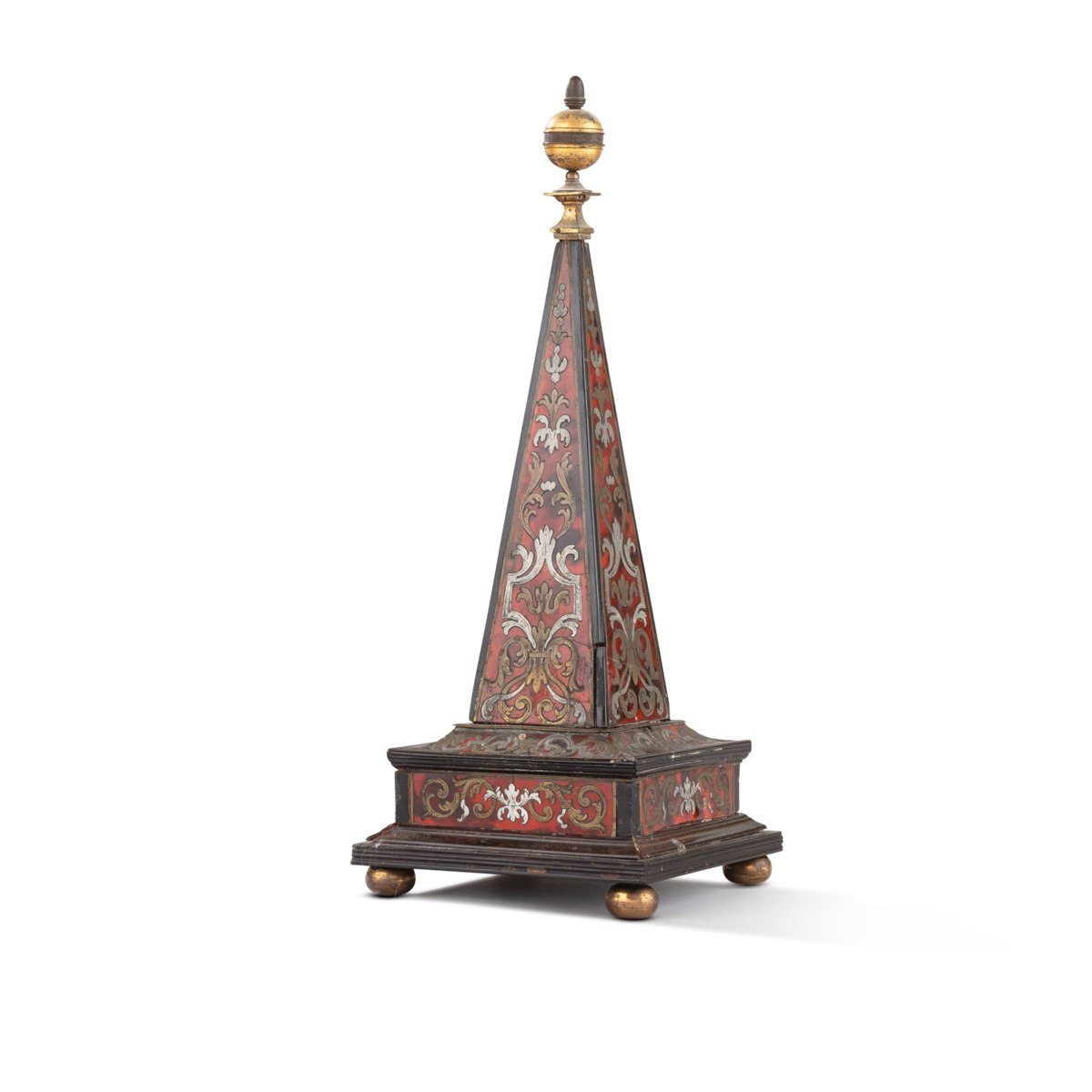
View of the Louis XIV pyramid-shaped marquetry clock case
View of the Louis XIV pyramid-shaped marquetry clock case — Sotheby's. Rights pending — permission not yet requested. Original source

Catalogue identity

Source
www.sothebys.com
Category
Clock · Pyramid-shaped mantel clock
Maker / attribution
Not established
Reference
Not recorded
Catalogue / lot identifier
40
Source-reported date
circa 1680
Country
probably German, Augsburg

Source-reported attribution and specifications are not independent authentication. A listing does not establish present ownership, current display, availability or permission to reproduce.

Object description

Case Architecture and Form

The object is documented as a Louis XIV pyramid-shaped mantel clock, catalogued with dimensions of 32 cm in height by 12.5 cm in width (12 5/8 in by 4 3/4 in).

Direct visual inspection shows a slender pyramid or obelisk-shaped upper structure supported upon a molded plinth base, elevated on four round ball feet, and surmounted at its summit by a turned metallic ball and baluster finial.

Evidence for this section
  • “A Louis XIV red tortoiseshell, horn, brass, pewter and ebony marquetred pyramid-shaped mantel clock, probably German, Augsburg, circa 1680”
  • “Haut. 32 cm, larg.12,5 cm; Height. 12 5/8 in, width. 4 3/4 in”
  • “Slender pyramid or obelisk-shaped upper body resting on a molded plinth base.”
  • “Supported on four round ball feet.”
  • “Pinnacle surmounted by a turned metallic ball and baluster finial.”

Marquetry and Materials

The auction entry identifies the case materials as red tortoiseshell, horn, brass, pewter, and ebony. The lot notice also notes the presence of restricted materials subject to international shipping and export regulations.

Observation of the visible exterior shows decorative panels inlaid with foliate and strapwork marquetry in pewter and brass tones set against a red ground.

Evidence for this section
  • “red tortoiseshell, horn, brass, pewter and ebony”
  • “Please note that this lot contains restricted materials.”
  • “Panels decorated with foliate and strapwork marquetry in pewter and brass tones set against a red ground.”

Horological State and Movement Replacement

The auction lot description explicitly records the status of the internal mechanism with the notation '(the movement replaced)'. The source does not specify the maker, date, caliber, or mechanical operation of the replacement movement.

No clock dial or hands are visible in the catalogued photographic view, leaving dial placement, configuration, and dial markings unrecorded in the provided record.

Evidence for this section
  • “(the movement replaced)”
  • “Clock dial is not visible in this angle.”

Attribution and Provenance

The auction catalogue dates and locates the clock as 'probably German, Augsburg, circa 1680'.

The lot is catalogued from the 'Late collection Jean Pétin, Rue de Varenne, Paris'. An accompanying catalogue note adds that the clock is illustrated in a color photograph of Jean Pétin's office from his personal archive.

Evidence for this section
  • “probably German, Augsburg, circa 1680”
  • “Late collection Jean Pétin, Rue de Varenne, Paris”
  • “The pyramid mantel clock is illustrated on a colour photograph of Jean Pétin's office (personal archive).”

Open research questions

  • Where is the clock dial positioned on the pyramid case, and what are its markings and numerals?
  • What are the specifications, origin, and date of the replacement movement noted in the catalogue?
  • What specific archival or stylistic comparisons support the attribution to Augsburg circa 1680?

Source evidence

Recorded claims and source quotations for A Louis XIV marquetred pyramid-shaped mantel clock
FieldSource-reported valueSource quotation
Attributionprobably German, Augsburg, circa 1680“probably German, Augsburg, circa 1680”
MaterialsRed tortoiseshell, horn, brass, pewter and ebony“red tortoiseshell, horn, brass, pewter and ebony”
DimensionsHaut. 32 cm, larg. 12,5 cm“Haut. 32 cm, larg.12,5 cm; Height. 12 5/8 in, width. 4 3/4 in”
Movement noteThe movement replaced“(the movement replaced)”
ProvenanceLate collection Jean Pétin, Rue de Varenne, Paris“Late collection Jean Pétin, Rue de Varenne, Paris”
Archival Photographic RecordIllustrated in a color photograph of Jean Pétin's office from his personal archive“The pyramid mantel clock is illustrated on a colour photograph of Jean Pétin's office (personal archive).”
Dimensions (Inches)Height 12 5/8 in, width 4 3/4 in“Height. 12 5/8 in, width. 4 3/4 in”

Visible details

  • Slender pyramid or obelisk-shaped upper body resting on a molded plinth base.
  • Supported on four round ball feet.
  • Pinnacle surmounted by a turned metallic ball and baluster finial.
  • Panels decorated with foliate and strapwork marquetry in pewter and brass tones set against a red ground.
  • Clock dial is not visible in this angle.

Research qualifications

  • Source notes that the original movement has been replaced.
  • The dial and internal clock mechanism are not shown in the provided photograph.

Photograph identity and source facts were screened before import; rights clearance remains pending.

Consulted source

A Louis XIV red tortoiseshell, horn, brass, pewter and ebony

Reviewed 2026-10-21 · Record 9d55e5e7d9

Terms in this record

Glossary explanations for terms named in this object’s record.