
Skip to content
The Encyclopedia of Horology

Clock · Tall case clock

19th Century French Tall Case Clock or Horloge De Parquet

Partially verified

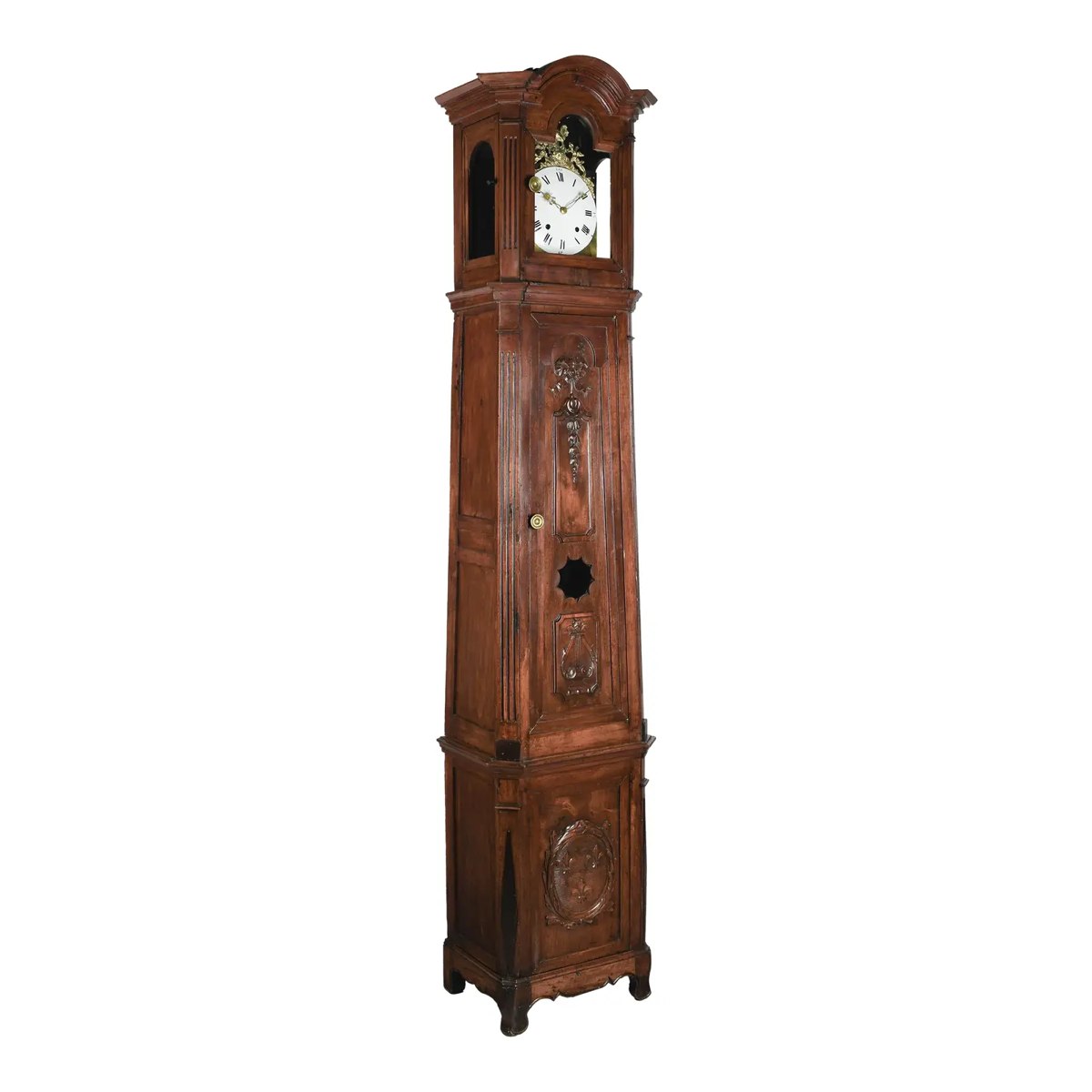
According to the seller, this French horloge de parquet, or tall case clock, dates to circa 1800–1820 and originates from Provence. Built from solid walnut with pegged mortise-and-tenon construction, the case is divided into three sections featuring paneled sides and a chapeau de gendarme crown. The wood case is adorned with hand carvings including a trio of fleur-de-lis on the lower base panel and a lyre with ribboned floral swags on the trunk door. The glazed arched hood houses a white dial with Roman numerals. The dealer notes that a 19th-century Morbier movement with rear escapement was fitted to the case and equipped with a replacement pendulum.

Full view of the French walnut tall case clock showing the arched hood, carved trunk door, and base panel
Full view of the French walnut tall case clock showing the arched hood, carved trunk door, and base panel — Olivier Fleury French Antiques of Winter Park, FL / Chairish. Rights pending — permission not yet requested. Original source

Catalogue identity

Source
www.chairish.com
Category
Clock · Tall case clock
Maker / attribution
Not established
Reference
Ref76210
Catalogue / lot identifier
23815384
Source-reported date
Circa 1800-1820
Country
France

Source-reported attribution and specifications are not independent authentication. A listing does not establish present ownership, current display, availability or permission to reproduce.

Object description

Construction and Form

This tall case clock is constructed from solid walnut with pegged mortise-and-tenon joinery. The case is composed of three sections with paneled sides and a chapeau de gendarme crown.

Exterior ornamentation includes hand-carved details, specifically a trio of fleur-de-lis on the lower base panel and a lyre with ribboned floral swags on the trunk door. The clock includes original brass hardware and exhibits minor restoration to the feet.

Evidence for this section
  • “made of solid walnut.”
  • “The case is in three parts with paneled sides and beautiful hand carvings: a trio of fleur-de-lis at the base and a lyre and ribboned floral swag on the door”
  • “The top has a chapeau de gendarme crown”
  • “Good craftsmanship with pegged and mortise and tenon construction.”
  • “Minor restoration on the feet.”
  • “Original brass hardware.”

Movement and Dial

The clock features an arched hood with glazed panels protecting a white dial with Roman numerals. The movement is a 19th-century Morbier type with a rear escapement, which the seller states was added to the case. The setup includes a replacement pendulum.

The clock is reported to be in working order, with chime functionality on the hour and half-hour.

Evidence for this section
  • “The 19th century Morbier movement has been added to fit the case”
  • “New Pendulum. Rear escapement.”
  • “Chimes on the hour and once on the half.”
  • “The top has a chapeau de gendarme crown and the original glass panes.”
  • “in working condition keeping a good time.”

Provenance and Condition

The item is described as originating from Provence, France, with an estimated production period of circa 1800–1820.

Condition disclosures include a hairline crack in the center glass pane of the hood. The wood surfaces feature a waxed patina.

Evidence for this section
  • “A fine early 19th century French Horloge De Parquet, or tall case clock, from Provence”
  • “Circa 1800-1820.”
  • “Note: the center pane has a hairline, but is not very noticeable.”
  • “Beautiful wood grain with waxed patina.”

Open research questions

  • What criteria distinguish the regional Provencal style in 19th-century tall case clocks?
  • Are there diagnostic features to differentiate a period-correct Morbier movement from later replacements in this style of case?
  • Is there evidence to substantiate the seller's claim that specific carvings serve as a sign of aristocratic ownership?

Source evidence

Recorded claims and source quotations for 19th Century French Tall Case Clock or Horloge De Parquet
FieldSource-reported valueSource quotation
OriginProvence, France“A fine early 19th century French Horloge De Parquet, or tall case clock, from Provence made of solid walnut.”
Case ConstructionSolid walnut in three parts“The case is in three parts with paneled sides and beautiful hand carvings”
CarvingsFleur-de-lis, lyre, and ribboned floral swag“a trio of fleur-de-lis at the base and a lyre and ribboned floral swag on the door”
Movement19th-century Morbier movement with rear escapement“The 19th century Morbier movement has been added to fit the case and it is in working condition keeping a good time.”
StrikeChimes on the hour and once on the half“Chimes on the hour and once on the half.”
Dimensions102.5"H x 22"W x 16"D“Dimensions: 102.5"H x 22"W x 16"d”
MaterialsWalnut, brass, and glass“original glass panes.”

Visible details

  • Arched hood with a chapeau de gendarme crest and glazed side panels
  • Trunk door featuring an aperture for viewing the pendulum, framed by carved ribbon swags above and a lyre motif below
  • Lower pedestal case centered with a carved oval medallion enclosing three fleur-de-lis
  • Circular white dial displaying black Roman numerals beneath an ornate pierced crest

Research qualifications

  • The 19th-century Morbier movement is not original to the case and was retrofitted
  • Source notes a hairline crack on the center glass pane
  • Fitted with a replacement pendulum
  • Minor restoration noted on the feet

Photograph identity and source facts were screened before import; rights clearance remains pending.

Consulted source

19th Century French Tall Case Clock or Horloge De Parquet | Chairish

Reviewed 2026-10-22 · Record b83188d084

Terms in this record

Glossary explanations for terms named in this object’s record.