
Skip to content
The Encyclopedia of Horology

Clock · Cuckoo wall clock

19th-Century Black Forest Spring-Driven Cuckoo Wall Clock

Partially verified

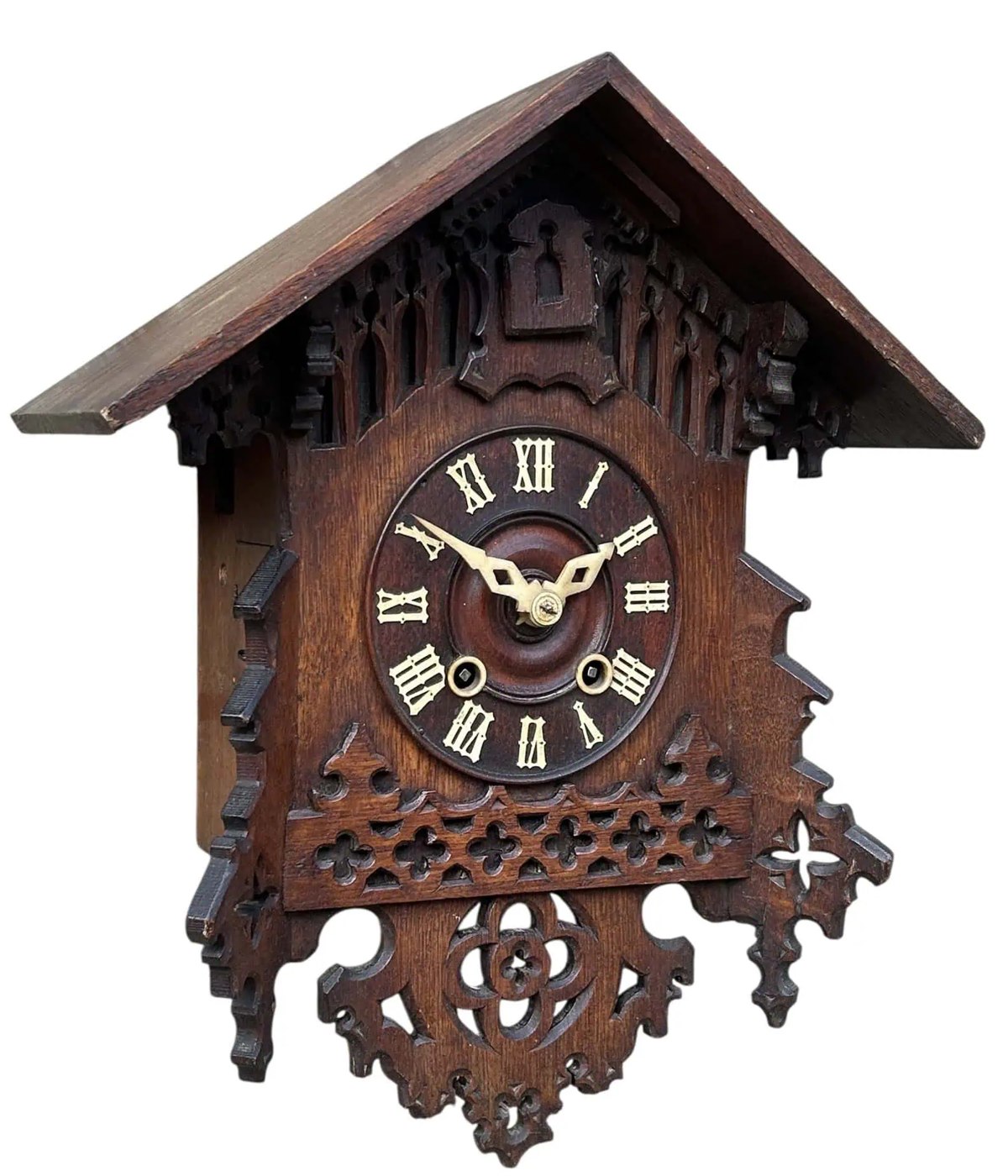
This is a 19th-century Black Forest cuckoo wall clock, dating between circa 1870 and 1890. Housed in a hand-carved wood case featuring a traditional Chalet style, it is distinguished by a spring-driven mechanical movement rather than the more common weight-driven system, thereby eliminating the need for hanging chains and weights. The clock is wound by key and features a wooden dial fitted with Roman numeral cartouches, believed to be made of bone or stained material. It includes an original painted wooden cuckoo bird housed behind a double-door aperture, which operates on the hour and half-hour. The clock is accompanied by its original wooden-leaf pendulum and a winding key. The mechanism is reported by the seller to be in functional, ticking condition, and the case exhibits a deep, original patina with high-relief wood carvings throughout the architectural frame and bottom apron.

Front three-quarter view of the 19th-century Black Forest spring-driven wall clock showing the hand-carved case and wooden dial.
Front three-quarter view of the 19th-century Black Forest spring-driven wall clock showing the hand-carved case and wooden dial. — Vintage Clocks UK. Rights pending — permission not yet requested. Original source

Catalogue identity

Source
vintageclocks.uk
Category
Clock · Cuckoo wall clock
Maker / attribution
Not established
Reference
JN154
Catalogue / lot identifier
Source URL identifies the listing
Source-reported date
circa 1870–1890
Source-reported place
Germany

Source-reported attribution and specifications are not independent authentication. A listing does not establish present ownership, current display, availability or permission to reproduce.

Object description

Case and Dial

The clock is constructed within a solid wood case, styled in a traditional deep-relief Chalet design. The exterior features ornate wood carvings that provide a high-relief texture across the frame and the bottom apron, which mirrors the architectural themes found in the upper portion of the case.

The dial is composed of wood and is decorated with Roman numeral cartouches. These markers are noted as being fashioned from either bone or a stained material. The time is indicated by a set of original, intricately carved hands. A central, double-door aperture is positioned at the top of the case to allow for the movement of the cuckoo bird.

Evidence for this section
  • “Housed in a magnificently hand-carved solid wood case”
  • “Traditional deep-relief Chalet style carving.”
  • “Wooden dial with hand-carved bone or stained Roman numeral cartouches.”

Movement and Mechanism

By employing springs for both the timekeeping and the cuckoo train, the design removes the requirement for exterior hanging chains and cast iron weights.

The movement is wound by a key, provided with the object. The seller reports that the mechanism is currently in working order, capable of ticking and striking. The cuckoo bird is triggered on both the hour and half-hour intervals, utilizing dual-tone bellow pipes to produce the characteristic sound.

Evidence for this section
  • “this premium model features a sophisticated spring-driven movement.”
  • “Key-wound, no weights or chains required”
  • “The cuckoo bird emerges reliably on the hour and half-hour, accompanied by the classic dual-tone bellow pipes.”

Condition and Maintenance

The case retains its original finish, which is described as a rich, deep patina. The carved elements remain well-defined, and the overall structural integrity of the woodwork is preserved.

Maintenance requirements for the clock during transit involve securing the bellows and the internal mechanical components. The pendulum is designed to be removed and packed separately to prevent damage to the clock during movement or shipping.

Evidence for this section
  • “The case retains its original rich, deep patina. Carvings are remarkably crisp”
  • “bellows and internal mechanisms will be gently secured, and the pendulum packed separately to ensure zero transit damage.”

Open research questions

  • What specific type of wood was used in the carving of the case?
  • Are there any hidden maker's marks on the movement plate that could confirm the provenance?

Source evidence

Recorded claims and source quotations for 19th-Century Black Forest Spring-Driven Cuckoo Wall Clock
FieldSource-reported valueSource quotation
Period19th Century (Circa 1870–1890)“Period: 19th Century (Circa 1870–1890).”
Movement TypeSpring-driven“features a sophisticated spring-driven movement.”
Dimensions40cm x 33cm x 19cm“Measures 40cm high, 33cm wide, 19cm deep”
AutomataPainted wooden cuckoo bird“Original painted wooden cuckoo bird that emerges from the double-door aperture.”
MaterialsCarved wood and bone or stained material for numerals“Wooden dial with hand-carved bone or stained Roman numeral cartouches.”
FunctionalityFully functional“The spring-driven movement is fully functional and ticking nicely.”

Visible details

  • Case features high-relief architectural wood carvings
  • Dial has Roman numeral cartouches
  • Small door aperture located at the top center of the case
  • Clock is spring-driven with a key-wind mechanism

Research qualifications

  • The exact composition of the numeral cartouches (bone or stained material) remains unverified
  • Attribution to a specific maker is not provided in the source

Photograph identity and source facts were screened before import; rights clearance remains pending.

Consulted source

Rare Antique 19th-Century Black Forest Spring-Driven Cuckoo Wall Clock

Reviewed 2026-11-02 · Record 29c7f19924

Terms in this record

Glossary explanations for terms named in this object’s record.