
Dublin, Ireland · 1745 – 1829
John Crosthwaite
Partially verifiedPrecision clocks, astronomical instruments and watches
Life & work
John Crosthwaite was a Dublin watch, clock and scientific-instrument maker active from the 1770s, working initially from Dame Street and later from premises on Grafton Street; he is recorded as watchmaker to the Board of Works from 1795. His firm, later trading as John Crosthwaite & Son and subsequently Crosthwaite & Hodges after an 1802 partnership with Frederick Hodges, was among the more prominent names in the documented but comparatively small Dublin trade.
Crosthwaite experimented with knife-edge pendulum suspensions on diamond plates, publishing his findings in 1788 and 1800, and his firm produced astronomical, musical and steeple clocks as well as longitude watches for long voyages, work that put Dublin-made precision horology into direct comparison with contemporary London practice.
Ireland's clockmaking trade, centred on Dublin (and to a lesser extent other cities such as Cork), operated under its own guild structures separate from London's Clockmakers' Company and is comparatively little discussed in mainstream English-language horological surveys; Crosthwaite is one of its better-documented individual figures thanks to genealogical and Royal Irish Academy-linked records.
Timeline
John Crosthwaite's recorded dates, dated events from this profile and its sources, and dated pieces and sales from the object catalogue. Dates are as each record gives them.
1745 · Career
Born
1788 · Career
Crosthwaite experimented with knife-edge pendulum suspensions on diamond plates, publishing his findings in 1788 and 1800, and his firm produced astronomical, musical and steeple clocks as well as longitude watches for long voyages, work that put Dublin-made precision horology into direct comparison with contemporary London practice.
1795 · Career
John Crosthwaite was a Dublin watch, clock and scientific-instrument maker active from the 1770s, working initially from Dame Street and later from premises on Grafton Street; he is recorded as watchmaker to the Board of Works from 1795.
1802 · Career
His firm, later trading as John Crosthwaite & Son and subsequently Crosthwaite & Hodges after an 1802 partnership with Frederick Hodges, was among the more prominent names in the documented but comparatively small Dublin trade.
1829 · Career
Died
Training, contributions & innovations
- Ran a leading Dublin precision clock, instrument and watchmaking business across several decades and two further generations of family involvement
- Experimented with knife-edge, diamond-plate pendulum suspension and published his findings
- Produced astronomical and longitude-capable timekeepers within the documented Irish trade
Inventions & patents
- No formally granted patent for Crosthwaite is confirmed in the sources consulted here; his pendulum-suspension experiments were published rather than patented.
Signatures & markings on surviving work
- Watches and clocks signed 'J. Crosthwaite, Dublin' or, in later partnership periods, 'Crosthwaite & Son' or 'Crosthwaite & Hodges', generally with a workshop number on watch movements
Collecting significance
Signed Crosthwaite watches and clocks are a recognised, if specialist, category within Irish horological collecting; because the firm traded under several successive names across five decades, dating an individual piece benefits from matching the signature form to the corresponding partnership period.
Firms, key models & movements
No firm, model or movement in this encyclopedia is yet recorded under this maker's name.
Photographs
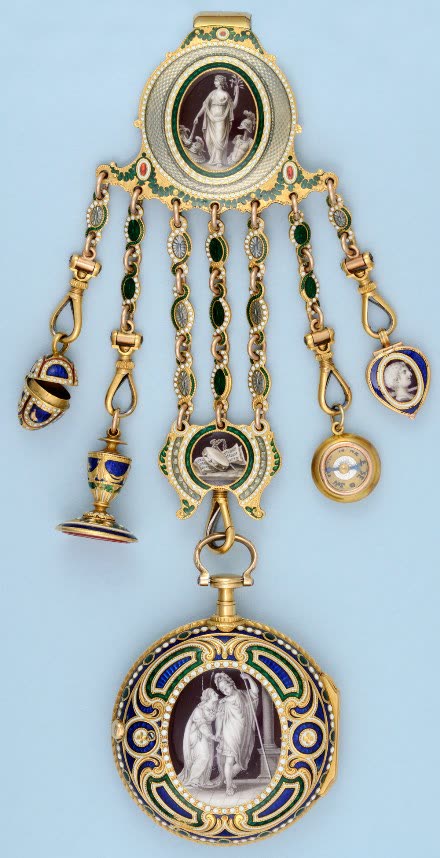
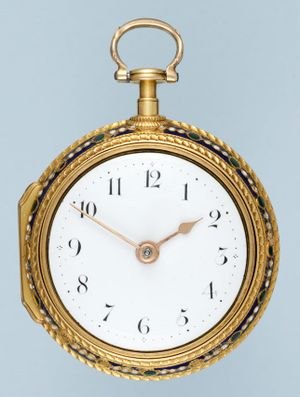
Photographs are illustrative examples of the type, not necessarily the exact object described. Verify details against the source file page.
Sources & references
- Baillie, G. H., Watchmakers and Clockmakers of the World
- Royal Irish Academy, Transactions, vol. 2 (1788) (Crosthwaite's pendulum-suspension paper)
Where sources disagree, the disagreement is stated rather than resolved silently.