
Sirnach, Switzerland · born 1971
Andreas Strehler
Partially verifiedIndependent watchmaking
Life & work
Developer of extremely precise moon phase complications.
Andreas Strehler completed his apprenticeship in Frauenfeld and graduated as a Watchmaker-Rhabilleur in 1991. After working as a head of prototyping at Renaud & Papi, he opened his own workshop in Winterthur on January 1, 1995. In 2000, he became a member of the Académie Horlogère des Créateurs Indépendants, and in 2005 he founded UhrTeil AG to manage his industrial activities.
Strehler relocated his company and domicile to Sirnach in 2007, where he continues to develop complex movements and components. His career includes the development of movements for H. Moser & Cie and the creation of highly precise moon phase mechanisms.
The fuller biography summarises the open references listed under Sources; each statement was checked against the cited passage. Confirm key dates in period documents before relying on them.
Timeline
Andreas Strehler's recorded dates, dated events from this profile and its sources, and dated pieces and sales from the object catalogue. Dates are as each record gives them.
1971 · Career
Born
1991 · Career
Andreas Strehler completed his apprenticeship in Frauenfeld and graduated as a Watchmaker-Rhabilleur in 1991.
1995 · Career
After working as a head of prototyping at Renaud & Papi, he opened his own workshop in Winterthur on January 1, 1995.
1998 · Career
The Tischkalender, introduced in 1998, was Strehler's first clock and incorporates a synchronized pocket watch.
2000 · Career
In 2000, he became a member of the Académie Horlogère des Créateurs Indépendants, and in 2005 he founded UhrTeil AG to manage his industrial activities.
2007 · Career
Strehler relocated his company and domicile to Sirnach in 2007, where he continues to develop complex movements and components.
2015 · Career
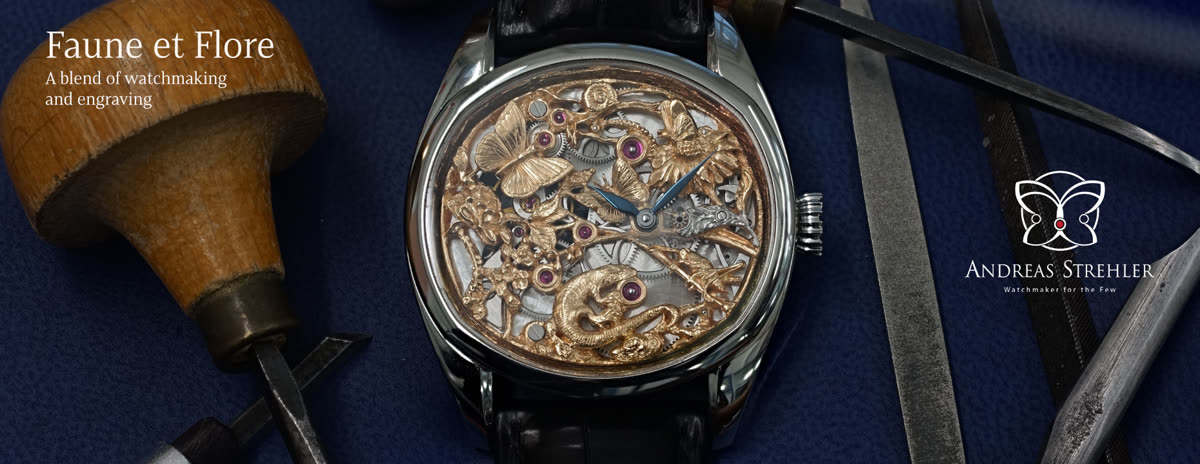
The Papillon d'Or, presented in 2015, highlights the movement's mechanics under a gold butterfly bridge.
Training, contributions & innovations
- Calculated the most accurate moon phase mechanism for a wristwatch
- Strehler developed a constant force mechanism known as a remontoire d’égalité to supply the escapement with consistent energy.
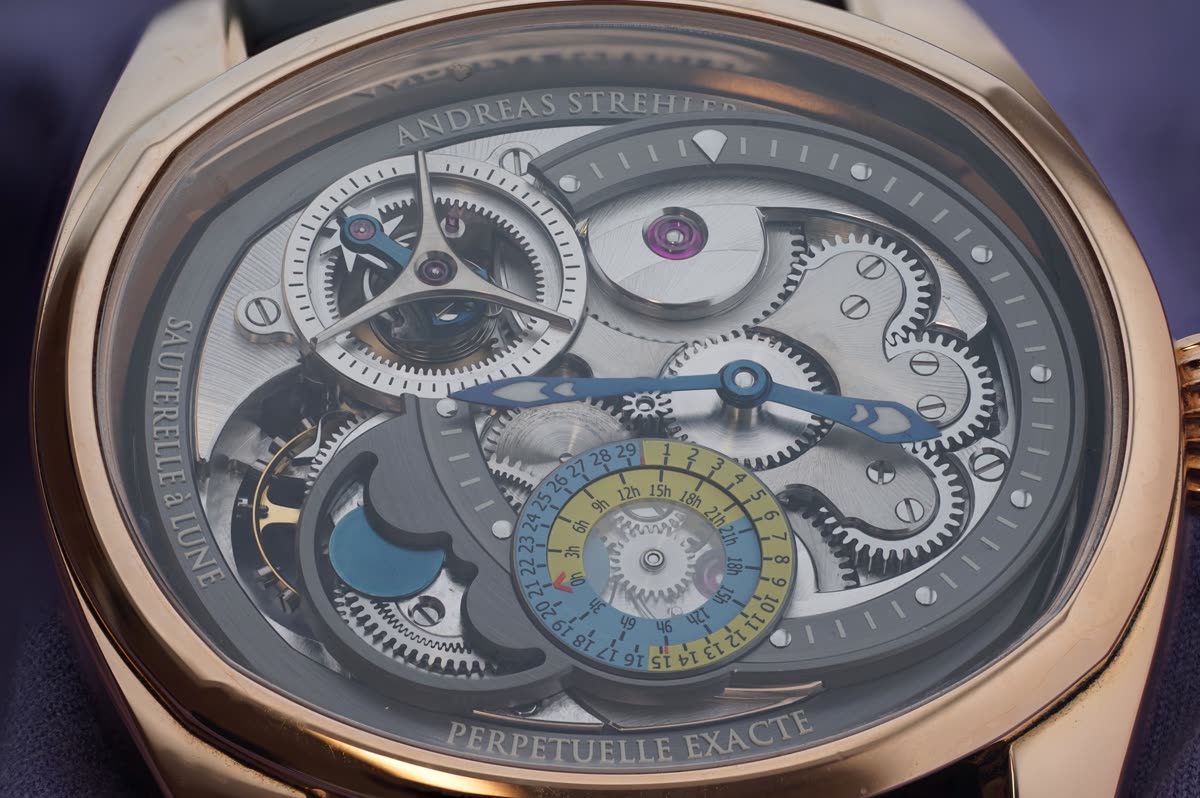
- He created an ultra-precise moon phase display with a deviation of one day in over two million years.
- He introduced a flash-calendar mechanism that allows for instantaneous switching from the final day of a month to the first day of the next.
Inventions & patents
- Patents for moon phase and remontoire mechanisms
Signatures & markings on surviving work
- Andreas Strehler
Documented works
- The Tischkalender, introduced in 1998, was Strehler's first clock and incorporates a synchronized pocket watch.
- The Sauterelle à lune perpétuelle features his patented constant force device and a world-record setting moon phase display.
- The Papillon d'Or, presented in 2015, highlights the movement's mechanics under a gold butterfly bridge.
Collecting significance
Authenticity depends on signatures and movement quality. For 19th-century makers, serial numbers often allow for precise dating. For modern independents, documentation from the maker is key.
Firms, key models & movements
No firm, model or movement in this encyclopedia is yet recorded under this maker's name.
Photographs


Photographs are illustrative examples of the type, not necessarily the exact object described. Verify details against the source file page.
Sources & references
- Andreas Strehler, Wikipedia (German), retrieved 2026-10-27 (text CC BY-SA 4.0)
- Britten, F. J., Old Clocks and Watches and Their Makers
- Loomes, B., The Early Clockmakers of Great Britain
- Ehrhardt, R., American Pocket Watch Identification and Price Guide
- Museum catalogue records
Where sources disagree, the disagreement is stated rather than resolved silently.