
USA · 1957
Battery-Powered Balance Watch (Hamilton 500)
Partially verifiedProved the market for electric watches, though contact reliability was poor.
A battery energises a coil on the balance, with contact wires switching the current; the first battery-powered wristwatch sold commercially.
Background
The Hamilton Electric 500 was introduced by the Hamilton Watch Company in 1957 as the world's first electric watch available for retail sale. This timepiece serves as an example of a moving coil system that utilizes a balance wheel with an integrated coil to maintain time. The mechanism relies on a battery-powered electro-mechanical solenoid to drive the movement, which transmits power through a wheel train to the hands. The watches were notably produced in various non-traditional asymmetrical case styles, such as the Ventura model designed by Richard Arbib.
Written from the encyclopedia entries listed under Sources; each statement was checked against the cited text.
How it works
- The system incorporates a balance wheel that contains an integrated coil and interacts with fixed magnets.
- The watch operation is regulated by the use of mechanical contacts.
Later history
- In 1962, the company formed a joint venture with the Japanese firm Ricoh to manufacture electric watches, though this partnership ended in 1965.
- Electro-mechanical watches of this kind were eventually superseded by more accurate and durable quartz technology.
How to verify this yourself
Search the relevant national patent office archive (Espacenet covers most European and US specifications) by inventor name and date range; confirm the number from the specification itself, not secondary sources.
Manufacturers known to have used it
- Hamilton
Photographs
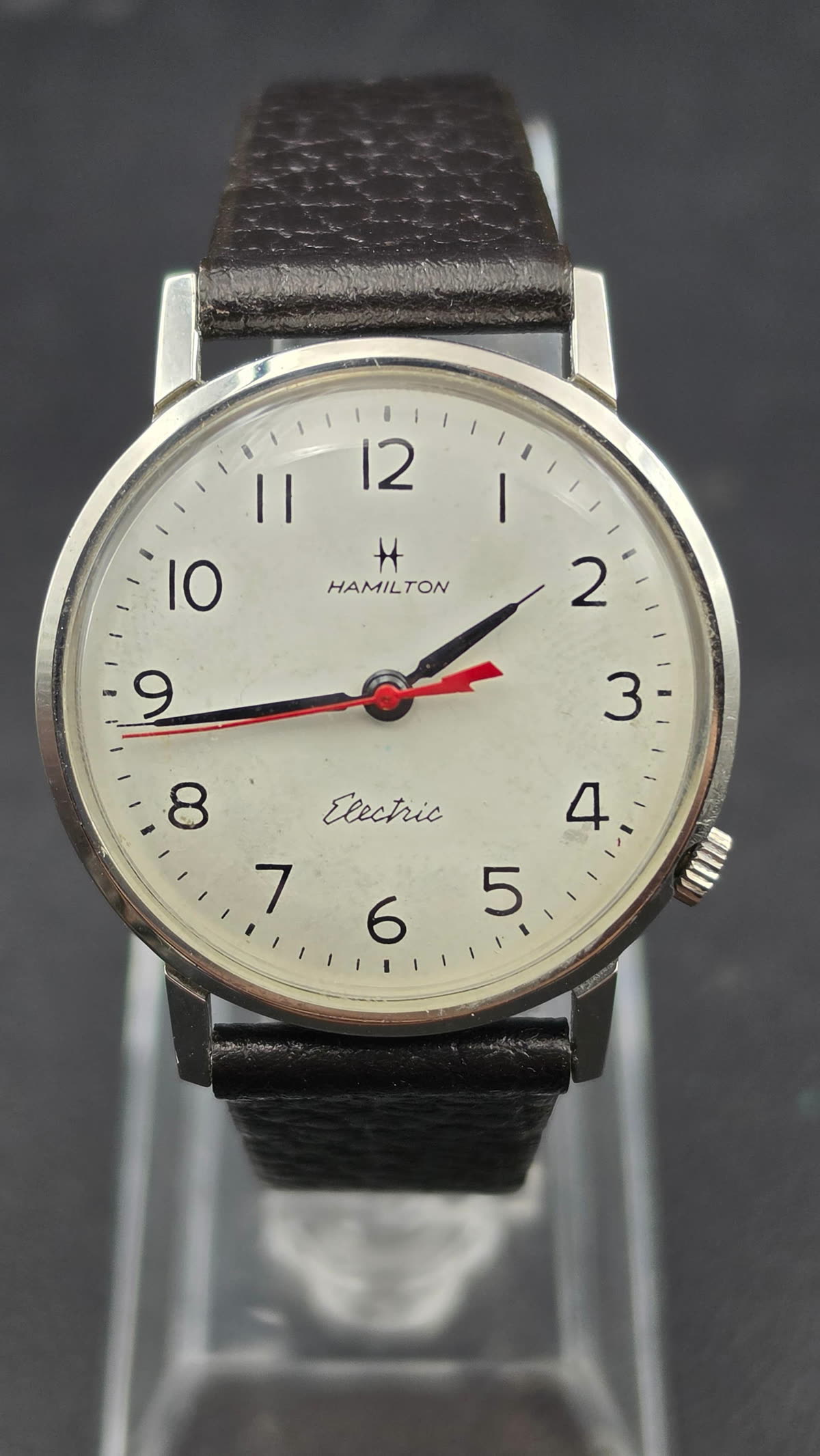
Photographs are illustrative examples of the type, not necessarily the exact object described. Verify details against the source file page.
Sources & references
- Electric watch, Wikipedia (English), retrieved 2026-10-28 (text CC BY-SA 4.0)
- Hamilton Watch Company, Wikipedia (English), retrieved 2026-10-28 (text CC BY-SA 4.0)
- Hamilton Watch Company published history
- Reymondin, C. et al., The Theory of Horology
Where sources disagree, the disagreement is stated rather than resolved silently.