
Movement record · Japan
Seiko calibre 7A28
VerifiedThe first analogue quartz chronograph movement, using three separate stepping motors so that the chronograph hands run independently of the timekeeping train and can be reset instantly.
Technical specifications
- Diameter
- Not recorded in a source consulted here
- Height
- Not recorded in a source consulted here
- Jewels
- 15 jewels
- Frequency
- Quartz, with independent stepping motors for the chronograph hands
- Power reserve
- Battery powered
- Winding
- Not applicable; battery powered
- Setting
- Crown setting
- Escapement
- None; quartz oscillator with stepping motors
- Balance
- None; quartz oscillator
- Complications
- Analogue chronograph reading to one-tenth of a second, Independent chronograph hands driven by separate motors
Identification features
- Calibre marking on the movement and case back
- Fully jewelled quartz movement, unusual for the type
Known variants
- 7A38 with calendar
- 7A48
Servicing notes
Service parts for the 7A family are long discontinued; specialists generally work from donor movements rather than new components.
General guidance only. Antique movements should be serviced by a qualified watchmaker.
Historical significance
A landmark in quartz engineering, showing that the analogue chronograph could be rebuilt around electronics rather than adapted from a mechanical design.
Photographs
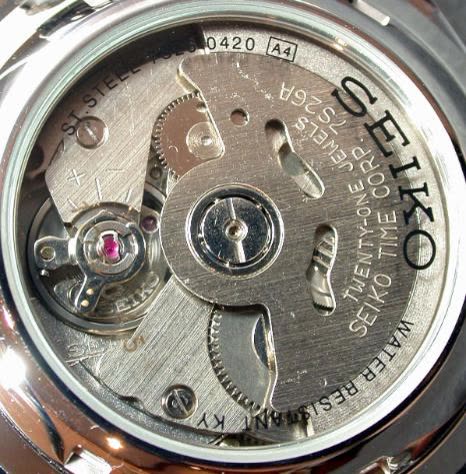
Photographs are illustrative examples of the type, not necessarily the exact object described. Verify details against the source file page.
Sources & references
- Seiko technical literature and museum descriptions of the 7A28
- Some widely cited online specification tables for this calibre are community-compiled rather than documented by the manufacturer.
Where sources disagree, the disagreement is stated rather than resolved silently.