
Clock escapement
Graham deadbeat escapement
VerifiedPallets with concentric locking faces hold the escape wheel motionless during the pendulum's excursion, eliminating recoil.
Schematic arrangement
How it is laid out
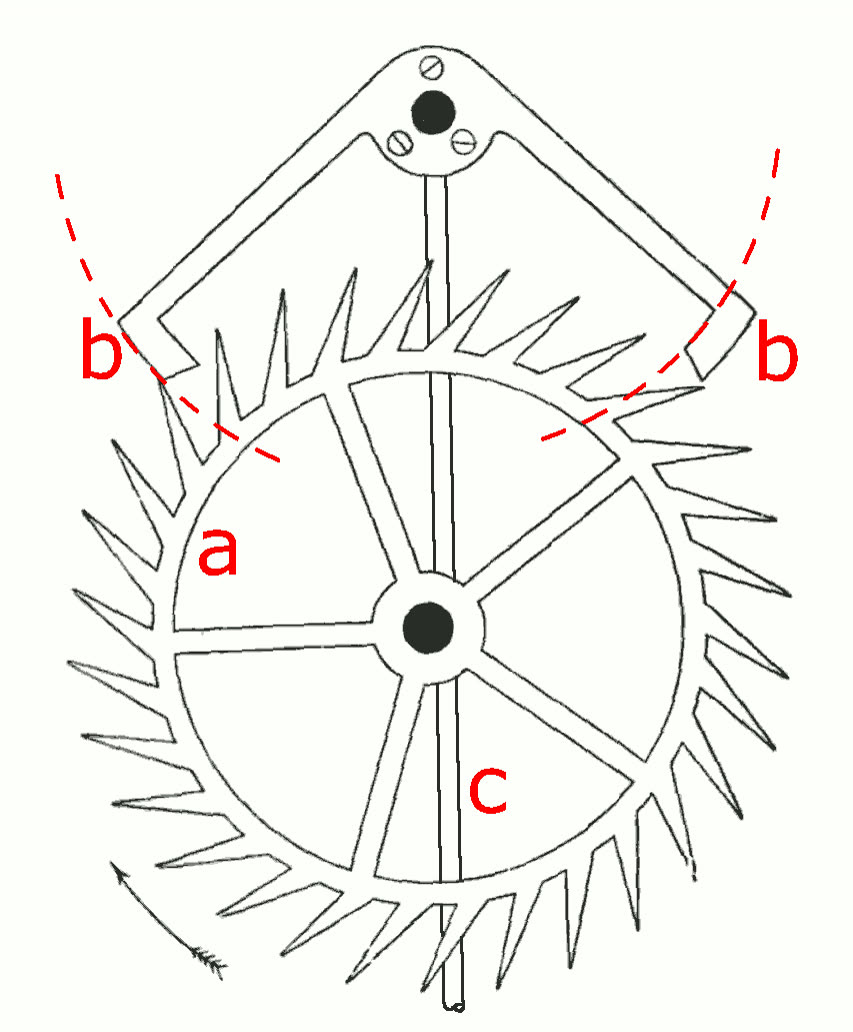
Outline schematic only, drawn to show the characteristic arrangement of wheel, locking member and oscillator. It is not a dimensioned working drawing and should not be used for setting up or repairing a movement.
Advantages
- No recoil
- Excellent for regulator clocks
Drawbacks
- Requires good workmanship and clean pivots
- Less tolerant of low power than recoil
Attribution and period
c. 1715, George Graham
Horological firsts are frequently contested. Where an invention is attributed to a named maker, that attribution is recorded as such rather than treated as settled fact.
How to recognise it
- Pallet faces cut as arcs concentric with the pallet-arbor centre, so the escape wheel stands perfectly still between beats.
- No visible backward motion of the escape wheel or seconds hand at each tick.
- Frequently jewelled pallets in fine regulators.
Servicing and conservation
A deadbeat gives little tolerance for worn pivots or bent teeth, and needs a clean, well-proportioned train to run on modest power. Depthing is critical: altering the pallet-arbor position to cure stopping usually makes the fault worse.
Work on an antique escapement by a qualified watchmaker or clockmaker. Conservation of original parts is preferred to replacement wherever the object will still run.
Bibliography
- Rawlings, A. L., The Science of Clocks and Watches
- Gazeley, W. J., Clock and Watch Escapements
Photographs
Photographs are matched automatically from freely licensed Wikimedia Commons material. Each caption states the actual subject of the image and credits its author; where a close match for this escapement does not exist, a related mechanism may be shown instead.