Skip to content
The Encyclopedia of Horology

Component record · Dial & hands

Chapter Ring

Verified

The graduated ring on a dial marked with the hour (and often minute) divisions against which the hands indicate the time.

What it does

Provides the reference scale that the hour and minute hands point to, and often the primary decorative and stylistic element of the dial.

How it works

On earlier and higher-grade dials the chapter ring is frequently a separate applied ring, sometimes silvered and engraved independently of the rest of the dial plate, allowing separate refinishing or replacement.

Minute markers, five-minute markers, and sometimes an inner track for a subsidiary indication are commonly incorporated into or alongside the main hour chapter ring.

Evolution

From applied, engraved silvered chapter rings on brass dial plates in earlier clocks and watches, to printed chapter markings integrated directly into modern dial faces.

Known variations

  • Roman numeral chapter ring
  • Arabic numeral chapter ring
  • Mixed or 'California' dial chapter ring (Roman upper half, Arabic lower half)
  • Track-only (index) chapter ring without numerals

Identification for collectors

  • Numeral style (Roman vs Arabic), and whether the ring is separately applied or printed, offer period and origin clues

Common failure modes

  • Wear or fading of printed or engraved markings
  • Loosening of a separately applied chapter ring

Photographs
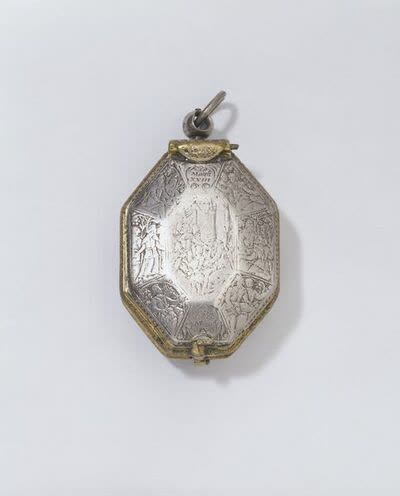
Watch, case and dial of engraved silver and gilt brass, English, about 1640. Octagonal watch with engraved silver and brass case, brass dial, silver chapter ring, single hand, pierced cock and pillars, verge escapement, gut-driven fusee.  Engraved silver, gilt brass and steel.
Watch, case and dial of engraved silver and gilt brass, English, about 1640. Octagonal watch with engraved silver and brass case, brass dial, silver chapter ring, single hand, pierced cock and pillars, verge escapement, gut-driven fusee.  Engraved silver, gilt brass and steel. — Victoria and Albert Museum via Europeana, http://rightsstatements.org/vocab/InC/1.0/. Europeana record
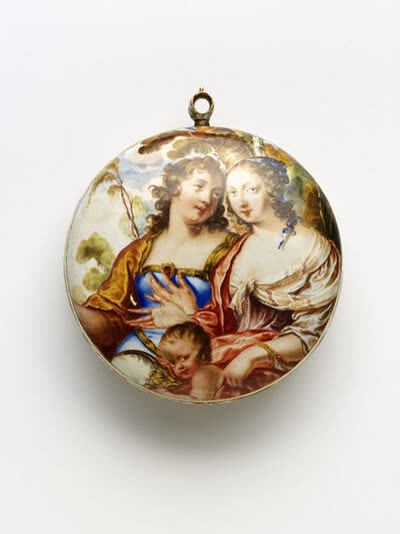
Watch with gold case decorated with figures and landscapes in painted enamel, France, 1640-60, with a later movement by J. Bernard Vrythoff, The Hague, ca. 1720-60. Gold watch. The case is enamelled in polychrome on the back with a male and a female figure with a cupid, and on the front with two cupids and a female figure holding an arrow directed towards a heart. Around the side of the case are landscapes vignettes. Inside the back of the case is a landscape with a seated man with a large burden on his back. On the reverse of the lid is a man fishing in a landscape. The centre of the dial is painted in enamel with a seated woman with her left hand extended. A cupid in the foreground holds a drawn bow with an arrow pointing towards her heart. White enamel chapter ring with Roman numerals and half-hour marks. Gilt-metal hands. Brass movement plates. Cylindrical pillars. Fusee and chain. Verge escapement. Balance wheel and spring, with regulator of Tompion type, with rotating silvered dial, numbered 1 to 6. Bridge balance-cock with mock pendulum aperture: engraved numerals 1 to 6 visible through the aperture. Two steel hands are screwed on top of the cock at the ends of the mock pendulum aperture. The cock is cast with a naked cupid setting fire to a heart by concentrating the rays of the sun with a magnifying glass. The rim of the cock outside the pendulum aperture is engraved 'HOWELL HY VER AF IS'. Pierced and engraved scrollwork applied to the top plate and the maker's name.  Gold with painted enamel; gilt-metal and steel movement, silver regulator dial.
Watch with gold case decorated with figures and landscapes in painted enamel, France, 1640-60, with a later movement by J. Bernard Vrythoff, The Hague, ca. 1720-60. Gold watch. The case is enamelled in polychrome on the back with a male and a female figure with a cupid, and on the front with two cupids and a female figure holding an arrow directed towards a heart. Around the side of the case are landscapes vignettes. Inside the back of the case is a landscape with a seated man with a large burden on his back. On the reverse of the lid is a man fishing in a landscape. The centre of the dial is painted in enamel with a seated woman with her left hand extended. A cupid in the foreground holds a drawn bow with an arrow pointing towards her heart. White enamel chapter ring with Roman numerals and half-hour marks. Gilt-metal hands. Brass movement plates. Cylindrical pillars. Fusee and chain. Verge escapement. Balance wheel and spring, with regulator of Tompion type, with rotating silvered dial, numbered 1 to 6. Bridge balance-cock with mock pendulum aperture: engraved numerals 1 to 6 visible through the aperture. Two steel hands are screwed on top of the cock at the ends of the mock pendulum aperture. The cock is cast with a naked cupid setting fire to a heart by concentrating the rays of the sun with a magnifying glass. The rim of the cock outside the pendulum aperture is engraved 'HOWELL HY VER AF IS'. Pierced and engraved scrollwork applied to the top plate and the maker's name.  Gold with painted enamel; gilt-metal and steel movement, silver regulator dial. — Victoria and Albert Museum via Europeana, http://rightsstatements.org/vocab/InC/1.0/. Europeana record

Photographs are illustrative examples of the type, not necessarily the exact object described. Verify details against the source file page.

Sources & references

  1. Britten, F. J., Old Clocks and Watches and Their Makers

Where sources disagree, the disagreement is stated rather than resolved silently.