
Complication · Calendar & astronomy
Tellurium
Partially verifiedA complication showing the relative positions and motions of the Earth, Sun, and Moon.
Definition
A complication showing the relative positions and motions of the Earth, Sun, and Moon.
Historical origin
Based on the three-dimensional astronomical models used for education.
How it works
A miniature Earth rotates on its axis while orbiting a central Sun, with the Moon orbiting the Earth.
Requires extremely complex differential gearing to maintain the relative speeds.
Pocket watch context
Exceedingly rare; usually found in large clocks.
Wristwatch context
A high-art complication in wristwatches from makers like Ulysse Nardin.
Identification
- Three-dimensional globes or rotating discs representing the Earth-Moon-Sun system
Servicing notes
Ultra-complex; requires factory-specialist service.
General guidance only. Complicated mechanisms should be assessed and serviced by a qualified watchmaker or clockmaker specialist, not adjusted at home.
Background
The tellurion (also tellurian, tellurium or loxocosm) is typically a French or Swiss clock surmounted by a mechanism depicting how day, night and the seasons are caused by the rotation and orientation of the Earth on its axis and its orbit around the Sun. Clocks featuring this complication normally display the phase of the Moon and the four-year perpetual calendar alongside these astronomical motions. The device is related to the orrery, which serves to illustrate the relative positions and motions of the planets and moons in the Solar System in a heliocentric model. Derivation of the word tellurion comes from the Latin term tellus, which translates to earth.
Written from the encyclopedia entries listed under Sources; each statement was checked against the cited text.
Photographs


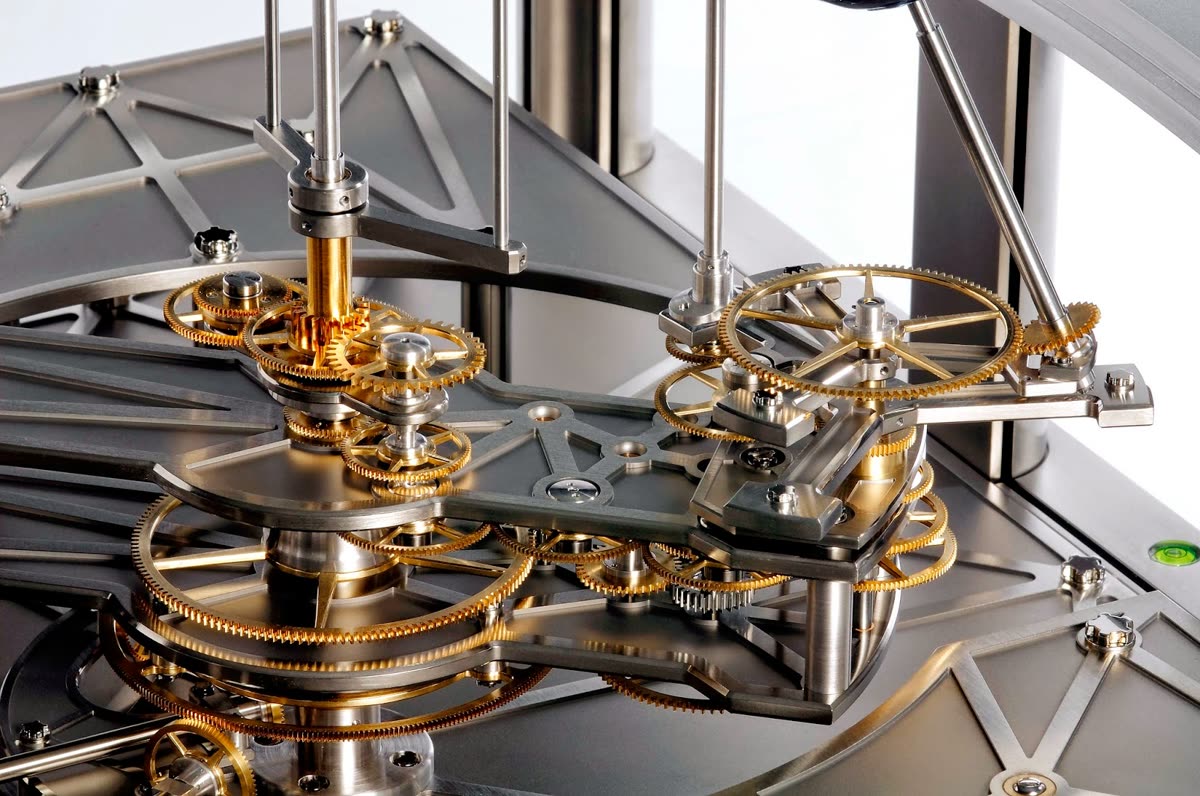
Photographs are illustrative examples of the type, not necessarily the exact object described. Verify details against the source file page.
Sources & references
- Tellurion, Wikipedia (English), retrieved 2026-10-28 (text CC BY-SA 4.0)
- de Carle, D., Watch and Clock Encyclopedia
- Britten, F. J., Old Clocks and Watches and Their Makers
- Horological Journal (British Horological Institute), technical articles
Where sources disagree, the disagreement is stated rather than resolved silently.