
Complication · Calendar & astronomy
Star Chart Display
Partially verifiedA rotating chart showing the visible night sky for a given latitude.
Definition
A rotating chart showing the visible night sky for a given latitude.
Historical origin
An astronomical display revived in modern watchmaking, descended from astrolabe and celestial-globe traditions.
How it works
A transparent or pierced disc carrying star positions rotates at the sidereal rate behind a mask representing the visible horizon for one latitude.
Because the mask is latitude-specific, a given watch is only correct for the latitude it was made for.
Pocket watch context
Related to astronomical pocket watches and pocket celestial instruments.
Wristwatch context
A decorative and educational modern complication.
Identification
- A star field disc with a horizon mask
- A stated latitude on the dial or in documentation
Servicing notes
This is specialist work. Levers, springs and cam profiles in complicated work are calibre-specific, and incorrect reassembly commonly damages parts that cannot be bought. Refer the movement to a watchmaker experienced with this mechanism.
General guidance only. Complicated mechanisms should be assessed and serviced by a qualified watchmaker or clockmaker specialist, not adjusted at home.
Background
Planispheres are instruments in the form of two adjustable disks that rotate on a common pivot to display visible stars for any time and date at a given latitude. The instrument consists of a circular star chart attached at its center to an opaque overlay that includes a window or hole to reveal a portion of the sky map. Claudius Ptolemy originally used the term planisphere in the second century to describe the representation of a spherical Earth via a map drawn in the plane.
Jacob Bartsch created the first star chart given this specific name in 1624, continuing a tradition that traces its origins back to the ancient astrolabe. Users observe the sky by adjusting the disk and overlay so that the local time of day corresponds to the specific calendar date marked on the star chart.
Written from the encyclopedia entries listed under Sources; each statement was checked against the cited text.
Construction and action
- An opaque overlay with a window is used to mask stars located below the observer's horizon line.
- The window on the overlay is designed to indicate the cardinal directions of the eastern and western horizons.
- Star charts are generated using projection methods, such as the polar azimuthal equidistant projection or the stereographic projection, to represent the celestial sphere.
Photographs
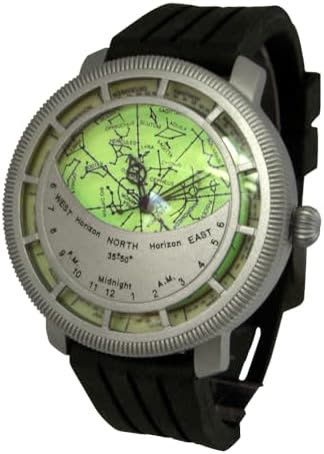
Photographs are illustrative examples of the type, not necessarily the exact object described. Verify details against the source file page.
Sources & references
- Planisphere, Wikipedia (English), retrieved 2026-10-28 (text CC BY-SA 4.0)
- de Carle, D., Watch and Clock Encyclopedia
- Britten, F. J., Old Clocks and Watches and Their Makers
- Horological Journal (British Horological Institute), technical articles
Where sources disagree, the disagreement is stated rather than resolved silently.