
Complication · Calendar & astronomy
Lunar Cycle Register
Partially verifiedA complication tracking the long-term cycle of the moon, including nodes or apogee/perigee.
Definition
A complication tracking the long-term cycle of the moon, including nodes or apogee/perigee.
Historical origin
Advanced astronomical horology going beyond the simple 29.5-day phase.
How it works
Uses additional gearing to track the Draconic or Anomalistic lunar months.
Can indicate when eclipses are likely to occur.
Pocket watch context
Found in the most complex astronomical clocks.
Wristwatch context
Extremely rare in wristwatches, found in 'Mega Complications'.
Identification
- Indicators for lunar nodes or distance to Earth
Servicing notes
Highly specialized; requires astronomical tables for setting.
General guidance only. Complicated mechanisms should be assessed and serviced by a qualified watchmaker or clockmaker specialist, not adjusted at home.
Background
On Jaeger-LeCoultre's Reverso Hybris Mechanica Calibre 185, a lunar register tracks the synodic, draconic and anomalistic cycles, which the maker says allows eclipses and rare phenomena such as supermoons to be determined. The synodic cycle tracks the phases of the moon from one new moon to the next, while the draconic cycle indicates when the moon's orbit intersects the ecliptic plane. The anomalistic cycle monitors the moon's elliptical orbit, specifically tracking the distance between the earth and the moon as it moves between apogee and perigee. Hodinkee notes that the Calibre 185 does not show the precession of the nodes or of the apsides, although its gear trains are calculated to show the time differences between the cycles accurately.
Written from the sources listed under Sources (makers, museums, auction houses and specialist publications are paraphrased, not reproduced); each statement was checked against the cited text, and claims a maker makes about its own work are attributed to it.
Construction and action
- The draconic cycle is shown by a counter depicting the sun with a moon orbited around it to indicate when nodes occur.
- The anomalistic display uses a domed, enamelled Earth with a hemispherical moon in eccentric orbit around it to show the changing distance between them.
- Hodinkee reports that the moon-phase display of this watch needs only one adjustment in 1,111 years.
Use and later history
- Jaeger-LeCoultre describes the Calibre 185 as the first wristwatch to combine these three lunar-cycle displays.
Photographs
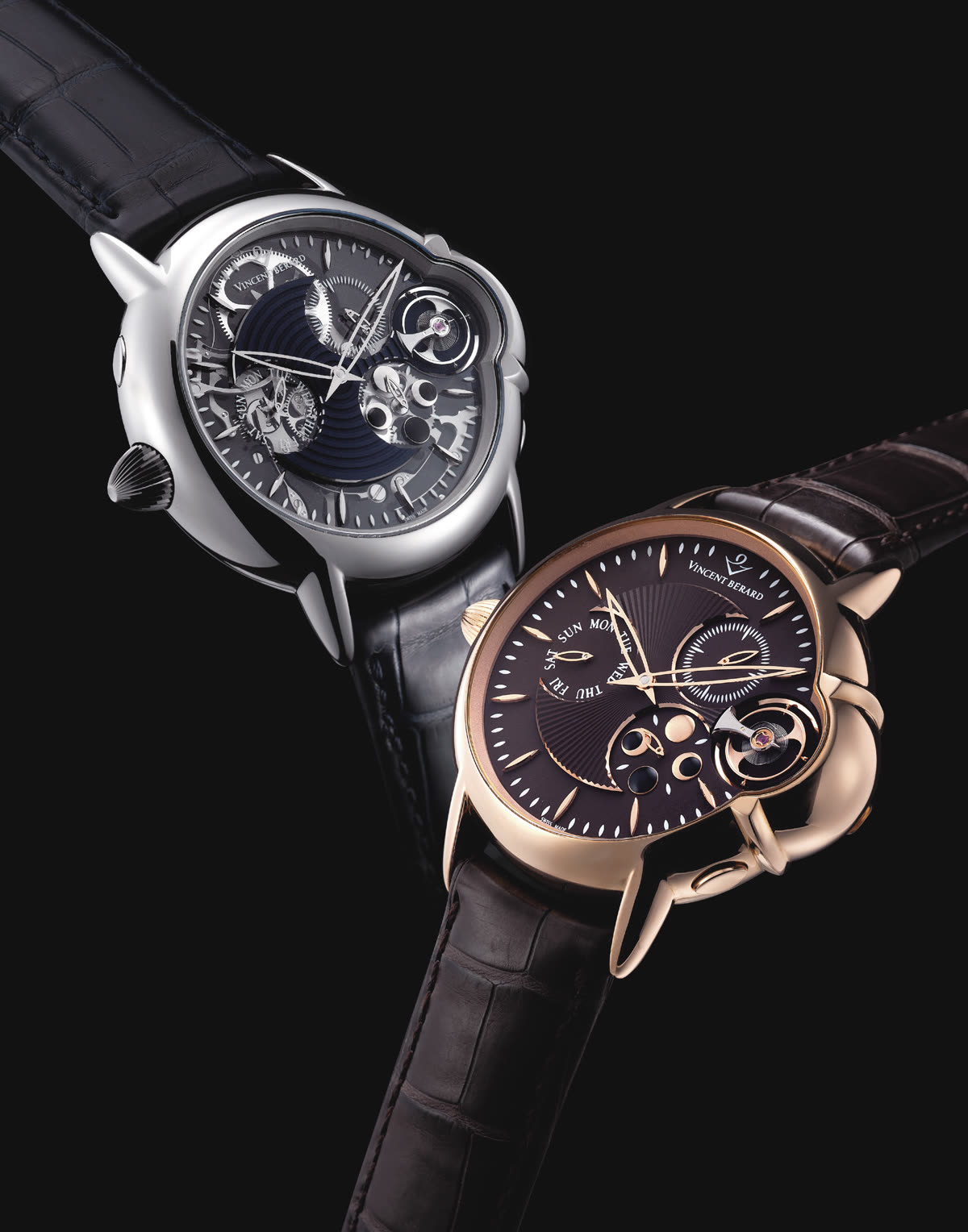
Photographs are illustrative examples of the type, not necessarily the exact object described. Verify details against the source file page.
Sources & references
- Jaeger-LeCoultre unfolds infinity: Reverso Hybris Mechanica Calibre 185 (press release), Jaeger-LeCoultre, retrieved 2026-10-30 (paraphrased; text © the publisher)
- Jaeger-LeCoultre Reverso Hybris Mechanica Calibre 185, Fondation Haute Horlogerie, retrieved 2026-10-30 (paraphrased; text © the publisher)
- In-Depth: Jaeger-LeCoultre launches the Reverso Quadriptyque, Hodinkee, retrieved 2026-10-30 (paraphrased; text © the publisher)
- Eclipses and the Moon's Orbit, NASA Goddard Space Flight Center, retrieved 2026-10-30 (paraphrased; text © the publisher)
- de Carle, D., Watch and Clock Encyclopedia
- Britten, F. J., Old Clocks and Watches and Their Makers
- Horological Journal (British Horological Institute), technical articles
Where sources disagree, the disagreement is stated rather than resolved silently.