
Clock type · Specialist
Time Recorders and Factory Clocks
Partially verifiedClocks that print or punch the time on a card to record working hours.
Background
Time recorders, also known as punch clocks or Bundy clocks, originated in the late 19th century as devices for recording start and end times for hourly employees. Willard Le Grand Bundy invented an influential version in 1888 in Auburn, New York, leading to the formation of the Bundy Manufacturing Company. These devices functioned by having an employee insert a heavy paper card into a slot, where the machine would print a timestamp once a contact was triggered.
Other designs featured a disk or ring with employee numbers, allowing a user to move a revolving arm to punch a specific number upon arrival or departure. Companies such as the International Time Recording Company consolidated several time equipment businesses to manufacture these products throughout the early to mid-20th century.
Written from the sources listed below; each statement was checked against the cited text.
Recognising one
- The devices often utilize a slot for inserting time cards or a revolving arm for selecting employee numbers.
- Early models such as the autograph recorder required the employee to sign a roll of paper and operate a lever.
Movement & mechanism
- A conventional clock movement drives a printing or punching mechanism
- A card is inserted and stamped with the current time
- Many were part of a master and slave network in larger works
- Conventional clock movement coupled to a printing mechanism
- Type wheels carry the hours and minutes
- A lever or card operation triggers the print
Identification
- A card slot and printing or punching mechanism
- Company nameplates from the recorder trade rather than clockmakers
- Original cards and ribbons are rarely present
- Heavy industrial case, often iron or wood
- A slot for cards or a handle to operate the print
- Presence of a paper roll or ribbon
Terminology
- Time recorder
- Card punch
- Works clock
- Punch clock
- Attendance clock
Known variations
- Printing, punching and dial-recorder versions
- Dial recorders and card recorders
Collecting notes
Originality decides value and interest: check that movement, dial and case belong together, and prefer honest wear over refinishing. Movement work belongs with a clockmaker; cleaning a dial or case yourself commonly destroys the evidence that dates the clock.
Photographs
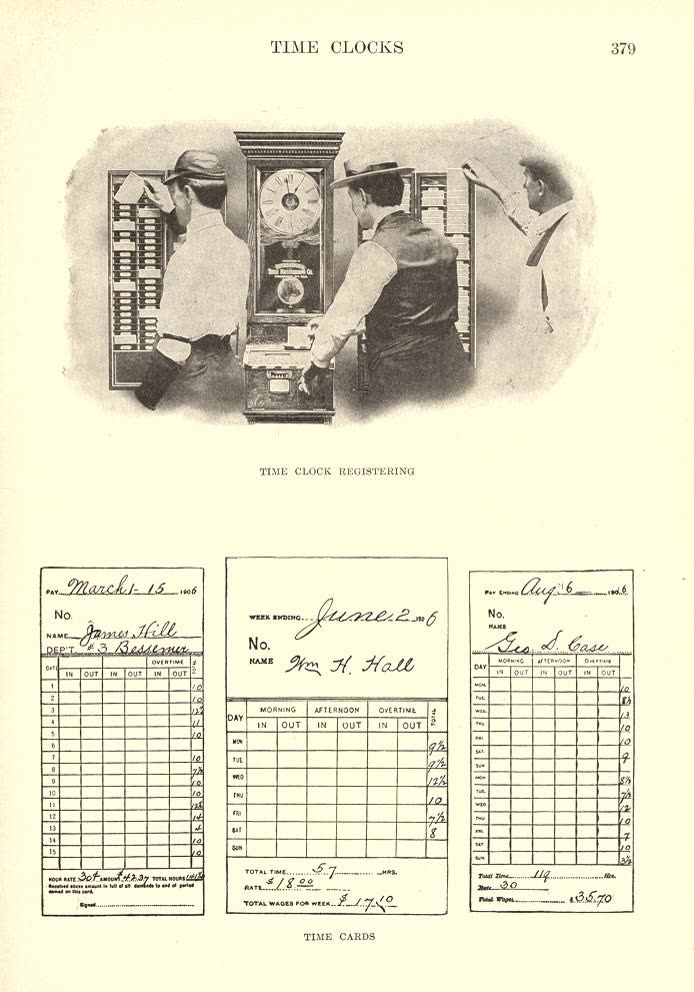
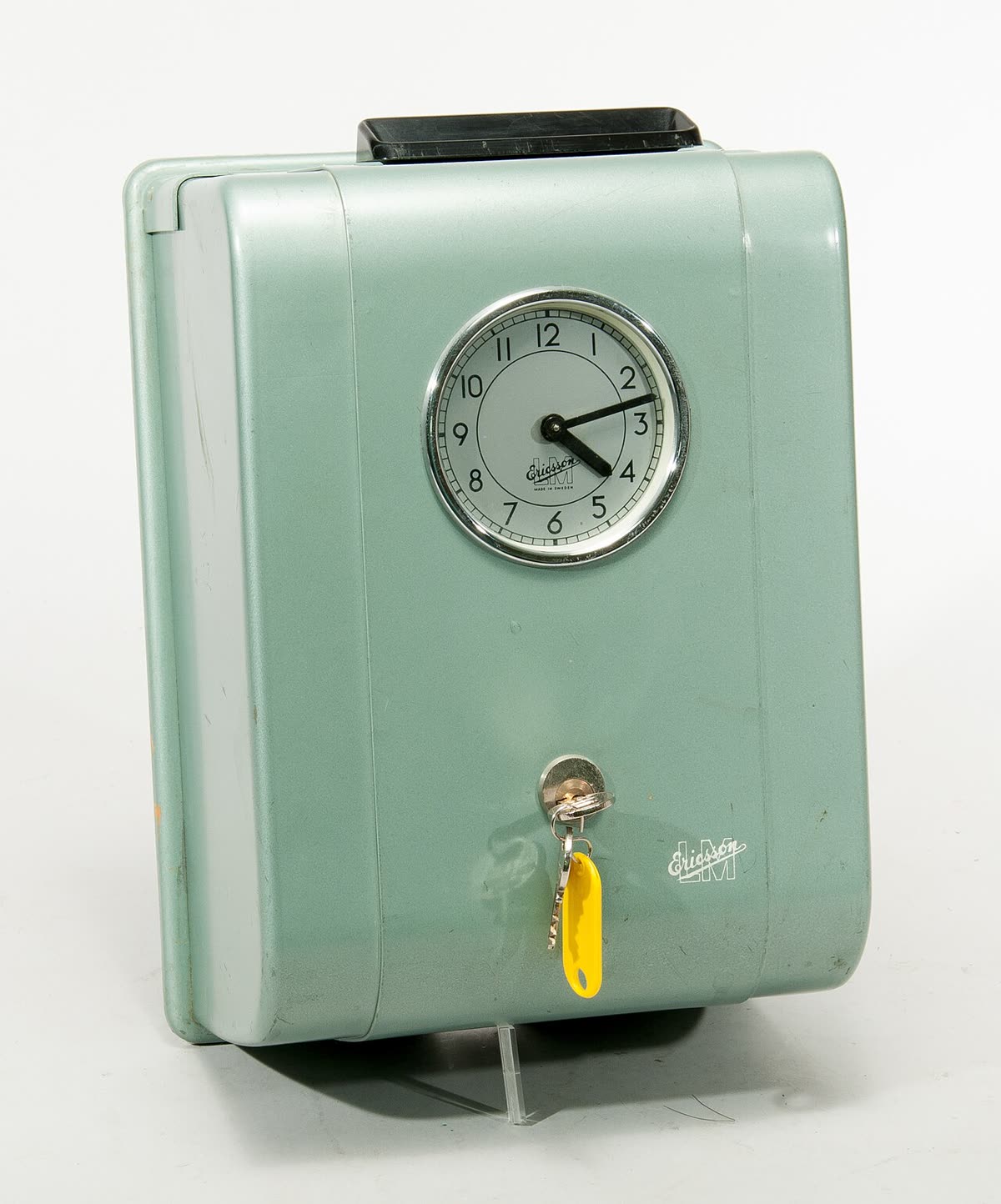
Photographs are illustrative examples of the type, not necessarily the exact object described. Verify details against the source file page.
Sources & references
- Time clock, Wikipedia (English), retrieved 2026-10-28 (text CC BY-SA 4.0)
- Bundy Manufacturing Company, Wikipedia (English), retrieved 2026-10-28 (text CC BY-SA 4.0)
- Britten, F. J., Old Clocks and Watches and Their Makers
- Loomes, B., reference works on British clockmakers (edition-dependent)
- Museum catalogue descriptions of comparable examples
- Loomes, B., The Early Clockmakers of Great Britain
- Museum catalogue records
Where sources disagree, the disagreement is stated rather than resolved silently.