
Clock type · Specialist
Organ Clocks
Partially verifiedClocks incorporating a small pipe organ that plays at set times.
Background
The origin of the pipe organ clock is unknown, though they were crafted as elaborate timepieces by masters in Augsburg around 1600. These clocks combine a mechanical timepiece with a small pipe organ that plays music at set times. Construction involves a pinned cylinder that controls the music, with the finest examples produced in Vienna and Berlin for wealthy and educated patrons.
Large quantities of simpler versions were manufactured in the Black Forest between 1770 and 1850 for use in public houses. Renowned composers including Haydn, Mozart, and Beethoven wrote works specifically for these musical instruments.
Written from the sources listed below; each statement was checked against the cited text.
Recognising one
- The case may take the form of a floor clock or a wall clock.
- Some examples feature ornate wooden cases with decorative metal inlay or gold-cast trimmings like rocailles and acanthus leaves.
- Advanced models may incorporate moving figures that act in coordination with the musical performance.
Condition and survival
- It is sometimes unknown if a specimen retains its complete musical mechanism, though the tin pipes often remain.
- Some rare examples have survived in nearly original condition with their original cylinders and melodies intact.
Where sources differ
- Period. This guide records: “c. 1750 – 1850”. While production peaked in the late 18th century, early versions were built by masters around 1600.
Movement & mechanism
- Bellows supply wind to a set of small pipes
- A pinned barrel opens pallets admitting air to each pipe
- A weight or spring train powers the bellows and barrel
Identification
- Organ pipes within or beneath the case
- Bellows and a pinned barrel
- Leather bellows commonly perished and re-covered
Terminology
- Flötenuhr
- Pinned barrel
- Pallet
Known variations
- Cabinet and longcase forms
Collecting notes
Originality decides value and interest: check that movement, dial and case belong together, and prefer honest wear over refinishing. Movement work belongs with a clockmaker; cleaning a dial or case yourself commonly destroys the evidence that dates the clock.
Photographs
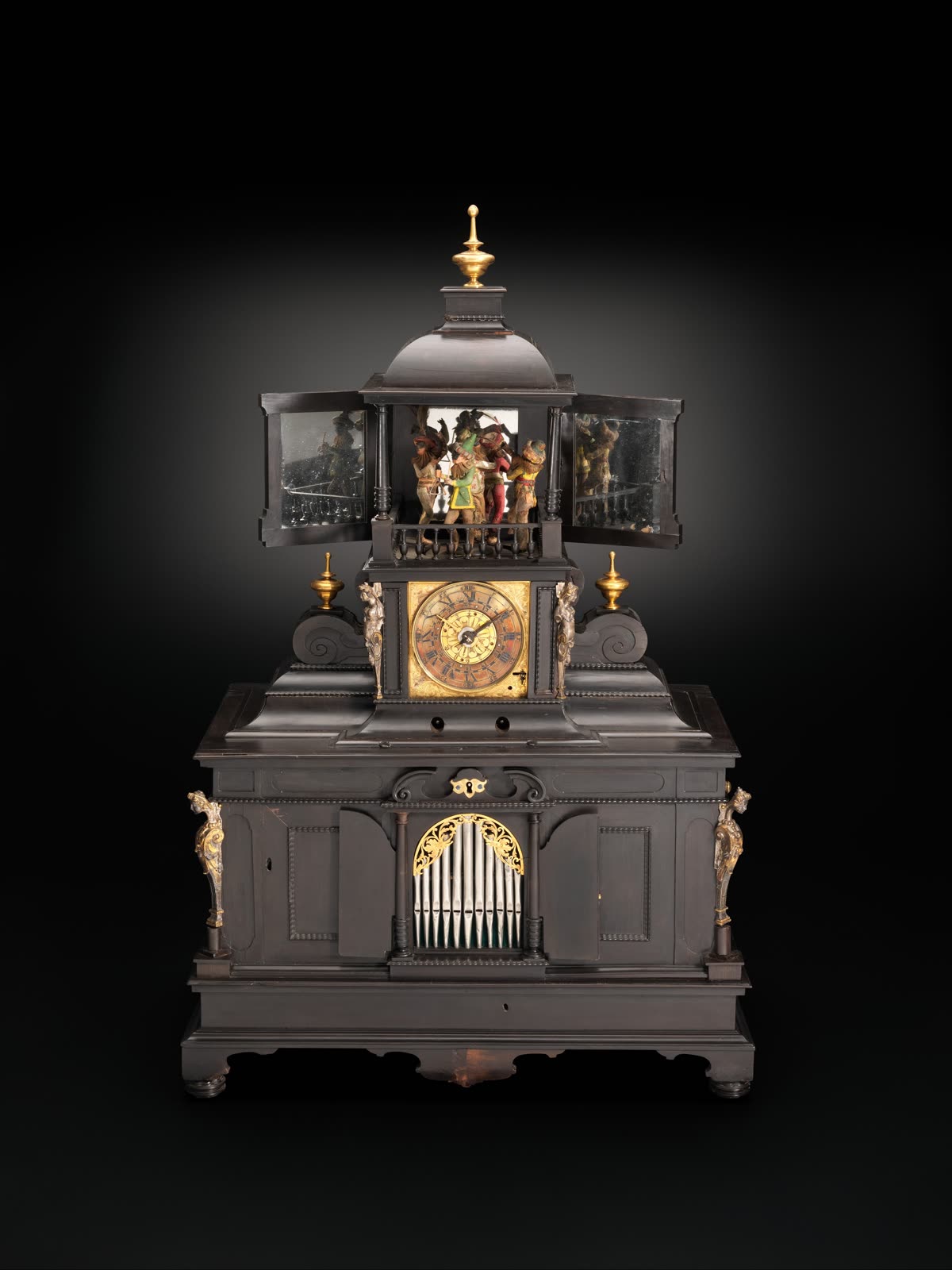
Photographs are illustrative examples of the type, not necessarily the exact object described. Verify details against the source file page.
Sources & references
- Musical clock, Wikipedia (English), retrieved 2026-10-28 (text CC BY-SA 4.0)
- Flötenuhr, Wikipedia (German), retrieved 2026-10-28 (text CC BY-SA 4.0)
- Britten, F. J., Old Clocks and Watches and Their Makers
- Loomes, B., reference works on British clockmakers (edition-dependent)
- Museum catalogue descriptions of comparable examples
Where sources disagree, the disagreement is stated rather than resolved silently.