
Skip to content
The Encyclopedia of Horology

Tool · Central European vertical disc dial

Vertical Disc Dial by Alexius Schniep

Partially verified

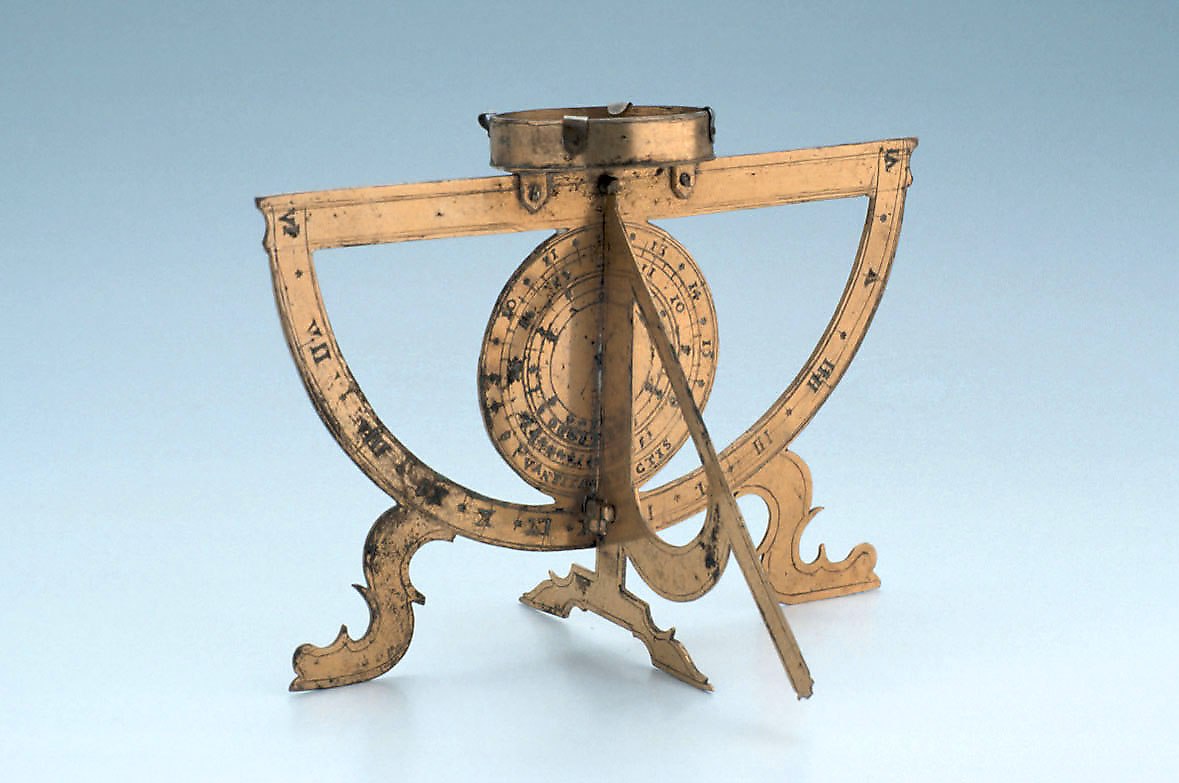
This gilt brass vertical disc dial, attributed to the maker Alexius Schniep, is dated to circa 1600. Measuring 145 x 85 x 2 mm, the instrument is constructed with a flat half-ring supported by a brass tripod stand. A folding gnomon is provided for timekeeping, with hour lines engraved on the ring, indicating common hours from VI to XII to VI to the half-hour. The central portion of the instrument features a round brass plate displaying the lengths of the day and night with hour markings and sunrise and sunset indicators. The reverse of the round plate includes a pierced lunar volvelle with an aspectarium. A compass is soldered to the top of the dial, which is currently missing its original needle and glass cover. The instrument displays technical markings in Latin, including cardinal points and descriptive labels for its various astronomical functions.

A gilt brass vertical disc dial with a folding gnomon and tripod base, signed by Alexius Schniep, circa 1600.
A gilt brass vertical disc dial with a folding gnomon and tripod base, signed by Alexius Schniep, circa 1600. — Museum of the History of Science, Oxford. Rights pending — permission not yet requested. Original source

Catalogue identity

Source
www.mhs.ox.ac.uk
Category
Tool · Central European vertical disc dial
Maker / attribution
Alexius Schniep
Reference
Not recorded
Catalogue / lot identifier
33775
Source-reported date
circa 1600
Source-reported place
Vienna, Austria

Source-reported attribution and specifications are not independent authentication. A listing does not establish present ownership, current display, availability or permission to reproduce.

Object description

Construction and Design

The instrument is crafted from gilt brass and is composed of several integrated components designed for portability and function. The main frame consists of a flat half-ring that serves as the dial plate, supported by a tripod stand which allows it to be placed upright on a flat surface. A folding gnomon is positioned at the center of the arc to cast the shadow required for solar time observation.

Mounted to the top of the ring is a compass housing, which is soldered directly to the structure. Internally, the assembly features a round brass plate positioned within the half-circle. This internal plate acts as a multifunctional astronomical tool, presenting both temporal and lunar calculations to the user through various engravings and a pierced mechanical component.

Evidence for this section
  • “The dial has a gilt brass flat half-ring with a folding gnomon surmounted by a compass.”
  • “The ring stands on a brass tripod”
  • “Inside the half-circle is a round plate”

Astronomical and Timekeeping Functions

The dial provides solar timekeeping via common hour lines engraved on the face of the half-ring, calibrated from VI to XII to VI and divided to the half-hour. In addition to standard time, the instrument facilitates calculation of seasonal day and night durations. The central round plate is engraved with 'QVANTITAS NOCTIS' and 'quantitas diei', allowing for the monitoring of the length of the night and day respectively, marked in half-hour intervals from 8 to 16.

The functionality is extended by the inclusion of 'oriens' and 'OCCIDENS' labels to denote sunrise and sunset times. Furthermore, the reverse of the central plate features a pierced lunar volvelle equipped with an aspectarium, providing the user with lunar phase information and planetary aspects.

Evidence for this section
  • “hour lines are engraved on the half-circle marking common hours from VI to XII to VI to the half-hour.”
  • “round plate, engraved on the same side as the hour lines, with the length of the night and of the day”
  • “On the other side of the round plate is a pierced lunar volvelle with aspectarium.”

Signatures and Condition

The maker's mark is engraved on the side of the half-circle, specifically identifying the piece as the work of Alexius Schniep of Vienna. The cardinal points of the compass are also inscribed on the compass ring in Latin, including 'meridies', 'occidens', 'septen', and 'oriens', accompanied by indications of magnetic declination. This signature block provides the attribution for the instrument's origin.

Regarding the state of the object, the source reports that the compass needle and the associated glass covering are absent. Despite these losses to the compass assembly, the brass structure and the engraved scales remain part of the catalogued instrument held within the Museum of the History of Science.

Evidence for this section
  • “On the other side of the half-circle is the signature 'HOC OPVS FECIT ALEXIVS SCHNIEPP VIENNA AVSTRIA'”
  • “The compass (needle and glass missing) is soldered on the top”

Open research questions

  • What specific type of magnetic declination scale is represented on the compass ring?
  • How does the aspectarium on the lunar volvelle function to calculate planetary aspects?

Source evidence

Recorded claims and source quotations for Vertical Disc Dial by Alexius Schniep
FieldSource-reported valueSource quotation
MakerAlexius Schniep“Signed by Alexius Schniep”
Datecirca 1600“circa 1600”
LocationVienna, Austria“VIENNA AVSTRIA”
Dimensions145 x 85 x 2 mm“145 x 85 x 2 mm”
Inventory Number33775“Inventory number 33775”
MaterialsGilt brass“Gilt brass”
SignatureHOC OPVS FECIT ALEXIVS SCHNIEPP VIENNA AVSTRIA“HOC OPVS FECIT ALEXIVS SCHNIEPP VIENNA AVSTRIA”

Visible details

  • Folding gnomon attached to the center of the arc
  • Engraved hour markings ranging from VI to XII to VI
  • Missing magnetic needle and glass cover for the compass

Research qualifications

  • Original compass needle is missing
  • Original compass glass is missing

Photograph identity and source facts were screened before import; rights clearance remains pending.

Consulted source

Vertical Disc Dial

Reviewed 2026-10-26 · Record 478adb7e3e

Terms in this record

Glossary explanations for terms named in this object’s record.