
Skip to content
The Encyclopedia of Horology

Tool · Universal ring sundial

Universal ring sundial

Partially verified

This universal ring sundial, accessioned as 03.21.25, is held in the collection of The Metropolitan Museum of Art in New York. The object is constructed from brass and measures three inches (7.6 cm) in diameter. It is categorized by the museum's European Sculpture and Decorative Arts department as a universal ring sundial. The instrument is intended for the measurement of time via solar observation, utilizing a circular ring format. The piece is dated by the museum to the early 18th century. This record is based on the institution's open-access documentation. The object serves as a tool for astronomical timekeeping, reflecting the portable nature of horological instruments during this period. It represents a specific item preserved within a public museum institution.

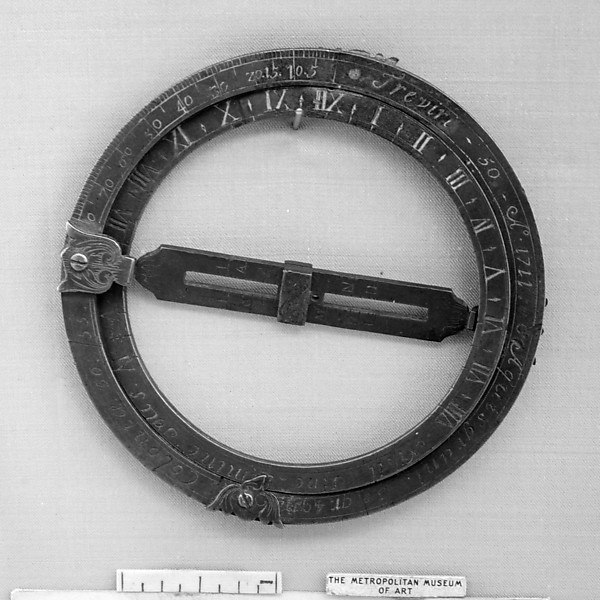
Universal ring sundial, early 18th century, brass, 3 inches in diameter, in the collection of The Metropolitan Museum of Art (accession 03.21.25).
Universal ring sundial, early 18th century, brass, 3 inches in diameter, in the collection of The Metropolitan Museum of Art (accession 03.21.25). — The Metropolitan Museum of Art, New York. Rights pending — permission not yet requested. Original source

Catalogue identity

Source
orbiscollectibles.com
Category
Tool · Universal ring sundial
Maker / attribution
Not established
Reference
Not recorded
Catalogue / lot identifier
03.21.25
Source-reported date
early 18th century
Source-reported place
Not established

Source-reported attribution and specifications are not independent authentication. A listing does not establish present ownership, current display, availability or permission to reproduce.

Object description

Construction and Design

The universal ring sundial is a portable astronomical instrument composed primarily of brass. The object has a diameter of 3 inches (7.6 cm) and is circular in its overall geometry. The frame consists of a ring that serves as the base for the various astronomical and temporal scales required for the calculation of time.

The instrument includes a pivoting central bridge that spans the diameter of the ring. This component is adjustable, allowing for the alignment necessary to capture solar positioning.

Evidence for this section
  • “The museum records the medium as Brass and the dimensions as Diameter: 3 in. (7.6 cm).”
  • “Universal ring sundial, early 18th century”

Inscriptions and Markings

The outer rim of the sundial displays a series of engraved markings. These include Roman numerals for time indication, as well as distinct numerical sequences that suggest coordinate or latitude data. The inscription 'Treviri' is visible on the surface, alongside the date '1711'.

The presence of these markings allows the user to calibrate the instrument.

Evidence for this section
  • “The museum dates it early 18th century.”
  • “Universal ring sundial, early 18th century”

Provenance and Documentation

The object is part of the collection of The Metropolitan Museum of Art in New York, where it is held under the accession number 03.21.25. It was catalogued by the museum's European Sculpture and Decorative Arts department. This institution maintains the object as an accessible part of its horological holdings.

As a documented specimen, the sundial provides insight into the history of portable timekeeping devices.

Evidence for this section
  • “Universal ring sundial in The Metropolitan Museum of Art, New York (accession 03.21.25), catalogued by the museum's European Sculpture and Decorative Arts department.”
  • “Met object 03.21.25 (ID 188845); photograph fetched and visually checked 2026-10-21; details transcribed from the museum record.”

Open research questions

  • What is the specific geographical origin of the 'Treviri' inscription?
  • Does the object retain all original functional components as of its accession into the museum?

Source evidence

Recorded claims and source quotations for Universal ring sundial
FieldSource-reported valueSource quotation
Dimensions3 in. (7.6 cm)“Diameter: 3 in. (7.6 cm)”
Object Number03.21.25“Museum object number 03.21.25”
DepartmentEuropean Sculpture and Decorative Arts“catalogued by the museum's European Sculpture and Decorative Arts department.”
ClassificationHorology“Classification Horology”
Accession ID188845“Met object id 188845”

Visible details

  • The outer ring features engraved Roman numerals for hour indication.
  • A central bridge is mounted on a swivel mechanism across the ring diameter.
  • The surface exhibits engraved inscriptions including 'Treviri' and '1711' along the outer rim.
  • Graduated degree scales are visible along the perimeter of the circular frame.

Research qualifications

  • The exact maker is not specified in the source provided.
  • The geographical origin of manufacture remains unconfirmed by the museum record.

Photograph identity and source facts were screened before import; rights clearance remains pending.

Consulted source

Universal ring sundial, early 18th century

Reviewed 2026-11-02 · Record 38f36dcd9d

Terms in this record

Glossary explanations for terms named in this object’s record.

Other universal ring sundial records