
Skip to content
The Encyclopedia of Horology

Clock · Time recorder clock

Time Clock by Cox Walkers Ltd

Partially verified

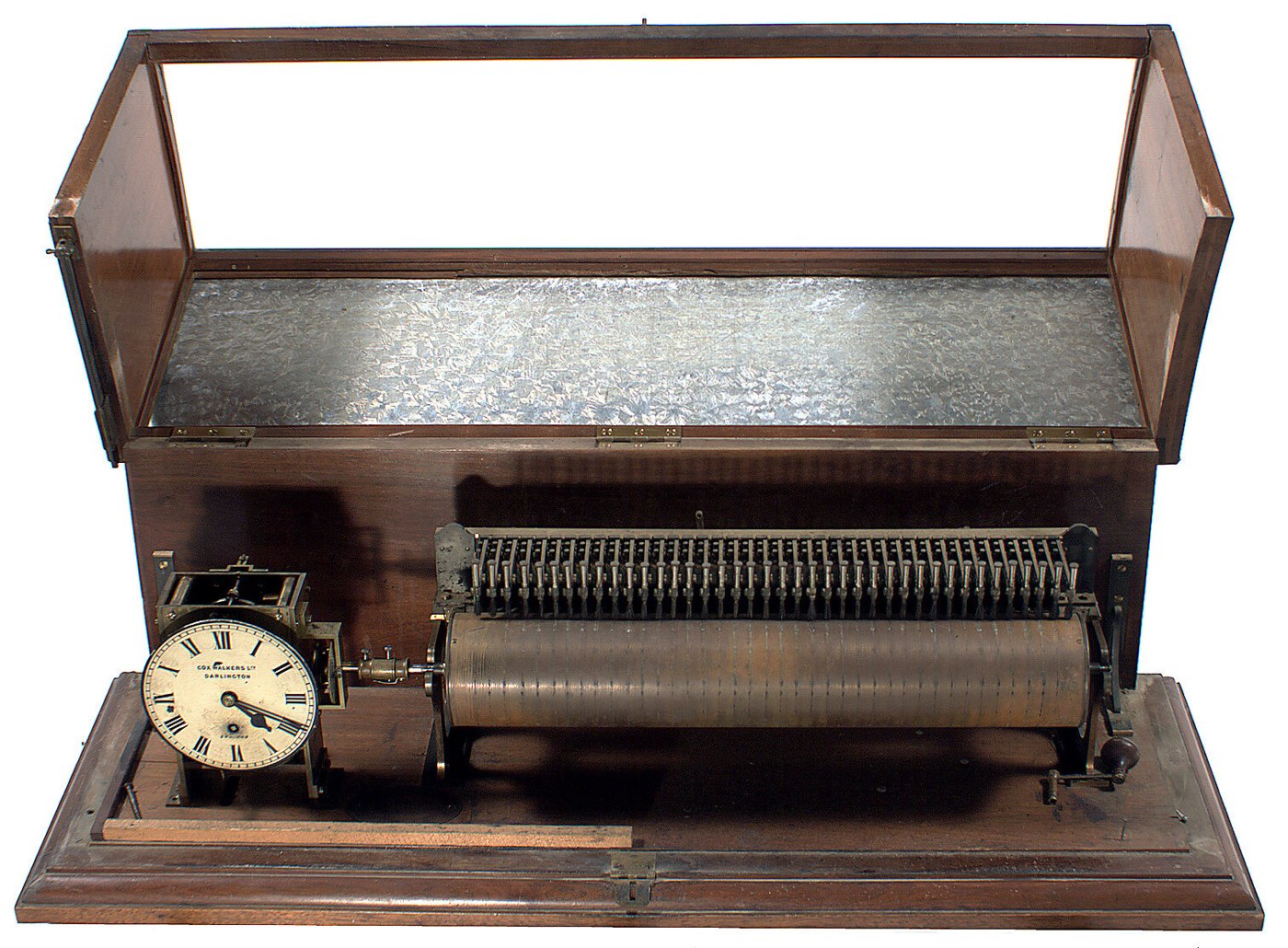
This time clock is a mechanical recording device produced by Cox Walkers Limited of Darlington, England, with additional electrical engineering work attributed to Lawrence and Hanson of Australia. Dated to approximately 1898, the device was designed to monitor employee attendance and round completion. The mechanism features a round clock face integrated with a horizontal copper cylinder. A row of suspended metal brushes sits above the cylinder, while a numbered wheel positioned at the side manages the recording process. The entire assembly is housed within a varnished wooden box, topped with a piece of galvanized iron and equipped with a front glass viewing panel. A internal winder with a wooden knob facilitates operation. The clock was formerly utilized at the Mayday Hills Hospital in Beechworth, Victoria, where it served to track staff activity through marked paper rolls reviewed by the facility's Superintendent.

Full view of the time clock, showing the clock face, recording cylinder with brush assembly, and wooden protective case with glass panel.
Full view of the time clock, showing the clock face, recording cylinder with brush assembly, and wooden protective case with glass panel. — Museums Victoria. Rights pending — permission not yet requested. Original source

Catalogue identity

Source
collections.museumsvictoria.com.au
Category
Clock · Time recorder clock
Maker / attribution
Cox Walkers Limited
Reference
Not recorded
Catalogue / lot identifier
SH 923100
Source-reported date
circa 1898
Source-reported place
England
Source-reported serial
SH 923100

Source-reported attribution and specifications are not independent authentication. A listing does not establish present ownership, current display, availability or permission to reproduce.

Object description

Mechanical Configuration

The time clock is constructed around a central horizontal copper cylinder, which serves as the primary recording surface for employee attendance data. A row of brushes is suspended directly above this cylinder to facilitate the marking process. The device is operated via a numbered wheel located at the side of the apparatus, which coordinates with the clock mechanism to log specific time intervals.

The clock face features standard Roman numerals and individual minute markers. The entire recording assembly is secured to a base and enclosed within a wooden cabinet. Access to the internal components is gained by lifting the box away from the base. A winder equipped with a wooden knob is provided for manual interaction with the system.

Evidence for this section
  • “Numbered wheel at side attaches to a long copper cylinder.”
  • “A row of brushes is suspended above cylinder.”
  • “A winder with a wooden knob lies inside the box.”

Housing and Materials

The instrument is contained within a varnished wooden box designed for interior institutional use. The front of the case features a glass panel that allows for viewing the clock face and internal mechanical components. The top of the housing is covered by a piece of galvanized iron, providing a protective lid for the mechanism.

The device is large, measuring 104.8 cm in length, 36.2 cm in width, and 32.7 cm in height.

Evidence for this section
  • “Clock consists of a round clock face mounted on a metal frame at the back of which is a bell.”
  • “Time clock is housed in a varn- ished wood box with a glass front and a piece of galvanized iron over the top.”

Operational History

The clock was installed in the Superintendent's Office at the Mayday Hills Hospital in Beechworth, Victoria, around 1920. Its primary purpose was the monitoring of staff rounds within the facility. Attendants were required to punch the bell at designated times, leaving marks on a paper roll situated within the recording mechanism.

The Head Attendant was responsible for the maintenance of the paper roll, which was subsequently provided to the Superintendent for verification. This system ensured that administrative staff could confirm that all scheduled rounds were performed accurately by hospital personnel. The device remained in institutional service until its donation to the museum collection in 1992.

Evidence for this section
  • “The Head Attendant would change the roll of paper and hand the marked roll to the Superintendent”
  • “It was located in the Superintendent's Office at Mayday Hills Hospital, Beechworth, Victoria.”

Open research questions

  • What specific type of electrical signal was integrated by Lawrence & Hanson into the mechanical design?
  • Are there records detailing the specific model name or patent number associated with this Cox Walkers unit?

Source evidence

Recorded claims and source quotations for Time Clock by Cox Walkers Ltd
FieldSource-reported valueSource quotation
Registration NumberSH 923100“Registration number: SH 923100”
MakerCox Walkers Limited“manufactured by Cox Walkers Limited”
Datecirca 1898“circa 1898”
Country of ManufactureEngland, Great Britain“country: England, Great Britain”
Electrical EngineerLawrence & Hanson“electrical engineering work by Lawrence and Hanson”
Length104.8 cm“104.8 cm (Length)”
ProvenanceMayday Hills Hospital“Donation from Mayday Hills Hospital”

Visible details

  • Clock face displays Roman numerals and minute markers.
  • Copper cylinder spans the majority of the wooden base.
  • Row of metallic brushes is suspended over the cylinder.
  • Top section of the wooden housing features a galvanized iron surface.

Research qualifications

  • Specific date of internal electrical modifications by Lawrence & Hanson remains unverified beyond '1898 or later'.
  • Functionality of the internal mechanism in current state is not assessed.

Photograph identity and source facts were screened before import; rights clearance remains pending.

Consulted source

Time Clock - Cox Walkers Ltd, circa 1898

Reviewed 2026-10-26 · Record a1ef06ecea

Terms in this record

Glossary explanations for terms named in this object’s record.