
Skip to content
The Encyclopedia of Horology

Clock · Tall case clock

Tiger Maple Tall Case Clock by Reuben Ingraham

Partially verified

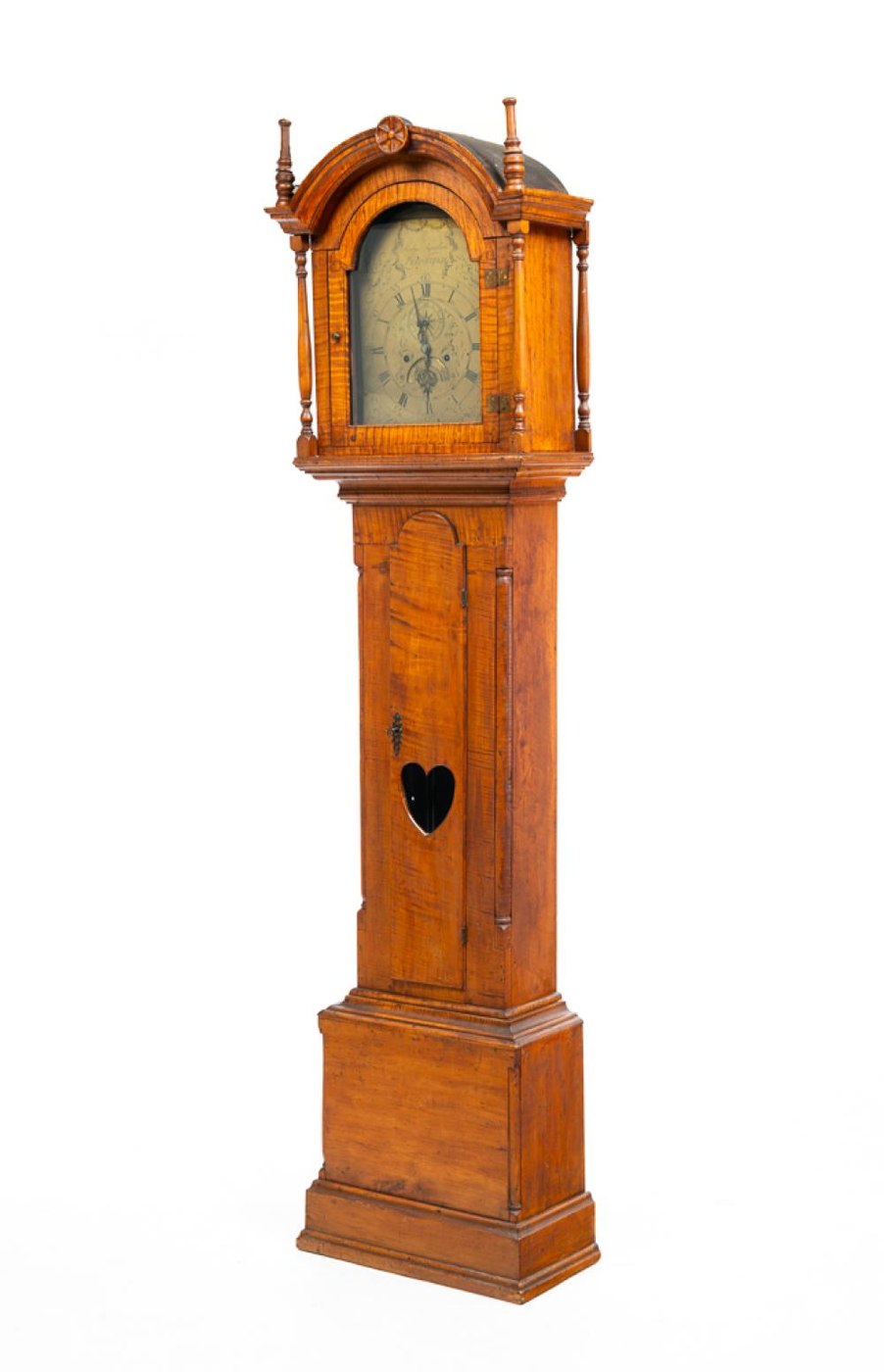
This tall case clock, constructed from tiger maple, is attributed to the clockmaker Reuben Ingraham (1743-1811) of Plainfield, Connecticut. The clock features a bonnet-top design with an arched top, turned finials, and pilasters, accented by a spoked central rondel. The case includes bold moldings beneath the bonnet and at the waist, complemented by quarter-round turned pilasters. The door is detailed with a distinctive heart-shaped pendulum window. The dial is composed of engraved brass, and the movement consists of brass works, powered by weights and a pendulum. According to the auction documentation, the case wood was reportedly harvested from the property of Stephen Hall in Plainfield, Connecticut, and referenced in his will. The clock stands 85 inches high, 21.5 inches wide, and 10.5 inches deep, and it has been previously featured in an issue of Antiques Magazine from September 1940.

Full-length view of the tiger maple tall case clock with bonnet top and heart-shaped pendulum window.
Full-length view of the tiger maple tall case clock with bonnet top and heart-shaped pendulum window. — Amelia Auctions & Appraisals (via Invaluable). Rights pending — permission not yet requested. Original source

Catalogue identity

Source
www.invaluable.com
Category
Clock · Tall case clock
Maker / attribution
Reuben Ingraham
Reference
Not recorded
Catalogue / lot identifier
572
Source-reported date
late 18th Century
Source-reported place
American

Source-reported attribution and specifications are not independent authentication. A listing does not establish present ownership, current display, availability or permission to reproduce.

Object description

Construction and Exterior

The clock case is executed in tiger maple and follows a traditional bonnet-top architectural form. The hood is characterized by an arched top fitted with turned finials and flanked by pilasters. A decorative spoked central rondel serves as a focal point for the arch. The trunk section exhibits bold moldings placed both under the bonnet and at the waist, providing a transition between the upper and lower elements.

Further ornamentation includes quarter-round turned pilasters running along the case. The door of the trunk is notable for an inset heart-shaped pendulum window. The base features simple moldings, anchoring the overall structure. The visual presentation of the tiger maple suggests high-quality timber, which provenance records identify as being sourced from the Connecticut property of the original owner, Stephen Hall.

Evidence for this section
  • “Bonnet with arched top, turned finials and pilasters, spoked central rondel, and arched door.”
  • “Case with bold moldings under bonnet and at waist, quarter round turned pilasters, overlapping door with heart-shaped pendulum window and simple base molding.”
  • “Reputedly made from wood cut on the property of Stephen Hall in Plainfield, Connecticut, and mentioned in his will.”

Movement and Dial

The timekeeping mechanism is driven by brass works. , which are visible through the heart-shaped opening in the door. The dial itself is crafted from engraved brass, which matches the aesthetic of the period described.

The clock's internal support structure has undergone repairs. The current auction condition report indicates that the original seat board has been replaced. Additionally, structural modifications include the installation of shims on the sides of the seat board at the back of the dial and the addition of one-inch cubes to the back of the case to meet the seat board.

Evidence for this section
  • “Engraved brass face, brass works, weights, and pendulum.”
  • “The seat board has been replaced; shims on each side of the seat board at the back of the face; 1" cubes shimming the back of the case where it meets the seat board.”
  • “Saddle board replaced.”

Provenance and Documentation

The history of this object is traced back to its original owner, Stephen Hall. It passed through the family to William F. Hall. The piece has maintained a documented history, having been featured in the September 1940 edition of Antiques Magazine.

Reuben Ingraham, the maker, was active in Plainfield, Connecticut, and held an apprenticeship under John Avery, Sr. This connection places the clock within a regional tradition of clockmaking in Connecticut during the late 18th century.

Evidence for this section
  • “Provenance: Stephen Hall (original owner); William F. Hall.”
  • “Cataloguer's note: This clock by Ingraham is discussed and pictured in Antiques Magazine, September 1940, pages 116-188, figure 1.”
  • “Reuben Ingraham apprenticed with clockmaker and silversmith John Avery, Sr. (1732-94) of Preston, Connecticut.”

Open research questions

  • To what extent does the internal movement mechanism match the style of John Avery, Sr., given Ingraham's apprenticeship?
  • Are there extant copies of the will of Stephen Hall that confirm the provenance and the origin of the wood?

Source evidence

Recorded claims and source quotations for Tiger Maple Tall Case Clock by Reuben Ingraham
FieldSource-reported valueSource quotation
MakerReuben Ingraham“BY REUBEN INGRAHAM (1743-1811)”
MaterialTiger maple“BONNET TOP TIGER MAPLE TALL CASE CLOCK”
Dimensions85"h. 21.5"w. 10.5"d.“85"h. 21.5"w. 10.5"d.”
Dial MaterialBrass“Engraved brass face”
ProvenanceStephen Hall, William F. Hall“Provenance: Stephen Hall (original owner); William F. Hall.”
LiteratureAntiques Magazine, September 1940“discussed and pictured in Antiques Magazine, September 1940, pages 116-188, figure 1.”
Mechanical ComponentsBrass works, weights, pendulum“brass works, weights, and pendulum.”

Visible details

  • Arched dial door with an integrated heart-shaped aperture
  • Tiger maple wood grain visible on the main case and trunk
  • Bonnet hood topped with turned wooden finials
  • Engraved brass dial plate visible within the arched hood door

Research qualifications

  • Origin of the wood is based on repute rather than independent verification
  • The seat board and saddle board have been replaced, affecting original internal components
  • Shimming has been added to the rear of the case to accommodate the seat board

Photograph identity and source facts were screened before import; rights clearance remains pending.

Terms in this record

Glossary explanations for terms named in this object’s record.