
Skip to content
The Encyclopedia of Horology

Tool · Flemish theodolite and sundial

Theodolite and sundial

Partially verified

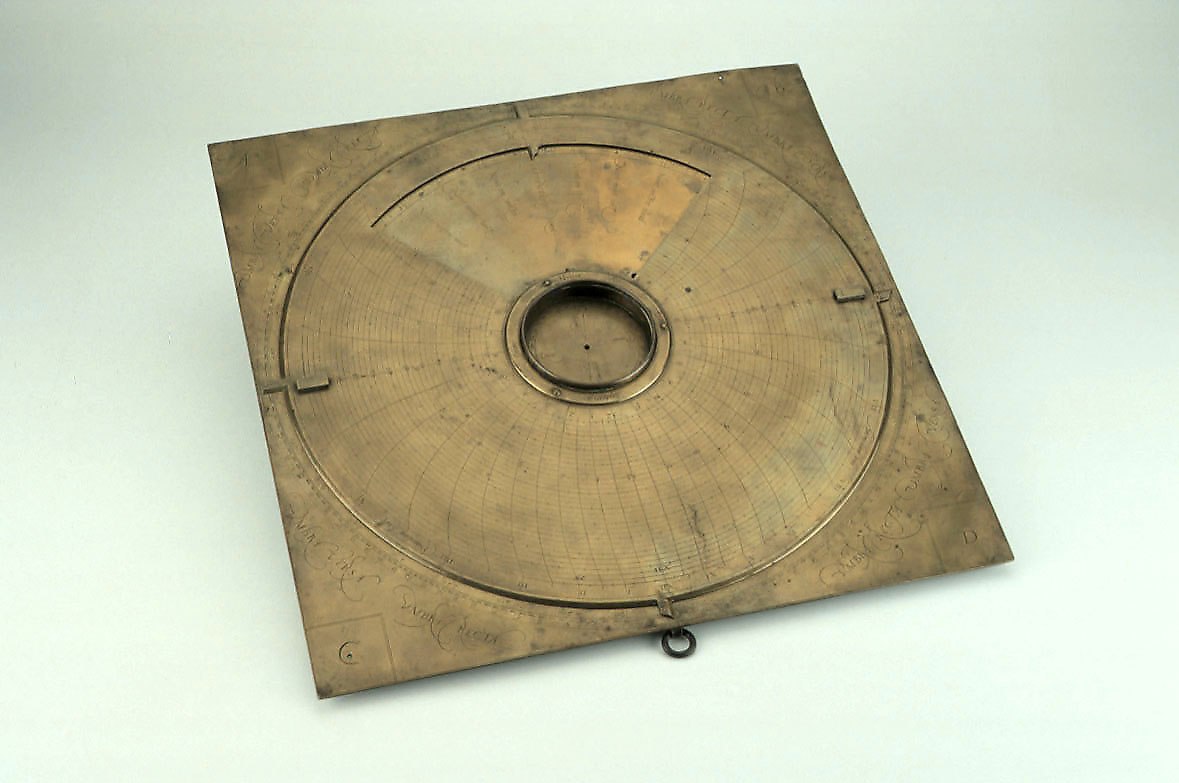
This 364 mm square brass instrument consists of a square base plate with a revolving disc containing an integrated sundial and theodolite. It is attributed to the maker Gualterus Arsenius, working in Louvain around 1570. The plate features a shadow square marked 'VMBRA RECTA' and 'VMBRA VERSA', a scale of degrees from 0 to 360, and a wind rose with 32 directions named in Dutch. The revolving disc, which includes an open quadrant, incorporates hour lines for a horizontal dial adaptable for latitudes 30 to 63 degrees. A central compass bowl, currently lacking its needle and glass, includes a degree scale and Italian wind labels. The reverse side features a cylindrical mounting socket, two suspension rings, and an earlier, now unusable, quadrant graduation. This object is one of several instruments associated with this specific technical design, mirroring features found on other tools of the period.

Square brass instrument showing the revolving disc, central compass bowl, and engraved scales.
Square brass instrument showing the revolving disc, central compass bowl, and engraved scales. — Museum of the History of Science, Oxford. Rights pending — permission not yet requested. Original source

Catalogue identity

Source
www.mhs.ox.ac.uk
Category
Tool · Flemish theodolite and sundial
Maker / attribution
Attributed to Gualterus Arsenius
Reference
Not recorded
Catalogue / lot identifier
86082
Source-reported date
circa 1570
Source-reported place
Louvain

Source-reported attribution and specifications are not independent authentication. A listing does not establish present ownership, current display, availability or permission to reproduce.

Object description

Construction and Plate Layout

The instrument is composed of a 364 mm square brass plate, designed with a revolving disc mechanism. Each corner is marked with the letters A, B, C, and D. The plate contains four circular scales, including an outer shadow square labeled 'VMBRA RECTA' and 'VMBRA VERSA' in each corner, alongside a 0-360 degree scale.

The plate also incorporates a wind rose featuring 32 directions labeled in Dutch, with cardinal points marked in Latin. A corresponding scale of 0-32 surrounds this, complemented by a simpler, ungraduated 32-part inner scale. The reverse side contains a cylindrical socket intended for post mounting and two suspension rings, as well as an earlier quadrant scale that can no longer be used due to subsequent modifications.

Evidence for this section
  • “The instrument consists of a square brass plate with a revolving disc which has one quadrant partly cut away.”
  • “There is a wind rose with 32 directions named in Dutch (with the four cardinal directions also named in Latin) around which is a corresponding circular scale 0 to 32”

Sundial and Compass Features

The revolving disc provides the functionality for a horizontal sundial, with hour lines calibrated for latitudes between 30 and 63 degrees. Declination lines are provided for each degree of latitude. The hours are divided into morning and afternoon sections, with quarter-hour incisions marked on every third declination line. Although the exact construction of the gnomon is not fully determined, a string-based design is proposed.

Located in the center of the disc is a compass bowl, 73 mm in diameter. It includes a degree scale from 0 to 90 and indicates the principal Italian winds. A magnetic variation of approximately 9 degrees east is noted on the instrument. The needle and protective glass are currently absent from the assembly.

Evidence for this section
  • “The revolving disc carries hour lines for a horizontal dial with an adjustable gnomon, for latitudes 30 to 63?, with a declination line for each degree of latitude.”
  • “The compass bowl is 73 mm in diameter and has a scale of degrees 0 to 90 to 0 to 90 to, divided to 10 and 2 and numbered by 10.”

Attribution and Comparative Context

The instrument is unsigned, but scholars have attributed it to Gualterus Arsenius, active in Louvain circa 1570. The design, which combines a square theodolite with a revolving sundial disc, shares characteristics with a signed example currently held in the Württembergisches Landesmuseum in Stuttgart.

The instrument's design philosophy is similar to work by other Flemish makers, such as Petrus ab Aggere, who produced theodolites of a comparable type, though without the integrated sundial feature. The inclusion of an abandoned quadrant on the reverse suggests that the object underwent modifications, such as the addition of the socket and suspension rings, after its initial production.

Evidence for this section
  • “Although unsigned, this unusually large instrument has been attributed to Gualterus Arsenius .”
  • “The combination of a square simple theodolite and a sundial whose hour lines are marked on a revolving disc is to the same design as a signed instrument presently in the W?rttembergisches Landesmuseum in Stuttgart.”

Open research questions

  • What specific string gnomon configuration is implied by the markings on the disc?
  • What is the full provenance of the instrument prior to its acquisition by the Museum of the History of Science?

Source evidence

Recorded claims and source quotations for Theodolite and sundial
FieldSource-reported valueSource quotation
MakerAttributed to Gualterus Arsenius“attributed to Gualterus Arsenius”
Datecirca 1570“circa 1570”
LocationLouvain“Louvain”
Dimensions364 mm square“364 mm square”
Inventory Number86082“Inventory number: 86082”
Wind Rose32 directions named in Dutch“There is a wind rose with 32 directions named in Dutch”
Compass73 mm in diameter“The compass bowl is 73 mm in diameter”

Visible details

  • Square brass plate marked with corner letters A, B, C, and D
  • Central circular compass bowl with a 73 mm diameter
  • Revolving disc with an open quadrant and hour line markings
  • Two suspension rings fixed to the edges of the plate

Research qualifications

  • The exact type of gnomon and its mounting method remain unclear
  • The magnetic needle and compass glass are missing from the central bowl

Photograph identity and source facts were screened before import; rights clearance remains pending.

Consulted source

Theodolite And Sundial

Reviewed 2026-10-26 · Record 55dde89b84

Terms in this record

Glossary explanations for terms named in this object’s record.