
Skip to content
The Encyclopedia of Horology

Tool · Augsburg sundial and dividers

Sundial and dividers by Christoph Schissler

Partially verified

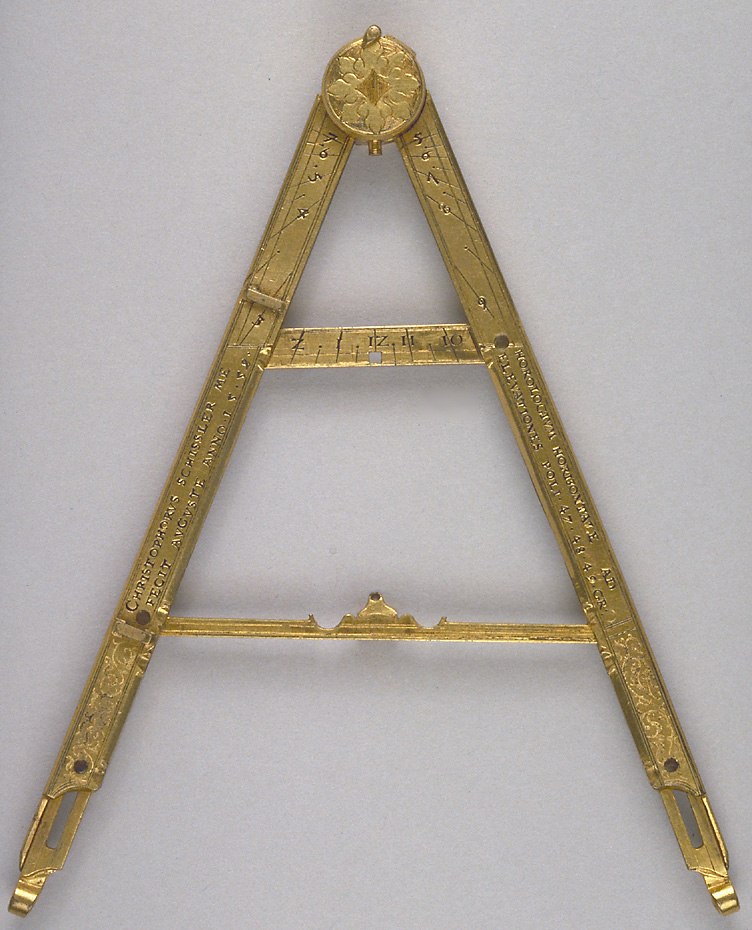
This instrument, fashioned from gilt brass and measuring 165 mm in length, serves as both a pair of dividers and a sundial. Signed by Christoph Schissler and dated 1558, it reflects 16th-century technical instrumentation from Augsburg. The device incorporates a central hinge originally containing a compass, now missing its needle and glass, with a detached, decorated cover. Hour lines for common hours are engraved on the obverse arms and a folding transversal cross-piece, while the reverse arms feature a scale of Augsburg inches. The design includes retractable hooks at the arm ends and unidentified U-shaped brackets on one divider arm. It entered the collection of the British Museum as a bequest from Octavius Morgan in 1888 and is documented in specialized literature regarding scientific instruments.

The sundial and dividers, showing the open arms, transversal supports, and engraved signature.
The sundial and dividers, showing the open arms, transversal supports, and engraved signature. — © British Museum, London. Rights pending — permission not yet requested. Original source

Catalogue identity

Source
www.mhs.ox.ac.uk
Category
Tool · Augsburg sundial and dividers
Maker / attribution
Christoph Schissler
Reference
Not recorded
Catalogue / lot identifier
MLA 1888, 12-1.283
Source-reported date
1558
Source-reported place
Augsburg

Source-reported attribution and specifications are not independent authentication. A listing does not establish present ownership, current display, availability or permission to reproduce.

Object description

Construction and Dial Layout

The instrument is primarily constructed as a pair of gilt brass dividers, with functionality integrated into the arm surfaces. The primary timekeeping scales for common hours are located on the obverse faces of both arms, divided to the half-hour increments. Additional time indication is provided by a folding transversal arm which features hour lines numbered from 10 to 2, facilitating horizontal time observation.

For assembly in use, the instrument is supported by the central hinge and two bun feet situated at the extremity of each divider arm. The instrument retains a degree of mechanical complexity, including extendable sliders that terminate in brass hooks, and specific architectural details such as the engraved arabesque motifs on the lower sections of the arms.

Evidence for this section
  • “The instrument consists of a sundial engraved on a pair of dividers”
  • “The obverse faces of both arms of the dividers is engraved with the hour lines for common hours, divided to the half-hour”
  • “The lower part of both arms is engraved with dotted arabesque decoration”

Inscriptions and Mathematical Scales

The instrument bears a clear signature and date on the obverse face, identifying the maker as Christophorvs Schissler and the place of manufacture as Avgvste. The inscription also specifies the instrument's intended astronomical use, designed for specific pole elevations of 47, 48, and 49 degrees.

The reverse side of the dividers functions as a measuring scale for Augsburg inches. These scales are divided differently on each arm, with one arm showing markings from zero to 6 and the other from 7 to 11, subdivided into fractional units of 1/2, 1/4, 1/8, 1/3, and 1/5, providing a precise utilitarian function alongside the sundial mechanism.

Evidence for this section
  • “'CHRISTOPHORVS SCHISSLER ME FECIT AVGVSTE ANNO ? 15 ? 58 ?'”
  • “'HOROLOGIVM HORIZONTALE AD ELEVATIONES POLI ? 47 ? 48 ? 49 ? GR:<ADVVM>'”
  • “The reverse side of the arms is engraved with a scale of Augsburg inches”

Components and Condition

The central hinge of the dividers serves as the housing for a compass, though this component is currently incomplete, lacking both the magnetic needle and the original glass. The compass cover remains with the instrument but is detached. Additionally, the original gnomon is entirely absent; it is posited that the gnomon was originally fixed between a square hole on the smaller transversal arm and the compass box area.

The instrument includes a fitted leather case, which is lined in green, serving as its primary preservation vessel since its acquisition via the Octavius Morgan bequest. , with specific components such as the gnomon missing, and certain mechanical parts like the U-shaped brackets remaining of uncertain function.

Evidence for this section
  • “On the hinge is a compass (needle and glass missing), with cover (now detached)”
  • “The gnomon is missing. It was probably fixed to the square hole on the smaller transversal arm and on the compass box”
  • “The dividers are kept in a fitted leather case, lined in green.”

Open research questions

  • What is the function of the two U-shaped brackets located on one of the divider arms?
  • Can the missing gnomon be reconstructed based on existing Schissler instruments from the same period to test original accuracy?

Source evidence

Recorded claims and source quotations for Sundial and dividers by Christoph Schissler
FieldSource-reported valueSource quotation
MakerChristoph Schissler“Signed by Christoph Schissler”
Date1558“Dated 1558”
Place of originAugsburg“Augsburg”
MaterialGilt brass“Gilt brass”
Length165 mm“165 mm in length”
Inventory numberMLA 1888, 12-1.283“MLA 1888, 12-1.283”
ProvenanceBequeathed by Octavius Morgan“The instrument was bequeathed by Octavius Morgan in 1888”

Visible details

  • Hinge features a floral engraved design
  • Lower arm sections display arabesque engravings
  • Folding transversal cross-piece contains hour markings
  • Retractable hook sliders extend from each arm end

Research qualifications

  • Missing gnomon and compass needle
  • Functionality of U-shaped brackets unknown

Photograph identity and source facts were screened before import; rights clearance remains pending.

Consulted source

Sundial And Dividers

Reviewed 2026-10-26 · Record a2447c22c4

Terms in this record

Glossary explanations for terms named in this object’s record.