
Skip to content
The Encyclopedia of Horology

Clock · Heliochronometer

Sunclock by William Ernest Cooke

Partially verified

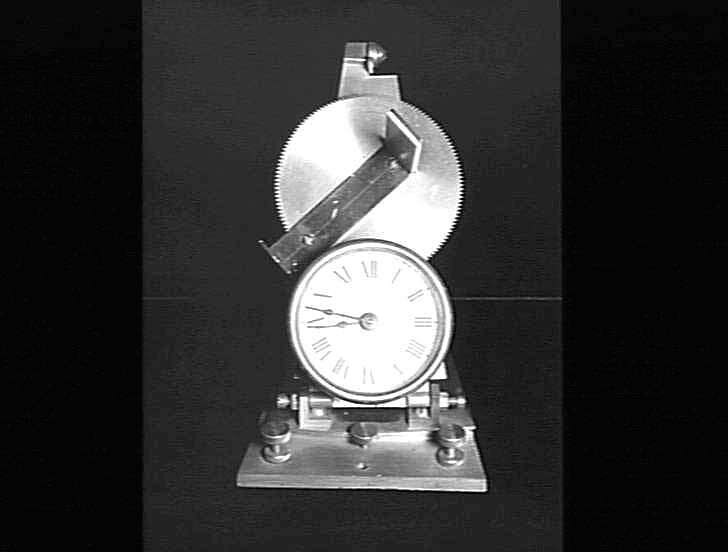
This heliochronometer, or sunclock, was designed and produced by the Government Astronomer of New South Wales, William Ernest Cooke, circa 1922. The instrument is constructed of brass and features a dial marked with the designer's name. It functions by allowing the user to adjust its arms to account for latitude, the time of year, and standard time. A beam of sunlight is directed through an aperture in one arm onto a scale on the opposite arm; this movement, facilitated by a internal gear train, shifts the clock hands to display Standard Time. While Cooke had created an earlier iteration around 1907, this refined model led to the formation of Cooke's Sunclocks Limited in 1926. Despite commercial distribution efforts within Australia and limited international sales, production eventually ceased due to the high costs associated with marketing and logistics.

A profile view of the brass sunclock showing the adjustable arm and gear assembly.
A profile view of the brass sunclock showing the adjustable arm and gear assembly. — Museums Victoria. Rights pending — permission not yet requested. Original source

Catalogue identity

Source
collections.museumsvictoria.com.au
Category
Clock · Heliochronometer
Maker / attribution
William Ernest Cooke
Reference
Not recorded
Catalogue / lot identifier
ST 19074
Source-reported date
circa 1922
Source-reported place
Australia

Source-reported attribution and specifications are not independent authentication. A listing does not establish present ownership, current display, availability or permission to reproduce.

Object description

Mechanical Design and Operation

The sunclock operates as a heliochronometer, utilizing solar positioning to determine the time. The physical configuration consists of a brass assembly where the hands of the clock are linked via a train of gears to two pivoting arms. By adjusting these arms according to the local latitude and the specific time of year, the user aligns the device with the solar path.

To operate the device, the arms are positioned until a beam of sunlight passes through a hole in one arm and strikes a specific line on the other. This mechanical alignment triggers the gear train, which subsequently adjusts the hands on the clock face to indicate the accurate Standard Time. The design reflects an attempt to achieve high precision in solar timekeeping through calibrated manual adjustment.

Evidence for this section
  • “The arms are moved so that a beam of sunlight passes through the hole in one arm onto the line on the other. This moves the hands of the clock to show Standard Time.”
  • “Brass, hands of clock are connected by train of gears to 2 arms”

Historical Context and Development

William Ernest Cooke, the Government Astronomer of New South Wales, was the primary innovator behind this project. He initially developed a prototype around 1907 while serving as the Government Astronomer of Western Australia. This improved model from circa 1922 represents a progression of his earlier scientific interests in solar measurement.

Following the design of this model, Cooke moved toward commercialization. Patents for the device were pursued beginning in 1923, and in 1926, the company Cooke's Sunclocks Limited was established to manage the manufacture and sale of the units. While several hundred clocks were produced and distributed domestically and overseas, the company faced significant financial challenges regarding marketing and distribution, leading to the end of production.

Evidence for this section
  • “Cooke originally designed a similar sunclock around 1907, when Government Astronomer of Western Australia.”
  • “patents obtained from 1923, and a company, Cooke's Sunclocks Limited, formed in 1926 to manufacture and sell the clocks.”

Provenance and Documentation

This specific object is recorded under registration number ST 19074. It entered the collection through a loan and subsequent bequest by Mr. John Askew, finalized on May 30, 1933. The object is categorized under the museum's science and measurement collecting areas.

Physical inspection indicates the dial carries the mark 'W. E. Cooke's Sunclock patent applied for,' providing primary evidence of its status during the production phase of the company.

Evidence for this section
  • “Loan & Subsequent Bequest from Mr John Askew, 30 May 1933”
  • “Dial marked 'W. E. Cooke's Sunclock patent applied for'”

Open research questions

  • What specific internal gear ratios are used to translate the solar arm movement to the clock hands?
  • Where were the primary markets for the 'few overseas' sales of these clocks?

Source evidence

Recorded claims and source quotations for Sunclock by William Ernest Cooke
FieldSource-reported valueSource quotation
MakerWilliam Ernest Cooke“designed and made by William Ernest Cooke, Government Astronomer of New South Wales, about 1922.”
ManufacturerCooke's Sunclocks Limited“Manufacturer, name: Cooke's Sunclocks Limited, date: circa 1922”
Dimensions26 cm x 11 cm x 20 cm“26 cm (Length), 11 cm (Width), 20 cm (Height)”
InscriptionW. E. Cooke's Sunclock patent applied for“Dial marked 'W. E. Cooke's Sunclock patent applied for'”
Registration numberST 19074“Registration number: ST 19074”
AcquisitionBequest from Mr John Askew, 1933“Loan & Subsequent Bequest from Mr John Askew, 30 May 1933”

Visible details

  • Circular clock dial with Roman numerals
  • Visible gear-train mechanism behind the main dial
  • Adjustable arms with a central aperture for sunlight
  • Brass construction throughout the main assembly

Research qualifications

  • Exact production numbers are not confirmed
  • Patent status at time of manufacture remains defined only as 'patent applied for'

Photograph identity and source facts were screened before import; rights clearance remains pending.

Consulted source

Sunclock - William Ernest Cooke, Sydney, New South Wales, circa 1922

Reviewed 2026-10-26 · Record df6c1e1195

Terms in this record

Glossary explanations for terms named in this object’s record.