
Skip to content
The Encyclopedia of Horology

Tool · Nuremberg sun and moon dial

Sun and Moon Dial by Hans Gruber

Partially verified

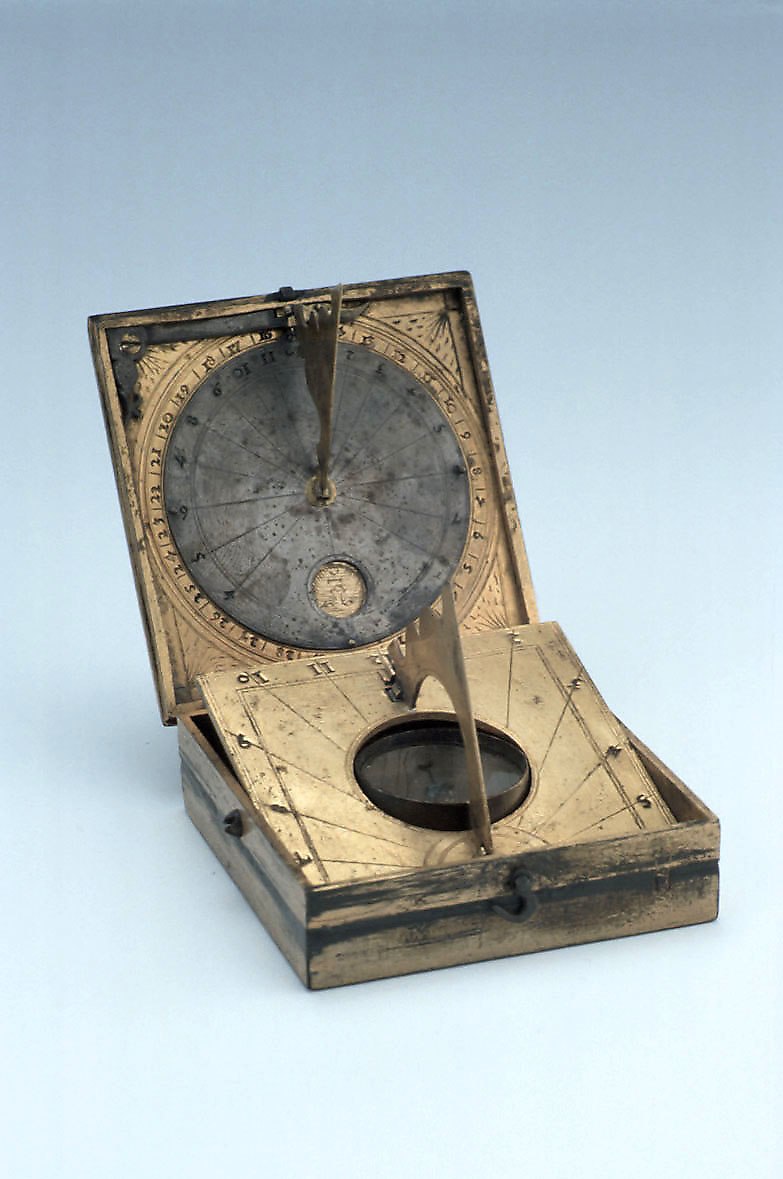
This portable sun and moon dial, manufactured in Nuremberg circa 1570, is signed by maker Hans Gruber. Constructed from gilt and silvered brass, the instrument measures 64 by 62 by 19 mm. The device features a hinged, square box design secured by a hook clasp. Its exterior cover is engraved with a depiction of the goddess Urania holding a globe, accompanied by celestial motifs. The interior components include a horizontal dial with a folding gnomon for latitude 48 degrees, serving as a lunar or solar dial. The base of the instrument houses a compass and an inclining dial adjustable for latitudes between 42 and 62 degrees, alongside a table of latitudes for 24 locations. The object was formerly held in the Michel and Billmeir collections and is currently part of the Museum of the History of Science, Oxford collection.

Sun and moon dial by Hans Gruber, showing the interior dial and the base-mounted compass.
Sun and moon dial by Hans Gruber, showing the interior dial and the base-mounted compass. — Museum of the History of Science, Oxford. Rights pending — permission not yet requested. Original source

Catalogue identity

Source
www.mhs.ox.ac.uk
Category
Tool · Nuremberg sun and moon dial
Maker / attribution
Hans Gruber
Reference
43553
Catalogue / lot identifier
43553
Source-reported date
circa 1570
Source-reported place
Germany

Source-reported attribution and specifications are not independent authentication. A listing does not establish present ownership, current display, availability or permission to reproduce.

Object description

Construction and Design

The instrument is composed of a square box fashioned from gilt and silvered brass. Measuring 64 x 62 x 19 mm, it utilizes a hinged lid mechanism secured by a hook clasp. The outer cover features a decorative engraving of Urania, the figure holding a globe, set against a background of celestial symbols including the sun, moon, and stars, all enclosed within a hatched border.

The internal configuration includes a horizontal dial mounted on the inner lid face, designed for approximately 48 degrees latitude. This component features a gnomon that folds into a vertical position for use. The corners of the dial face display ornamentation identified in the museum records as representing winds.

Evidence for this section
  • “The instrument consists of a square box with a hinged lid retained by a hook clasp.”
  • “The outer face of the cover represents astronomy as Urania holding a globe and overlooked by sun, moon and stars.”
  • “The inner face of the cover carries a horizontal dial for about latitude 48? with a folding gnomon sprung to the vertical.”

Timekeeping Functions

The device functions as a dual-purpose solar and lunar dial. The silvered disc on the inner lid carries an hour scale ranging from 4 to 12 to 8, which can be adjusted using a circular aperture for lunar age setting. The lunar age scale is graduated from 1 to 29 1/2.

The base of the instrument contains an additional inclining dial, which also features a folding gnomon and an hour scale running from 4 to 12 to 8. This plate is adjustable for latitudes between 42 and 62 degrees at two-degree intervals, facilitating use across various locations. A compass, 25 mm in diameter, is installed within the base to assist with orientation.

Evidence for this section
  • “The dial serves either as a direct-reading lunar dial or as a solar dial.”
  • “The hours run from 4 to 12 to 8 on a silvered disc with a circular aperture to graphically set the age of the moon.”
  • “The dial plate can be inclined for latitudes from 42? to 62? at 2? intervals.”

Signatures and Provenance

The base of the instrument bears the maker's signature, 'Ioannes Gruber Norimb:', confirming the provenance to the Nuremberg workshop of Hans Gruber. Included on the base is a table of latitudes for 24 distinct places, providing geographic utility for the instrument's user.

The instrument has been held in several notable private collections, specifically the Michel Collection and the Billmeir Collection (catalogued as 57-84/52). It is now part of the permanent holdings at the Museum of the History of Science, Oxford, under inventory number 43553.

Evidence for this section
  • “The base of the instrument carries the signature 'Ioannes Gruber Norimb:' and a table for the latitudes of 24 places.”
  • “Provenance: Michel Collection; Billmeir Collection (57-84/52)”

Open research questions

  • How does the 25mm compass indicate magnetic variation specifically?
  • What are the names of the 24 specific locations listed in the latitude table on the base?

Source evidence

Recorded claims and source quotations for Sun and Moon Dial by Hans Gruber
FieldSource-reported valueSource quotation
MakerHans Gruber“Signed by Hans Gruber”
Datecirca 1570“circa 1570”
Place of manufactureNuremberg“Nuremberg”
Dimensions64 x 62 x 19 mm“64 x 62 x 19 mm”
MaterialsGilt and silvered brass“Gilt and silvered brass”
Latitude coverage42 to 62 degrees“The dial plate can be inclined for latitudes from 42? to 62? at 2? intervals.”
ProvenanceMichel and Billmeir Collections“Provenance: Michel Collection; Billmeir Collection (57-84/52)”

Visible details

  • Hinged square box form with a hook clasp
  • Silvered disc dial featuring lunar age adjustment
  • Folding gnomons on both the upper and lower surfaces
  • Compass integrated into the base

Research qualifications

  • Interpretation of corner decorations as representations of winds is speculative
  • The exact function or specific application of the 'simply marked' compass variation is not detailed

Photograph identity and source facts were screened before import; rights clearance remains pending.

Consulted source

Sun And Moon Dial

Reviewed 2026-10-26 · Record 67650bb3f9

Terms in this record

Glossary explanations for terms named in this object’s record.