
Skip to content
The Encyclopedia of Horology

Clock · Picture clock

South German Biedermeier Picture Clock

Partially verified

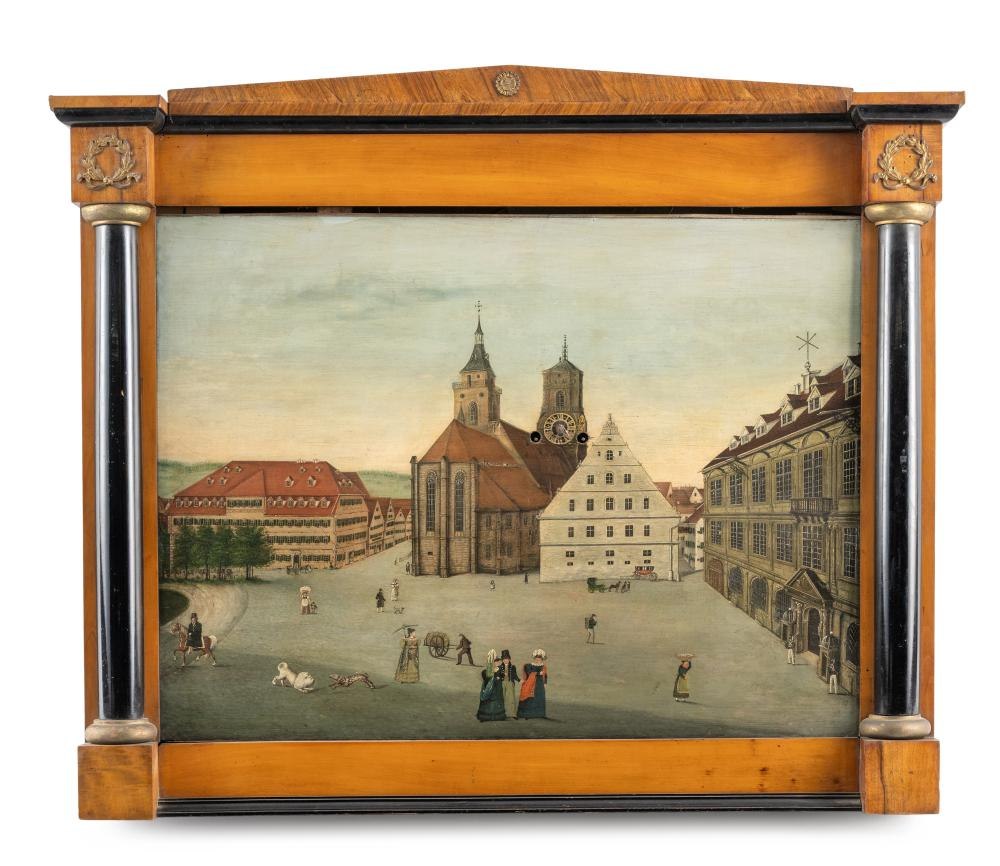
This South German Biedermeier picture clock, dating to approximately 1830/40, features a frame measuring 90 x 95 x 8 cm. The exterior is composed of parcel ebonized and brass-mounted wood, characterized by a pediment finial and half-columns flanking both sides of the central scene. The front panel depicts an oil painting on wood of the Schillerplatz in Stuttgart, including the Stiftskirche, the Fruchtkasten, and figural staffage. The integrated clock mechanism is identified as a later skeletonized anchor movement with an eight-day running duration and a bell-striking mechanism. The current condition is reported to include signs of age, including restoration, added components, and wear, with the auction description noting that the movement requires an overhaul.

Front view of the Biedermeier picture clock showing the oil painting of the Schillerplatz in Stuttgart and the integrated clock face.
Front view of the Biedermeier picture clock showing the oil painting of the Schillerplatz in Stuttgart and the integrated clock face. — Nagel Auction (via Invaluable). Rights pending — permission not yet requested. Original source

Catalogue identity

Source
www.invaluable.com
Category
Clock · Picture clock
Maker / attribution
Not established
Reference
Not recorded
Catalogue / lot identifier
2149
Source-reported date
circa 1830/40
Source-reported place
South Germany

Source-reported attribution and specifications are not independent authentication. A listing does not establish present ownership, current display, availability or permission to reproduce.

Object description

Cabinet and Pictorial Panel

The object is a picture clock designed as a rectangular frame constructed from various woods. It features a parcel ebonized finish accented by brass mounts, a pediment finial, and decorative half-columns positioned on both sides. The frame holds an oil-on-panel painting that represents a view of the Schillerplatz in Stuttgart, specifically depicting the Stiftskirche and the Fruchtkasten, accompanied by figures.

The structural composition of the frame incorporates a simple, straight-edged pediment design at the top and vertical column supports. The pictorial surface integrates the clock face into the architecture of the depicted Stiftskirche tower, allowing the timekeeping function to blend into the landscape scene. The rear side of the object exposes the wooden support frame and the central access point for the clock movement.

Evidence for this section
  • “Parcel ebonized and brass mounted wood, with pediment finial and half-columns on both sides.”

Movement and Mechanism

The clock is powered by a skeletonized anchor movement, which provides an eight-day running time. It includes a strike train that operates on a bell. The source identifies this movement as a later addition or modification to the case rather than the original component of the Biedermeier frame.

The movement is currently in a state that requires technical intervention. The auction house reports that the mechanism must be overhauled to restore full functionality.

Evidence for this section
  • “Later skeletone pallet work with 8 day running time and striking on bell.”
  • “Clockwork has to be overhauled.”

Condition and Provenance

The object shows clear signs of age, characterized by the auction house as including damages, restorations, and additions. These physical changes indicate that the assembly has undergone maintenance or alterations during its history, consistent with the reported age of the item.

The piece has a recorded provenance associated with a private collection based in Stuttgart. No further historical ownership details are provided in the documentation.

Evidence for this section
  • “Rest., additions, damages doue to age.”
  • “Privatsammlung Stuttgart”

Open research questions

  • What is the specific date and origin of the 'later' skeletonized movement?
  • Which elements of the frame or painting are considered 'additions' or 'restored' as noted in the auction description?

Source evidence

Recorded claims and source quotations for South German Biedermeier Picture Clock
FieldSource-reported valueSource quotation
MakerNot recorded“A SOUTH GERMAN BIEDERMEIER PICTURE CLOCK”
Dimensions90 x 95 x 8 cm“90 x 95 x 8 cm”
Datecirca 1830/40“circa 1830/40”
MovementSkeletonized anchor movement with 8 day duration“Later skeletone pallet work with 8 day running time and striking on bell.”

Visible details

  • Case features two flanking half-columns finished in black
  • Dial integrated into the painting at the tower of the Stiftskirche
  • Brass wreath ornaments applied to the upper corners of the frame
  • Back side reveals the wooden panel structure and movement winding access

Research qualifications

  • The movement is described as a 'later' skeletonized anchor type, suggesting it may not be original to the cabinet
  • The extent of 'additions' and 'restorations' mentioned in the condition report is not specified

Photograph identity and source facts were screened before import; rights clearance remains pending.

Consulted source

A SOUTH GERMAN BIEDERMEIER PICTURE CLOCK

Reviewed 2026-10-26 · Record d084940f8e

Terms in this record

Glossary explanations for terms named in this object’s record.