
Skip to content
The Encyclopedia of Horology

Clock · Mantel clock with candelabra

Sitzendorf Porcelain Clock Garniture

Partially verified

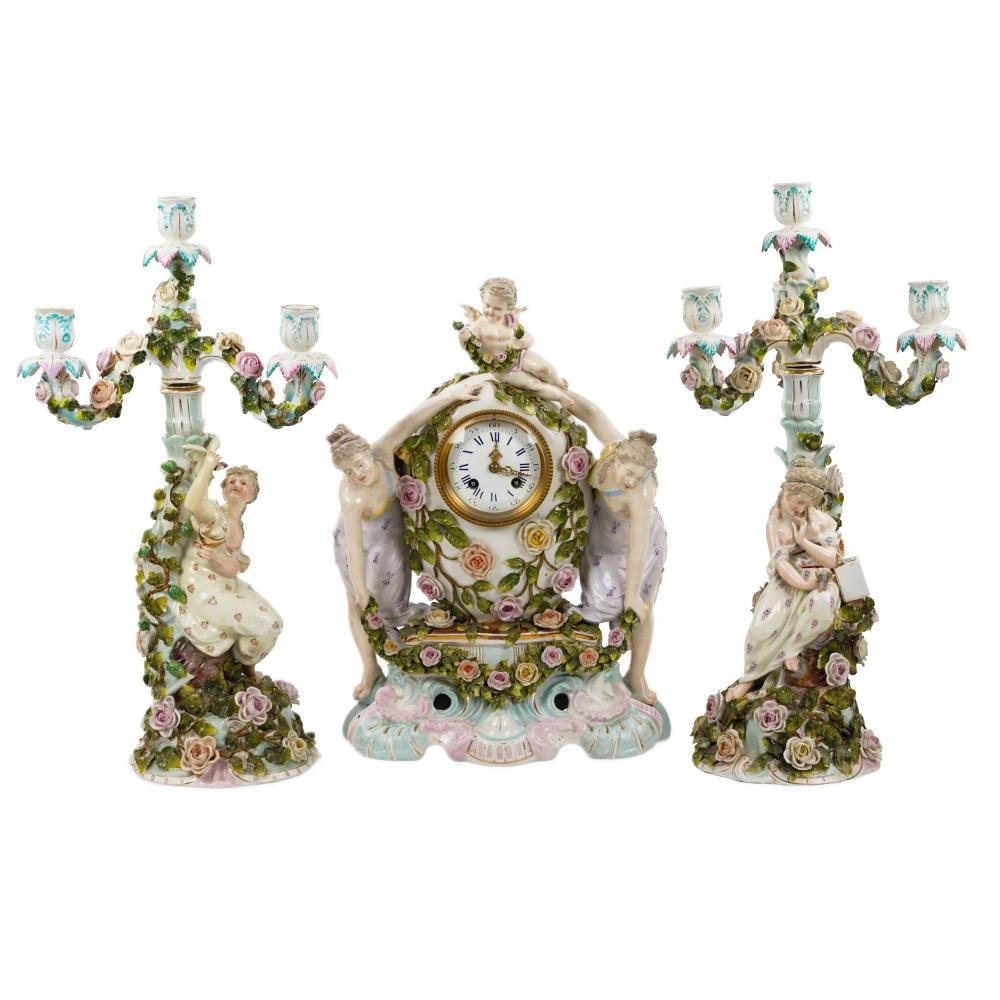
This clock garniture, attributed to the Sitzendorf manufactory and dated to 1880, comprises a porcelain mantel clock and two four-armed candelabra. The ensemble is composed of hand-modeled porcelain featuring extensive three-dimensional floral decorations. The clock is set upon a base formed by rock-like ridges, flanked by two female figures dressed in tunics. A circular winged putti crowns the clock case. The dial features black Roman numerals against a white background, accompanied by openwork gilded hands. The accompanying candelabra mirror the aesthetic of the clock, each supported by a flower-adorned base featuring a female figure. One figure is oriented downward with a bird, while the other looks upward, interacting with a white macaw.

Sitzendorf porcelain clock set, consisting of a central clock flanked by two candelabra, featuring hand-modeled floral decorations and classical figures.
Sitzendorf porcelain clock set, consisting of a central clock flanked by two candelabra, featuring hand-modeled floral decorations and classical figures. — Antiqon (via Invaluable). Rights pending — permission not yet requested. Original source

Catalogue identity

Source
www.invaluable.com
Category
Clock · Mantel clock with candelabra
Maker / attribution
Sitzendorf
Reference
Not recorded
Catalogue / lot identifier
369
Source-reported date
1880
Source-reported place
Germany

Source-reported attribution and specifications are not independent authentication. A listing does not establish present ownership, current display, availability or permission to reproduce.

Object description

Construction and Design

The garniture consists of a central table clock and two four-armed candelabra, all rendered in hand-modeled porcelain. The design is characterized by a dense application of three-dimensional floral motifs. The clock case sits on a base defined by rocky, ridge-like porcelain structures, flanked by two female figures draped in tunics. A winged putti figure is positioned at the apex of the clock housing.

The candelabra follow a thematic consistency with the clock, utilizing bases covered in porcelain flowers and supported by female figures. These figures display individual postures: one appears to look downward while holding a bird, and the other is depicted looking upward, feeding a white macaw from a small bowl. The overall composition is unified by the repeated use of floral garlands and classical figure studies.

Evidence for this section
  • “Made by hand in a round shape and completely covered with 3D decorative flowers.”
  • “The clock stands on a baroque base made up of rock ridges on which we see two female figures dressed in tunics with garlands of flowers.”
  • “The two chandeliers have a similar design, with a flower-covered base on which are the figures of women, also wearing a tunic.”

Dial and Movement

The clock features a white dial face marked with black Roman numerals. The time-telling function is facilitated by openwork baroque hands, which are finished in gilding to match the metallic edging surrounding the clock face. The movement is housed within this gilded aperture, integrated into the central porcelain structure.

While the exterior visual elements of the clock are documented, the specific mechanical construction of the internal movement is not detailed beyond its presentation within the gilded bezel.

Evidence for this section
  • “Movement in gold metal edging, with black Roman numerals on a white background and openwork baroque hands, also made in gilding.”

Condition and Dimensions

The auction description indicates that the set exhibits general signs of wear that are considered consistent with the object's age. The total set is described with a weight of 7 kilograms, and the clock unit measures 43 centimeters in height by 31 centimeters in width and 15 centimeters in depth. The candelabra measure 51 centimeters in height and 30 centimeters in width.

The porcelain material serves as the primary medium for both the clock housing and the support structures of the candelabra, reflecting the hand-modeled nature of the manufacture.

Evidence for this section
  • “Condition: Signs of wear commensurate with age”
  • “Clock size: 43 x 31 x 15 cm; Candelabra - 51 x 30 cm”
  • “Weight: 7kg”

Open research questions

  • What is the specific manufacturer's mark present on the base of these pieces?
  • Does the internal clock movement bear any signatures of the clockmaker, or is it a generic movement installed in the Sitzendorf porcelain casing?

Source evidence

Recorded claims and source quotations for Sitzendorf Porcelain Clock Garniture
FieldSource-reported valueSource quotation
MakerSitzendorf“Sitzendorf. 1880”
CountryGermany“Germany. 1880”
Clock Dimensions43 x 31 x 15 cm“Clock size: 43 x 31 x 15 cm”
Weight7 kg“Weight: 7kg”
Lot Number369“Lot 369 : Porcelain clock set with candelabra.”
MaterialsPorcelain“Material: Porcelain”

Visible details

  • Clock crowned with a circular winged putti figure
  • Candelabra feature female figures and floral applied work
  • Roman numerals on the clock dial
  • Openwork gilded clock hands

Research qualifications

  • The exact horological mechanism inside the porcelain case is not described or photographed
  • The current functional state of the movement remains unverified by the auction description

Photograph identity and source facts were screened before import; rights clearance remains pending.

Consulted source

Porcelain clock set with candelabra. Sitzendorf. 1880

Reviewed 2026-10-26 · Record 8a816a6e99

Terms in this record

Glossary explanations for terms named in this object’s record.