
Skip to content
The Encyclopedia of Horology

Tool · Portable sundial

Silver Butterfield-pattern portable sundial by Bion

Partially verified

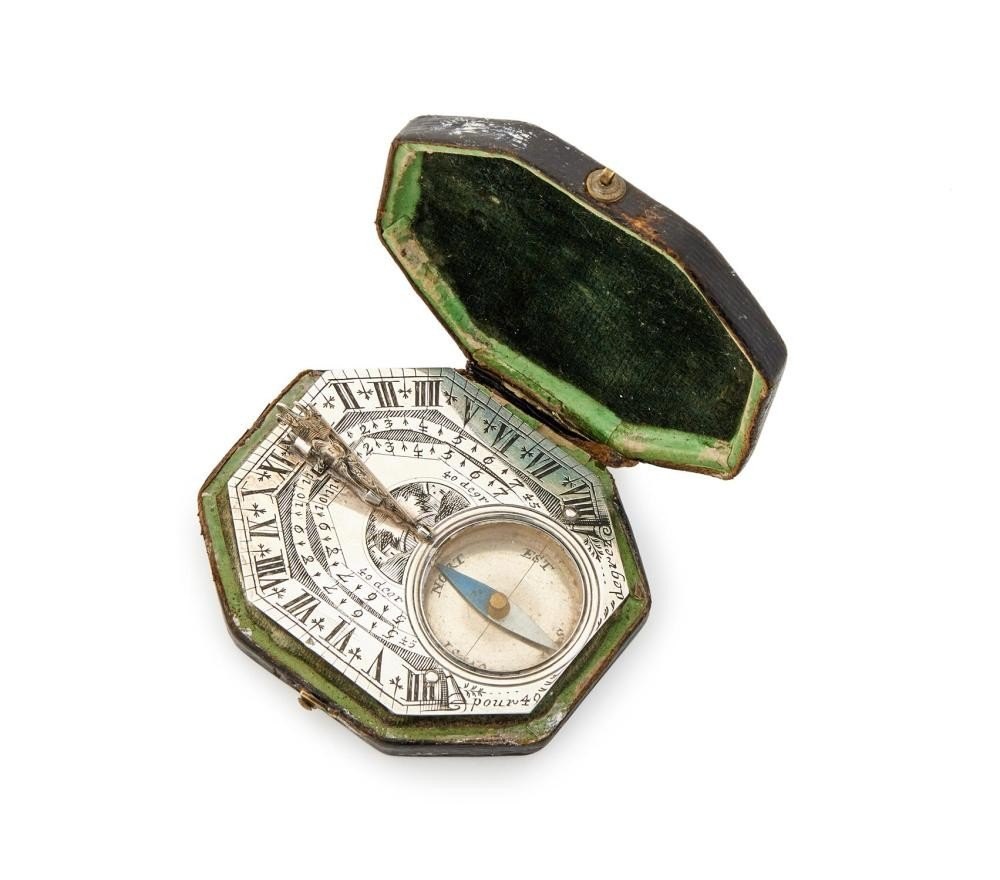
This portable sundial is an elongated octagonal plate of silver, designed in the Butterfield pattern and signed by the Parisian instrument maker Bion. The dial features three internal hour scales calibrated for latitudes of 40, 45, and 49 degrees. An adjustable, bird-engraved gnomon is hinged to the plate and calibrated for elevation. The central area includes an engraved landscape lunette and a glazed compass divided for cardinal points. The underside of the plate provides a list of latitudes for twenty-two cities, while , measuring 6cm by 5cm. The signature 'BION A PARIS' is engraved on a banner positioned at the gnomon end of the dial plate.

Silver Butterfield-pattern portable sundial showing the dial face and compass with the gnomon raised.
Silver Butterfield-pattern portable sundial showing the dial face and compass with the gnomon raised. — Dreweatts 1759 Fine Sales / Invaluable. Rights pending — permission not yet requested. Original source

Catalogue identity

Source
orbiscollectibles.com
Category
Tool · Portable sundial
Maker / attribution
Bion
Reference
Not recorded
Catalogue / lot identifier
199031903
Source-reported date
Late 17th century
Source-reported place
France

Source-reported attribution and specifications are not independent authentication. A listing does not establish present ownership, current display, availability or permission to reproduce.

Object description

Construction and Dial Design

The sundial consists of an elongated octagonal plate crafted from silver. Its primary surface is divided into three distinct hour scales intended for use at latitudes of 49, 45, and 40 degrees. These scales are annotated with Roman numerals IIII through XI and I through VIII, interspersed with markings for the hours 5 through 12 and 7, which are repeated twice.

The outer Roman numeral chapters incorporate cruciform-shaped half-hour markers and are further divided for quarter-hour precision. A central lunette depicts an engraved landscape, positioned adjacent to a glazed compass that marks the four cardinal points. The adjustable gnomon, which is hinged and decorated with bird engraving, is calibrated along its outer edge to allow for setting the elevation.

Evidence for this section
  • “The elongated octagonal plate with three hour scales for 49, 45 and 40 degrees”
  • “outer Roman numeral chapters with cruciform half hour markers and divided for quarter-hours”
  • “centre with landscape engraved lunette adjacent to the with glazed compass divided for four cardinal points only”

Signature and Underside Features

The instrument is signed 'BION A PARIS', with the text engraved on a banner located at the end of the plate corresponding to the gnomon's position. The underside of the plate provides a reference for twenty-two different cities, including specific latitude values such as 42 for Rome, 41 for Madrid, 52 for London, 52 for Amsterdam, 50 for Cracouie, and 49 for Paris.

Beneath the compass, the underside is decorated with an engraving of a seated hound. This scene is accompanied by the motto 'ardente et fidette', providing a decorative element to the functional underside of the dial. The assembly is housed within a folding leather case, which retains its original green velvet lining.

Evidence for this section
  • “signature BION A PARIS engraved to a banner at the gnomon end”
  • “the underside engraved with latitudes for twenty-two cities”
  • “the underside of the compass engraved with scene of a seated hound with motto ardente et fidette”

Provenance and Historical Context

The record identifies the maker as Bion, noting that Nicholas Bion was a mathematical instrument maker born in 1652 who was active in Paris until his death in 1733. Historical references suggest he was regarded as being of similar importance to Michael Butterfield, the originator of the Butterfield pattern for portable pocket sundials.

The Butterfield pattern was developed by the English instrument maker Michael Butterfield, who established a workshop in Paris near the 'Le Quay de L'Horloge' around 1685. The placement of his workshop in this area of Paris situated him within the active Parisian clockmaking community of the late 17th century.

Evidence for this section
  • “Nicholas Bion is recorded in Baillie, G.H. Watchmakers & Clockmakers of the World as a 'famous mathematical instrument maker'”
  • “This type of portable pocket sundial was devised by Michael Butterfield an English instrument maker who settled in Paris in around 1685”

Open research questions

  • Does the dial's construction align with known examples of 17th-century French instrument making?
  • What is the specific historical significance of the 'ardente et fidette' motto on this instrument?

Source evidence

Recorded claims and source quotations for Silver Butterfield-pattern portable sundial by Bion
FieldSource-reported valueSource quotation
MaterialSilver“silver”
Dimensions6cm x 5cm“6cm (2.375ins) by 5cm (2ins)”
MakerBion“BION A PARIS”
Latitudes listed22 cities“latitudes for twenty-two cities”
CaseOriginal folding leather with green velvet lining“original green velvet lined folding leather case”
GnomonHinged and bird engraved“hinged bird engraved adjustable gnomon”

Visible details

  • Cruciform half-hour markers on the Roman numeral chapters
  • Bird-engraved adjustable gnomon
  • Latitude list on the underside of the plate
  • Seated hound engraving with motto on the compass underside

Research qualifications

  • Authentication of the signature as that of Nicholas Bion (1652-1733)
  • Verification of original versus later components

Photograph identity and source facts were screened before import; rights clearance remains pending.

Consulted source

Sundial, Butterfield pattern, Paris, late 17th century

Reviewed 2026-11-02 · Record 28f829e4e7

Terms in this record

Glossary explanations for terms named in this object’s record.

Other portable sundial records