
Skip to content
The Encyclopedia of Horology

Component · Watch outer case

Second case of a watch with the Adoration of the Shepherds

Partially verified

This object is a second or outer case for a pocket watch, produced in Amsterdam between circa 1750 and 1775. The watchmaker associated with the piece is Jan Marc Juntès, while the gold case itself is attributed to the goldsmith Paulus Bellanger. The case is constructed from gold and is accompanied by a protective etui made of sharkskin, which is decorated with gilded copper nail heads. Measuring 2.8 cm in height and 5.4 cm in diameter, the casing includes specific inscriptions on its closing ring that reference a religious verse. The interior of the inner casing bears various assay and maker marks that assist in its dating, including a Dutch hallmark for gold and a date letter for 1762. The assembly reflects the specialized craft practices for horological protection and ornamentation in eighteenth-century Amsterdam.

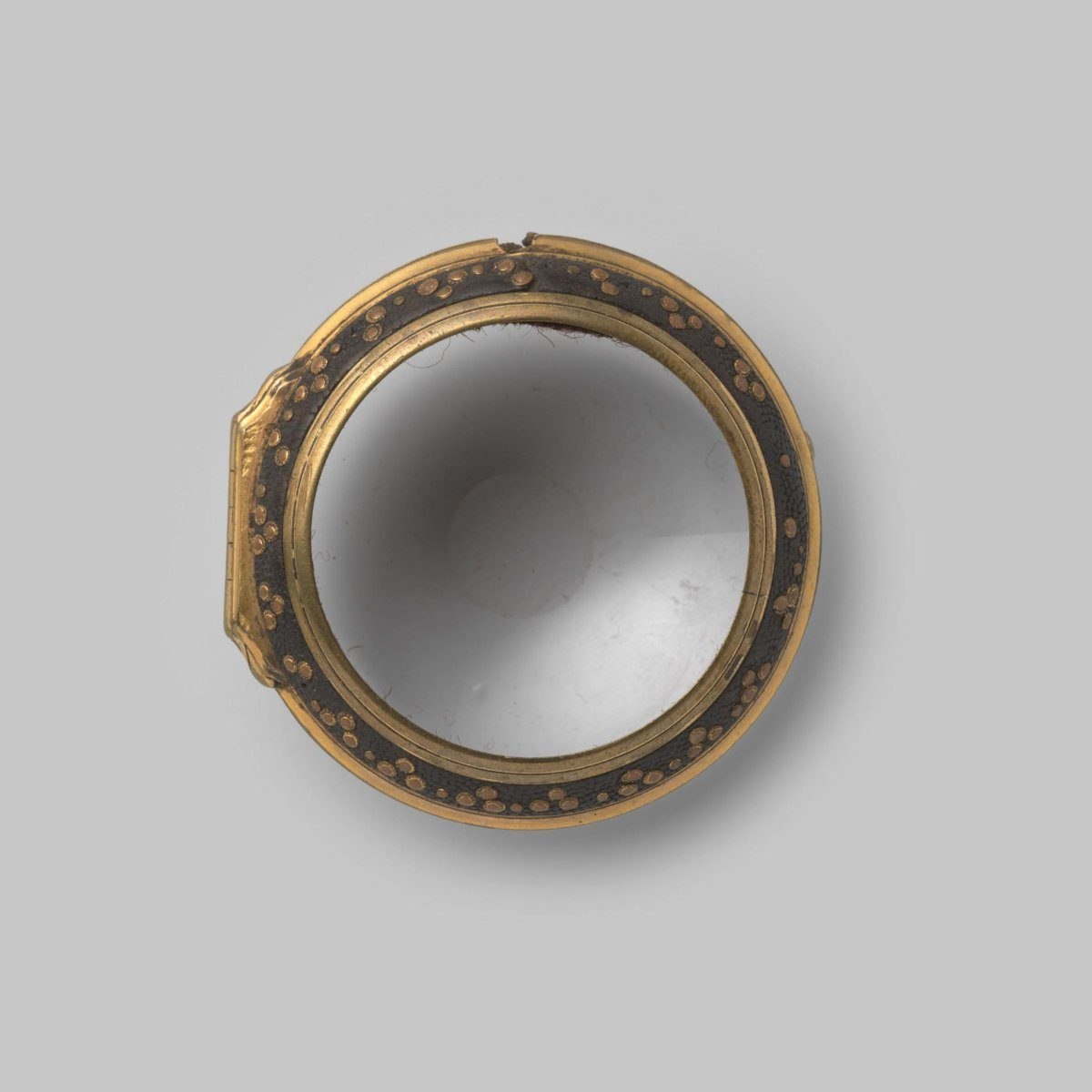
Exterior view of the sharkskin-covered outer watch case showing the gold-lined interior aperture.
Exterior view of the sharkskin-covered outer watch case showing the gold-lined interior aperture. — Rijksmuseum. Rights pending — permission not yet requested. Original source

Catalogue identity

Source
www.rijksmuseum.nl
Category
Component · Watch outer case
Maker / attribution
Jan Marc Juntès (watchmaker), Paulus Bellanger (goldsmith)
Reference
Not recorded
Catalogue / lot identifier
BK-1958-32-1
Source-reported date
ca. 1750 - ca. 1775 (1762)
Source-reported place
Netherlands

Source-reported attribution and specifications are not independent authentication. A listing does not establish present ownership, current display, availability or permission to reproduce.

Object description

Construction and Materials

The object functions as a secondary protective outer housing for a gold pocket watch. Its exterior composition consists of sharkskin, a material often utilized during the eighteenth century for its durability and aesthetic texture. This surface is punctuated by numerous gilded copper nail heads, providing both structural reinforcement and decorative ornamentation. The main chassis of the case is fashioned from gold, as indicated by the hallmarks found on the interior components.

The dimensions of the case are specifically recorded as 2.8 centimeters in height and 5.4 centimeters in diameter. This outer casing is designed to encapsulate the primary watch case, providing a barrier against environmental damage and wear.

Evidence for this section
  • “Etui van haaienvel met verguld koperen spijkerkoppen.”
  • “hoogte 2,8 cm x diameter 5,4 cm”

Signatures and Marks

The provenance and technical history of the case are documented by several marks stamped on the interior of the inner casing. A maker's mark consisting of the initials 'PB' enclosed within a rectangle under a crown identifies the goldsmith as Paulus Bellanger. The authenticity of the metal is confirmed by the presence of a Dutch lion mark, representing the gold standard. Additionally, a specific year letter 'C' corresponds to the year 1762, anchoring the creation of the case within the broader production period of 1750 to 1775.

Furthermore, the closing ring of the case bears a lengthy inscription in French, which reads: 'GLOIRE SOIT A DIEU/AUX LIEUX/TRES HAUTS & EN TERRE PAIX/ENVERS LES HOMMES/BONNE VOLONTE'. This text serves as a devotional element integrated directly into the housing of the timepiece.

Evidence for this section
  • “meesterteken, binnenkant binnenkast, afgeslagen: PB in rechthoek onder kroon (Citroen 1975, nr. 729) (Paulus Bellanger.)”
  • “jaarletter, binnenkant binnenkast, afgeslagen: ‘C’ (1762)”
  • “signatuur, platine: ‘J.M. Juntes // Amsterdam’”
  • “inscriptie, op sluitring: ‘GLOIRE SOIT A DIEU/AUX LIEUX/TRES HAUTS & EN TERRE PAIX/ENVERS LES HOMMES/BONNE VOLONTE’”

Historical Context and Acquisition

This watch case and its associated components entered the collection of the Rijksmuseum on May 6, 1958, through an acquisition process. The records explicitly link the goldsmithing work to Paulus Bellanger and the horological mechanism to Jan Marc Juntès, both active in Amsterdam during the eighteenth century. The inclusion of a tax mark 'V', dated to the period of 1814-1831, indicates that the object was present in the market or officially appraised during the nineteenth century, providing a secondary timeline for its circulation.

The documentation establishes a clear distinction between the watchmaker and the goldsmith, highlighting the collaborative nature of luxury horology in Amsterdam. The attribution of the piece to the period between circa 1750 and 1775 aligns with the active dates of the identified makers and the specific hallmarks present.

Evidence for this section
  • “aankoop 1958-05-06”
  • “belastingteken, pendant en scharnier, afgeslagen: ‘V’ (1814-1831)”
  • “uurwerkmaker: Jan Marc Juntès, Amsterdam”
  • “goudsmid: Paulus Bellanger, Amsterdam”

Open research questions

  • What specific movement type was housed within this case?
  • Does the 'V' tax mark signify a specific customs or valuation event in the early 19th century?

Source evidence

Recorded claims and source quotations for Second case of a watch with the Adoration of the Shepherds
FieldSource-reported valueSource quotation
Maker (watch)Jan Marc Juntès“uurwerkmaker: Jan Marc Juntès, Amsterdam”
MaterialsGold, sharkskin, gilded copper“Etui van haaienvel met verguld koperen spijkerkoppen.”
DimensionsHeight 2.8 cm, diameter 5.4 cm“hoogte 2,8 cm x diameter 5,4 cm”
Date Letter1762“jaarletter, binnenkant binnenkast, afgeslagen: ‘C’ (1762)”
Tax markV (1814-1831)“belastingteken, pendant en scharnier, afgeslagen: ‘V’ (1814-1831)”
InscriptionReligious verse on the closing ring“inscriptie, op sluitring: ‘GLOIRE SOIT A DIEU/AUX LIEUX/TRES HAUTS & EN TERRE PAIX/ENVERS LES HOMMES/BONNE VOLONTE’”

Visible details

  • The exterior of the case is clad in textured dark material, identified as sharkskin.
  • Small, decorative metallic studs (nail heads) are embedded across the sharkskin surface.
  • The gold inner rim of the case is visible, showing the join where the watch would be seated.

Research qualifications

  • The source refers to the object as a 'second case', implying the absence of the primary watch movement and dial.
  • The relationship between the 1762 date letter and the broad production window of 1750-1775 is noted as an specific internal attribution.

Photograph identity and source facts were screened before import; rights clearance remains pending.

Consulted source

Second case of a watch with the Adoration of the Shepherds

Reviewed 2026-11-02 · Record 2377eb3a05

Terms in this record

Glossary explanations for terms named in this object’s record.